10/16/10

Captain Marvel for President (CMA #41 - 1944)

With the midterm elections, and the upcoming 2010 presidential elections everyone remarks how "this time it's different." People cite the war, the economy, and backlash at incumbents. Interestingly enough, you can find cycles of this again and again through history. In fact, the 1944 elections were held in the middle of WWII, at a time when the economy was just beginning to pick up, and one of the candidates was the most entrenched President ever. Wikipedia does a good job summing up the situation:
The United States presidential election of 1944 took place while the United States was preoccupied with fighting World War II. President Franklin D. Roosevelt (FDR) had been in office longer than any other president, but remained popular. Unlike 1940, there was little doubt that Roosevelt would run for another term as the Democratic candidate. His Republican opponent in 1944 was New York Governor Thomas E. Dewey. Dewey ran an energetic campaign, but there was little doubt, in the midst of a world war, that FDR would win a record fourth term.

I recently picked up a copy of Capt. Marvel Adventures #41 from 1944 and was surprised by the cover.
 

Take a look at the two people carrying Captain Marvel, do they look at all familiar?  Let me suggest they're caricatures of FDR and Thomas Dewey.
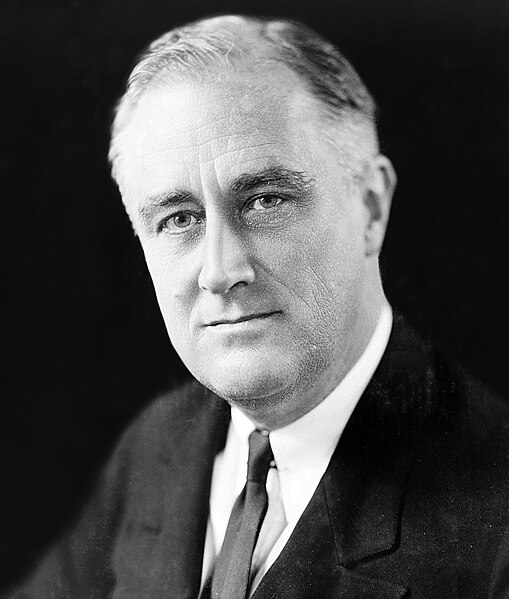
Franklin Delano Roosevelt
Thomas Dewey
I find all sorts of things interesting about this cover.  First, the fact that FDR is carrying Captain Marvel.  Since 1929 FDR had been increasingly paralyzed by disease, and in 1944 his doctor gave him at most six months to live.  In the Internet age this would be the death knell for even a school board candidate, yet FDR and his administration managed to limit public knowledge of his health problems, restricting photos of him in a wheelchair, and completely covering up his failing health.

Second, to portray the sitting president and the presidential candidate on the cover of the most popular comic book of the 40's either says a lot about the comic, or about the candidates.  It looks to me like CC Beck and the writers at Fawcett are poking a bit of fun at the campaign.  1944 was the height of WWII, and also the height of restrictions on luxury items and even staples.  A note above the indicia asks readers to order in advance "We are trying to cooperate 100% in the war effort. With this aim in view, and due to the paper shortage, we a cutting down on the number of copies of each magazine printed....ask your news dealer to reserve your copy."  "Captain Marvel Adventures" was the most popular comic of the 40's, outselling Superman and anything from DC or Timely.  With Capt. Marvel's popularity, I'd say it was a natural and clever jibe to promote him over the politicians.

And finally, the placards stating "Captain Marvel the People's Choice" is just a clever way of advertising their own product.  Sure, he's the most popular, but it doesn't hurt to toot your own horn every once in a while, and this cover gives Fawcett a chance to announce that on the news stand, next to your competitor's comics.


In the story the the likenesses are less pronounced. The "distinguished guest" in the second panel of the story looks more like Mr. Moneybags from Monopoly than FDR.  Once again they him walking, which would not have happened with FDR in a wheelchair.


Note the appearance of Captain Marvel/Billy Batson's assistant Steamboat in the third panel. Reportedly, Steamboat is the first black character in any of the Captain Marvel Adventures (CMA) books, although he's less a character and more of a comic-relief stereotype.  It's a sad reflection on the times and everyone involved in the publication that while they provide accurate and detailed portrayals of real people and places in CMA, Steamboat is such an offensive cartoon.

During the story it turns out that the distinguished guest wants Capt. Marvel to run for president of the Ancient Society of Moose, although Cap is confused due to a persistent jackhammer interrupting their conversation.  Some crooks are also confused, and they try to foil the campaign, sure that President Marvel would come "after us crooks wid de Army and Navy! and Marines!"  Likewise, the Big Red Cheese isn't sure he could handle the responsibility of being president.  In the end he decides not to run "My job is to fight crime, and that's a big enough job for one man!"

The writers give us lots of opportunities to imagine what it would be like to have a superhero as president.  For example,in this sequence the crooks toss a bomb. The crowd goes wild when Cap saves the day. "That's the kind of man we want for president!" "A man of action, courage and daring!"
 
This issue is a real time-capsule of public sentiment at the time.  The lead story isn't "Capt. for President," but "Captain Marvel Battles the Seven Deadly Enemies of Man."  The old wizard Shazam summons Billy to the subway tunnel and alerts him that every four years the living counterparts of the statues assemble some place on Earth to plot further wickedness.  You might recognize Dr. Sivana, who turns out to represent Pride and Injustice in the storyline, but I wonder if the character of Hatred in the last panel was supposed to represent Hitler?  His crewcut and upraised arm certainly suggest it.
 
Throughout the 40's Fawcett would set many of the CMA stories in actual locations with real personages.  In "The Adventure of the Two Heroes in Dayton, Ohio," Billy Batson is assigned to cover two soldiers from the Pacific theatre of war as they speak in Dayton. According to Mr. Morris, Billy's boss, "The city is having a special war bond and speed-up production drive."  Billy meets with Dwight Young, editor of the Journal-Herald and Walter Locke, chief of the Dayton Daily News.  Other local notables, such as Dayton Mayor Frank M. Krebs, radio personalities Lin Mason and Paul Ackerman of WING and WHIO's Dick Cull and "Si" Burdick also appear in the course of the story.  Even the soldiers are actual people, although due to the way the story is edited it's not clearly mentioned that they are Pfc John Bright and Pfc Stanley Kupinsky.

The plot is that some "Jap" spies are trying to kill the soldiers, putting an end to the bond drive and demoralizing the war plant morale.  The villains are obviously demonized, drawn with cartoon features and yellow skin that stands in contrast to the fine-lined features of the real-life characters.  The lampoon is so blatant that it almost interferes with the story at a point where the spies pose as "lowly Chinese" laundry workers in order to gain entrance to the war plant.

This issue also has a great chapter from the ongoing serial The Monster Society of Evil.  Titled  "Chapter 20 Mr. Mind's Book!" it tells the story of how Mr. Mind decides that the pen is mightier than the sword, and his manifesto, "Mind Kampf!", will spread the poison of propaganda and help him crush humanity.  Mr. Mind has his crocodile henchmen print up 10,587,432 and a half copies of the first chapter to give away. Even in his ruthless takeover of humanity Mr. Mind is thinking of the war effort: "If it weren't for the paper shortage I'd print up a billion copies."

The crocodile men are called slaves in this chapter, although Wikipedia suggests they are Crocodile Men from the planetoid Punkus.  It also suggests that they influenced the creation of Sobek for the DC series 52 from 2006.  Personally, I think one of the most memorable and surprising parts of 52 is where Sobek convinces Osiris to turn human, and then eats him.


Of course, the way comics got their 4th class mail rate was to include a one- or two-page text story.  This issue has "The Fourth Pigeon" by someone named Jack London Berkebile. It's about a young Greek resistance fighter named Nikoli whose family is forced to eat their carrier pigeons for food. Luckily he saves the fourth pigeon, and after Nazis attack his family he sends the bird on its way to warn the Greek guerrillas in the mountains. The story is remarkable for the image of the boy using his own blood from a Nazi-inflicted cut on his face to write the warning message on a scrap of paper.

And finally, since I had the scanner warmed up, here's the back page.  I love how this Dick Tracy Detective Kit offers you the chance to play "Detective Spy, Saboteur games."  It's "almost free" and "worth many dollars in hours of fun to you."
 

10/9/10

Chrysler Comic: Things That Even Dads Don't Know About... (1959)

In this 1959 comic from Chrysler, Bill comes home bursting to tell his dad everything he saw during his guided tour through the "huge Chrysler Corporation," which includes "missles, and air conditioners, and tanks, and cement, and.." all sorts of swell stuff.

The comic covers the new 1960 Chrysler car features: Plymouth's air-scooped fender insert, Dodge's double-barrelled taillight sets, flying V taillights and the Imperial's gunsight taillights (seems to be a lot of focus on taillights). The Constant-control power steering gives their cars "the quick reflexes of an athlete," while the push-button transmission control "works at the flick of a finger."

They also mention the Simca cars, which Chrysler imported from France. "Over 750 quality dealers selling and servicing Simca in this country." In a stunning aside they also mention it got 37 MPG gas mileage on "regular grade gasoline."

From there the comic jumps into the space age, mentioning the missles Chrysler built for the US Army: The Redstone, the Jupiter and Jupiter C, and Juno II. The Jupiter was used in the wold's first space journey, sending a monkey to the edge of space. They also mention the Mercury program, which was a year in the future, and how Chrysler plans to provide the missles for the training flights.

On the back page Bill quotes his dad as saying Chrysler is "one of the most vigorous, dynamic companies in America."


9/26/10

Homage to Bill Griffith's Zippy the Pinhead

2010 photo of a 1987 shirt
In the late 80's I was really into Bill Griffith's Zippy the Pinhead. As an homage to Zippy I enhanced a short-sleeve button-up shirt from Goodwill into a timeless keepsake... at least for me.
The shirt reads. "Punk Rock, Disco Duck, Birth Control -- I am Reporting as a Modern Person...I want to do the Hustle Now!!!", with "YOW" on the back.

I don't remember if I made up the text, or got it from one of the strips in Pinhead's Progress, which came out about that time. Looking at it now Zippy looks a bit robotic, but since it was the 80's that's understandable.

At the time I was in a band Maurice and the Chevaliers, and this was my performance shirt.


9/23/10

The Depth of Charles Schulz

The rear-window view of Charles Schulz's body of work is continually in danger of being obscured by late-life Peanuts reprints and MetLife commercials.

Yet, occasionally I spot a strip or frame that has the spark or angst that made Peanuts a national treasure. Here's one example I found on the website www.counter-force.com.

9/10/10

Spotlight on: Jason (John Arne Sæterøy)

I’d hesitate to call the works by the Norgwegian-born cartoonist Jason “graphic novels”, at least in our classic understanding of novels as a longer work. These stories are usually the length of three comic books, about 48 pages, and read more like short stories. Likewise, they have a feeling of a short story, focusing more on character and epiphanies rather than plot lines. Jason fills his compositions with pauses and silent reactions, a laconic response in a medium where too many artists tend to fill the action with explanation. In a way he seems to be trying to emulate Hemingway’s style in "Hills Like White Elephants", except Hemingway never wrote about time machines, werewolves and larcenous expatriate cartoonists.


“The Left Bank Gang” (2006) emphasizes Jason’s link to the Lost Generation author since it imagines Hemingway, Fitzgerald, James Joyce and Ezra Pound as starving cartoonists in Paris in the 20s. They hang out at the Deux Magots, deal with harsh critics, spend too much time drawing cartoons, and complain about American tourists, the French, and how tough it is to get work. It’s surprising how much actual biographical material Jason has packed into panels, including scenes with Zelda Fitzgerald, Hadley Hemingway, Sylvia Beach, Gertrude Stein and other contemporaries. The scenarios are generally realistic with each artist worrying about money and their families and obligations, until Hemingway gets the idea to rob the cash office at the boxing ring. The “Pulp Fiction” ending, providing the conclusion to the story from each character’s viewpoint is well done, although I had to re-read the story several times before I understood the outcomes.

The plot of “I Killed Adolf Hitler” (2007) is as simple as any time-travel story. In a world where assassinations are as casual as a visit to the doctor’s office, an unnamed hit-man is hired by a scientist to kill Hitler. The scientist has a time-machine, but so much power is needed that it takes fifty years to charge it up. The assassin goes back in time, fails, and Hitler steals time machine to return to the present. Meanwhile the assassin has survived the past 50 years to complete his task. Like “The Left Bank Gang” the story’s conclusion is told from various viewpoints, although it uses the time-machine as the device for the point of view (pun intended).
His latest book, “Werewolves of Montpellier” (2010) revolves around Sven, an expatriate living in Montpellier, France. By night he’s a thief dressed up in a werewolf costume, by day he longs for Audrey, the girl next door, who is a lesbian and his best friend. The story begins when a photo of Sven in costume appears in the newspaper and the real Brotherhood of Werevolves tries to discover who he is.

The spareness of the stories leave plenty of space for exploring the themes hidden within them. The clean lines and iconic drawings hide deep concepts which Jason seems to be working out as he creates the book.
For example, The themes in “I Killed Adolf Hitler” circle around violence, regret and second chances. At the beginning of the book a man who hired the assassin to kill his first wife complains that he’s starting to get tired of his second wife. The assassin himself is attacked, but kills his opponent, leaving the question: who tried to kill him? At the end of the book we reach enlightenment, but at what price?

The time machine provides many second chances: The scientist gets a chance to kill Hitler, Hitler escapes to the 20th century, giving him a new life. The assassin and his girlfriend both use the time machine for second chances, but second chances don’t always improve things. After a string of mid-day murders the girlfriend complains “Hitler disappeared in 1938. World War II never happened. Shouldn’t the world be a better place?”

This isn’t a spoiler, but once the assassin decides to live life anew he’s killed by a stray bullet. It closely echoes Hemingway’s “The Short Happy Life of Francis Macomber,”  but instead of dying heroically he dies casually, accidentally. Did he make a bad decision, or is this Jason’s way of saying “Life is short, make good decisions the first time.”?

In the “Left Bank” Jason struggles with the question of “why write?”  The story is a balance between money and obligations and the quest to create, to spawn your own stories.  In this case the sparse panels work as theatre, spotlighting for example Pound performing his monologue “Why do we do comics?” while at the boxing match.
There’s a fabulous sequence where Hemingway gets the full blast of Gertrude Steins critical capabilities in nine panels. The advice is so pertinent that it could be applied to almost any young writer or cartoonist, and sounds so authentic I imagine Jason enjoyed himself creating this page.

He also has fun with the macho image the writers projected, mapping it onto his cartoonists.  For example, Hemingway punches a critic, then accompanies Fitzgerald to the bathroom to help him determine if his prick is too small.  When they’re accidentally interrupted the embarrassment is only temporary as they take the quest to the art museum to compare themselves to the statues.  In the end they drink, hang out, and draw, draw, draw until the ink stains their fingers.
“Werewolves” takes a different tack.  Instead of the camaraderie of the writers we have a small orbit of outsiders. Sven is an expatriate in France, and he’s also chosen a profession, jewel thief, that makes him an outsider and loner.  On a whim he dresses as a werewolf during his robberies – if anyone sees him they’ll be afraid of him, and he’ll get a chance to escape. Unfortunately, someone photographs him leaping over the roofs of Montpellier, which brings him to the attention of a brotherhood of real werewolves.  Even as a werewolf Sven is an outsider.
He’s also alone in love. He’s in love with Audrery who lives opposite his apartment, but she’s a lesbian and sees him more as a friend and confidante.  Everyone in the story is a planet without a sun, and the more they search the more lost they become. It’s only as Sven and Audrey accept who they are that they find a resolution.
I wonder about Jason’s stylistic decision to draw all his characters as iconic anthropomorphic animals.  One one hand it makes the work more accessible, drawing on a legacy of cartoon characters that goes back to Mickey Mouse.  On the other hand it was difficult for me to see the difference between some characters. In Werewolves it the only visual differences between Sven and the lead werewolf were that the werewolf had a squiggly jaw (whiskers?) and longer ears.  In “Hitler” when the lead character gets left in the past and returns to his girlfriend’s door 50 years later she doesn’t recognize him. Except, I couldn’t tell any difference in the way he was drawn. Is this Jason making his own personal joke?

A documentary on Charles Schulz described how after WWII the cartoonist would draw hundreds of identical objects, perhaps honing his cartooning abilities, or maybe suffering from PTSD.  Perhaps these iconic characters are a similar therapy for Jason?
Jason is the pen-name of John Arne Sæterøy, which is easier to spell than the original, but much harder to find using Google.  You can read more about Jason at Wikipedia, or find his books on Amazon.  Here's an excerpt to "I Killed Hitler."

9/1/10

"The Superman Chronicles Volume 3" by Jerry Siegel and Joe Shuster

The cover of The Superman Chronicles exclaims: “Every Superman story in exact chronological order!”

This volume contains stories from Action Comics #’s 21 – 25 and Superman #’s 4 and 5, as wells as the New York World’s Fair 1940 giveaway, a range in time from Feburary 1940 to “Summer” 1940. Most of the stories are untitled, so DC gave them titles “for reader convenience.”

The stories are so non-canon it’s almost like a different superhero – maybe Kal-el’s distant uncle. In multiple stories Superman either kills the villains, or allows them to die.

Action Comics #22 and #23 are a two part story where Clark and Lois are sent the European country of Luxor as war correspondents. The plot thickens as Clark follows and protects the starlet Lita Laverne (LL!) who turns out to be a spy of some kind. At this point the continuity within the story breaks down as they dock in the country of Toran, a country that plans on invading Galonia. From there Superman gets a chance to join the action, fighting Toranian bombers, submarines, and soldiers. By the end of the issue the headline screams “Korian Army Shake Up!!” with Clark Kent’s byline.
 
In Action Comics #23 the Toran / Galonia war continues until Superman discovers a secret base deep inside a mountain. He learns that the soldiers are being coerced into the war by a mysterious madman named Lex Luthor. In this first appearance of Luthor he’s a heavy-set fellow with red hair who sits in a wooden throne with what appears to be a German Eagle carved on the backrest. Although he looks different, he still has the superior science: a flying city, voice and image projection machines, and green laser beams. Eventually Supes destroys floating city, apparently killing Luthor, and armistice is declared.

In the next issue Luthor is back, threatening Metropolis with earthquakes unless they meet his demands, a premise that’s pretty similar to Action #21 where the villain used an atomic disintegrator to extort money from the city. The story gets interesting, however, when Superman agrees to a challenge from Luthor: “If your muscles can surpass my scientific feats, I will admit defeat. But if I can outdo you, then you are to retire and leave me a clear path.” Luthor is ruthless in his use of henchmen, letting them die right and left, but I noticed Superman never lifted a hand to save them either.

Other than Luthor most of the villains are gangsters trying to extort, steal and kidnap. In “The Slot Machine Racket” Slug Kelly forces shopkeepers to put out slot machines where kids will waste their nickels. In “Terror in the Trucker’s Union” a mob boss takes over the truck drivers’ union, shutting down food distribution, and holding a hungry city hostage for ransom.
 
Two stories echo fears of the great depression, only 10 years earlier. In “The Economic Enemy” a financier has architected an economic crisis. As one henchman explains “a foreign nation promised him important concessions if he’ll wreck America’s economic structure! I just work for him!” And in “Luthor’s Incense Machine” the super scientist has created a statue that talks and spits a narcotic incense, which was “placed in the offices of prominent men throughout the nation, thus enslaving them.” I wonder if this was a wry comment by the writer on the US government.
 
I’d consider “Superman at the World’s Fair” to be the first mature appearance of Superman. The art is less sketchy, more work has been done to detail the backgrounds, and Lois is drawn and written with the personality that’s most familiar to modern readers. Superman has all his trademark traits: he says “up, up!” as he zooms into the sky, the bullets bounce off his chest, and he heaves a car over his head.

My one complaint about this series is that I’d like to see a one or two page introduction giving some insight into the art, writing, editing or even the current events of 1940.

If you’re going to buy any of these series, then this volume, with the introduction of Lex Luthor, and the World’s Fair comic will keep you amused in multiple ways.

8/26/10

"Mercury" by Hope Larson

The graphic novel Mercury by Hope Larson weaves two stories together, sometimes echoing themes, sometimes building one off the other.

The synopsis from the inside cover flap: “In 1859 French Hill, Nova Scotia, Josey Fraser has just met handsome Asa Curry – a man with a mysterious and traveled past. While quickly winning young Josey’s heart, Asa reveals a secret ability to locate gold on the Fraser’s farm. But there is darkness in the woods…and in Asa.

In the same town one hundred fifty years later, Tara Fraser is dealing with the aftermath of her house burning down; a house that has been in her family – and Josey’s – for generations, when Tara discovers a pendant that turns out to be much more than a simple heirloom. As Josey’s story plunges into tragedy, Tara’s emerges with the promise of gold.”

The description sounds like a romance, but it’s much more down to Earth than that. Josey in 1859 lives with her parents on their failing farm. She's doing chores and thinking about the world beyond her house when a stranger knocks on the door. Meanwhile, in 2009 Tara is returning to French Hill High school after a year-long hiatus. Her house burned down and she and her mother had to move north to earn extra money. Tara is back in town, living with her cousin. In the next 234 pages Larson tells how the everyday lives of these two girls intersect in time.

The story grew on me as I read it, and the languid pace goes with the fluid artwork. The whimsy in the art is especially noticeable in the special effects, such as the cursive “flee” when a character runs away, or the elusive “Finish” hovering over the goal in a race.

I like the sense of place. The opening panels show a road in French Hill, Nova Scotia evolving from a forest in the 1400, through Native Americans, settlers, soldiers, farmers and suburbs to the year 2009 when we meet up with Tara jogging past the Hungry Miner Pizzeria. It feels like I could find the remains of Tara’s burned house on Google Maps.  It was also fun to see how Larson compares and contrasts the lives of the two teen girls, Josey and Tara, in the same place, similar situations, years apart.

Although it was less evident at the start, the graphic novel has elements of magical realism. Larson tells the tale as if both girls live in the real world, but by the conclusion there are plot points which make us question reality: malevolent pits, ghost processions and talking crows with human faces. The occasional sparks or lines emitting from characters adds to this impression.

I also like Larson’s general spirit toward her work. She truly wants to reach the teen girl audience. At Stumptown Comics Fest 2010 panel “Comics for Young Readers”, and online on her twitter feed she talked about finding readers.  It's evident in this book that she wants to deliver an honest story, not only for the teen girl audience but for everyone, while sticking with a goal of reaching young readers.

There were only a few distractions from the quality of the novel. If anything, I felt the conclusion could have been extended somewhat. I liked that Tara, as the protagonist, solved her own problems but to me it felt too pat. The redeeming feature, however, was that although magic led her to the solution, Tara had to solve the problem herself.

I was also confused by theme of mercury. Asa has a pendant filled with mercury that he uses to search for gold, and it’s also possible that Tara has a mercuric personality, but it didn’t work for me to link this to the house fire. Although the fire was the impetus for Tara moving away, and subsequently moving back as an outsider, the connection was a weak link for me. That theme was jarring to me, even though it worked well in the plot line.

In summary, Mercury is a great read. It’s an original story, and the artwork stretches comic tropes into new areas. I’d recommend it as fun for kids, teens, or adults. If you’d like to read more about Hope Larson you can visit her website www.hopelarson.com.

"North World: Other Sagas" by Lars Brown

According to the cover, Lars Brown’s North World: Other Sagas contains “slackers, warriors and lovelorn pizza cooks are just a few of the heroes introduced in North World: Other Sagas! Their adventures bring them above the clouds, into cursed forests, and against all manner of evils. Viking raiders, cloud giants, pink Cyclops, demon curses, tribes of angry squirrels – if swords and magic don’t work, kitten throwing just might.”

The blurb, however, doesn’t accurately describe North World, so let’s discuss the short story called “Cloud Story,” as an example. The mercenary swordswoman Nico has hitched a ride with her old friend Capt. Harker on an air-sailing ship. En route, the crew discovers a pair of gods about to have a fight, and they decide to place bets and watch the bout. Nico is so enrapt with the match that she yells loudly enough to capture the gods’ attention, and they chase the air ship. Harker manages to elude the gods, but not before Nico gives one of them a black eye with her sword. As the story closes Nico and Harker make goo-goo eyes at each other.

Likes: My teen son chose to buy this book at Stumptown Comics Fest 2010 based on the cover. After reading it his opinion of North World was it’s a “collection of funny, sort-of cool short stories.” I liked the art – cartoony without being goofy, and it’s nice that Brown can vary his art depending on the story.

Dislikes: My problem was that most of the stories followed a similar pattern: clever set-up, a frisson of love interest, some irony mixed with smashing, and a slightly funny ending. One or two of those in a collection wouldn’t be bad, but 10 in a row became monotonous. Maybe it works better as a web comic (www.north-world.com). Or, maybe I should try North World 1: The Epic of Conrad, which judging by the title promises to be a larger story.

If you’re a teen boy, or into irony, or have ever wondered what Cimmeria would be like if you swapped Conan the Barbarian for Clive the Hipster, then get Lars Brown’s North World: Other Sagas.