1/13/14

Archie vs Wilbur

Recently I've been reading through some Golden Age MLJ comics, specifically Pep and Wilbur, and was struck by how some of the Wilbur plots were lifted directly from Archie stories. Wanting to check my memory, I tracked down some of the duplicates.

Some of the stories use a similar plot, but don't follow exactly. For example, in "Pop's Rest Cure" in Wilbur #21, Wilbur causes a lot of trouble when he drives his sick father to Uncle Ben's farm for some rest. Parts of this story come directly from Pep #38, "On the Farm." Archie causes trouble while trying to help out at his sick uncle's farm. Compare a two page sequence from each of the stories.


The Pep story is written and drawn by Bob Montana, whom some have said is the rightful creator of Archie. The pencils for the Wilbur story are attributed to Bill Vigoda (at the Grand Comics Database), but the writer is unknown.
 "Bob Montana created Archie; he wrote, he drew, he designed it...But John Goldwater, for merely saying, 'I would like an imitation of Henry Aldridge,' claims creation." - - Comics Between the Panels
Normally, I would assume that the same writer came up with both stories, and they were just pushed for time. Except, the Wilbur story was published four years later. Bob Montana wrote the Archie stories, and then left to fight in World War II. Four years later, after the war, the Wilbur stories seem like an echo.

Here's another example. "Batching It" appears in Pep #40 (1943), with script and pencils are by Harry Sahle (aka "Jewell"). The plot is that Archie and Mr. Andrews run the house while Mrs. Andrews is on vacation. Five years later, in Wilbur #12, "It's a Man's World" with pencils by Bill Vigoda has a similar storyline: Wilbur's mother leaves to visit her sister and Wilbur and Mr. Wilkin have to keep house.
The first and last pages of the story are eerily similar.


It might be acknowledged that the plots have been simple enough to allow for some duplication, but the last example is the oddest. In both the Archie and Wilbur stories, the principals decide to use psychology to promote better behavior from Archie and Wilbur (deep down, aren't Archie and Wilbur just good kids? It's Reggie and Red who are the rats!). Anyway, I'm including the full stories here for comparison. 


"Aboard the NARCISSUS" is from Pep #49 (1944), with pencils by Harry Sahle and script by Ed Goggin. "Down in the Dumps" is from Wilbur #21. 
In Pep, Mr. Weatherbee gives Archie the task of hiring a boat for the school picnic. Archie accidentally charters a garbage scow, but everything turns out all right in the end. In Wilbur, Mr. Dripwaite gives Wilbur the task of hiring a boat for the faculty excursion. Wilbur accidentally rents a garbage scow and causes Mr. Dripwaite a lot of trouble.

PS: Sahle later worked with Mickey Spillane on a comic called "Mike Danger", which was the original version of Mike Hammer. 


12/31/13

"The Simon & Kirby Library: Science Fiction" by Jack Kirby and Joe Simon

There is nothing like finding a new comic that grabs your attention.  Especially if it's an old comic and you don't have to wait a month for the next issue.

"The Simon & Kirby Library: Science Fiction" is one of those comics. It showcases some of their best "unknown" science fiction stories by Joe Simon and Jack Kirby from the 1940's to the early 60's.  The stories include the first 10 issues of the superhero Blue Bolt, a variety of short monster and rocket stories from Alarming Tales and Black Cat Mystic, and then their all-too-short run of Race for the Moon, inspired by the Cold War space race.

The past couple of years there have been a lot new nice reprint editions of golden age comics, all of them vying for your comic dollars.  For example, I Shall Destroy All The Civilized Planets! about Fletcher Hanks, Spacehawk by Basil Wolverton, and Amazing Mysteries: The Bill Everett Archives (the creator of Namor, the Sub-mariner) all caught my eye (and my wallet!).

The first reprint that I saw like this was Supermen!: The First Wave Of Comic Book Heroes 1936-1941which was sort of disappointing since it failed to include any extras to set the context for the stories.  Although it had a nice foreward by Jonathan Lethem, the stories themselves felt as if they existed in a vacuum.

The omission of context is even more disappointing given that many of these books are available as public domain scans.
Downloading public domain comics has some advantages
  • Free -- always a good price
  • Portable. You can read your Golden Age comics on an iPad or other tablet device without worrying about wear and tear
  • The works are easily accessible
Public domain sites are supported by collectors who have scanned their copies and uploaded them for sharing.  The sites are supported by donations or advertising.  Perhaps the best thing about the public domain sites is that they allow access to material that was previously limited only to a few collectors. For example, earlier this year I found Kirby in Alarming Tales #1 on a public domain site.

But there are still problems with the public domain scans
  • The quality is not the same as a professionally printed book
  • Sometimes scans are not complete, or may be unreliable
  • Presentation is limited by the electronic device
  • Not all people who are interested in older comics will have the tech savvy to find these sites
Which brings me back to appreciating professionally edited editions of reprints
  • There's usually an interesting introduction by a comics pro who was influenced by these early comics
  • Often an essay sets the context for the artist, and the era
  • Publishers opt for large-size format with high-quality printing and coloring that shows the comic as it might have appeared (in the best of cases) on the rack in the drugstore

The reprint of "Hole in the Wall" by Simon & Kirby compared with
the same story downloaded from a public domain site and read on an iPad. 
It wasn't until I started reading "The Simon & Kirby Library: Science Fiction" that I realized Kirby had art in the first six issues of Alarming Tales, as well as in Black Cat and Race for the Moon.  Since the editors had compiled the stories across a slice of comics, they exposed the lesser-known works, providing a new insight into the works of both Joe Simon and Jack Kirby.

Still, the book left me wanting. The foreward by Dave Gibbons is inspiring, but it arrives from a fan's point of view.  I'd like something more... a timeline or an behind-the-scenes an interview? Bits of this are included in the book: an unpublished two-page spread from a 1940's Captain America story is presented beside a re-worked version that appeared in "Win a Prize" comics. There's also a description of a couple pet projects that Joe Simon shopped around in the 60's, 80's, and later coupled with sketches by Kirby.

But I have to compare these reprints to a DVD boxed set with extras!  Most Criterion editions of movies have at least one audio commentary, along with trailers, interviews, biographies and documentaries.  I'd like to see the editors stretch to include these with the reprints.  For example, a time line showing how Kirby was concurrently drawing Young Romance, Black Cat and Quick Trigger Western would be very interesting. It would remind you that Joe Simon, the creator of Blue Bolt, Captain America, The Boy Commandos, and the Fighting American, didn't get much money from his creations, but still had a wealth of creativity.

A different "Thing". From Race For The Moon #2.
In the meantime, I'll appreciate this volume of Kirby & Simon stories and art. The editors have done a good job of collecting the important stories and presenting them together to show the breadth of imagination this team was capable of.  I hope that a portion of the money from these books goes to the estates or family of Simon & Kirby.  I'm looking forward to more Kirby & Simon reprint collections.

8/19/13

"Before Watchmen: Minutemen/Silk Spectre" by Darwyn Cooke

I was late to the Watchmen party. I first learned about Alan Moore's Watchmen after the series had been compiled into a graphic novel, and just after the guy ahead of me in line had purchased the last copy at Future Dreams comics and books.  I asked the clerk if they had any used copies, and a punk with a mullet and a belly T-shirt said he'd sell me his old copy.

"Only, it's at my house. I only live a couple blocks away."

Maybe it was a testament to how excited I was about Dave Gibbons art and Alan Moore's cracked-mirror version of the comics world I had grown up with, but I told him I'd buy his copy.  He hopped on a midget BMX one-speed and took off for his apartment. I started walking in the general direction, and about ten minutes later he zoomed up with the book under his arm. As a marginal comics snob, I hesitated when I saw the dog-eared copy rubbing covers with his pits, but I bought it anyway (half price!).  Since then, I've bought all the original single issues, but I still go to the dog-eared copy when I want to read the Watchmen.

For me, the Watchmen is such a pivotal work, I avoided sullying the memory with any sequels, prequels or movies.  But, I've been enjoying Darwyn Cooke's adaptations of Richard Stark's "Parker" novels, so when I saw he had a prequel to Watchmen, I was hesitant.  In the "Parker" books he captures a "Mad Men" feel of graphics from the early '60s with such elan. To me, it's reminiscent of the cover art from Dave Brubeck's jazz album "Time Out."  The look and feel is so perfect. So, despite misgivings, I hoped that Cooke would deliver a good showing on the Watchmen backstory.

Before Watchmen: Minutemen/Silk Spectre compiles two mini-series inspired by The Watchmen. Minutemen gives Cooke a chance to visit both the 40's and the 60's. The story bounces between the origin of the original super-hero group founded in the 40's and the tell-all publication of Hollis (Nite Owl) Mason's book "Under the Hood."

I doubted that any prequel could add to Alan Moore's Watchmen story in a way that was relevant, but Cooke does an excellent job pulling the threads from Moore's graphic novel, and tying them together in the past. It starts with the origin of the group as we meet the Nite Owl, The Silhouette, Silk Spectre, The Comedian, Hooded Justice, Dollar Bill, Captain Metropolis, and Mothman. There's the obligatory try-outs scene, the first mission (a fiasco and a scandal), and Cooke explores some inter-group sexual conflicts and attractions. Altogether, the story is much more violent and graphic than stories from the 40's or 60's, and explores explicitly sexual undertones mentioned in the Watchmen, but the tone fits the universe created by Moore.

The story fits together, within itself, and with the Watchmen. The back story for the Comedian at first feels a bit shaky, but ends with horrific events from WWII and ultimately makes us question the motivation for any super heroes.

So, does it deliver? Yes, on finishing my first read of  Minutemen I wanted to re-read it immediately. It was just as engaging and twisted as the original.  


Unfortunately, Silk Spectre is less faithful to the comics of the 60's, and even seems to condemn the spirit of the 60's. The art, by Amanda Conner, is wonderfully detailed,  but that underscores even more that it's not abiding the style of the era.

Laurie Jupiter, daughter of Sally Jupiter, the original Silk Spectre, runs away from home to San Francisco.
She begins to realize how big the world is, when suddenly kids start having bad drug trips. Laurie dons the Silk Spectre costume, updating the high-heels to some kick-ass leather boots, and takes on the mysterious Chairman of the organization pushing the drugs.

It's a coming of age story with sex, violence, drugs and superheroes. While it was fun, the story didn't dovetail nearly as well the Minutemen story with the Watchmen universe.  The story felt like it had been borrowed from The League of Extraordinary Gentlemen: 1969.

Bottom line: worth reading, especially if you were as excited as I was the first time you read Watchmen.  Cooke and Conner bring the characters to life with their art and stories, and do justice to the Watchmen universe.
Enhanced by Zemanta

7/27/13

"Prophet" by Brandon Graham

Set in the far-distant future, throughout the universe, "Prophet " tells the story of a plan to re-ignite the dying human race.  A series of sleeper clones, all named John Prophet, awake from their slumber to find themselves on planets and space stations knowing only intuitively their ultimate missions.  This first book, "Remission," collects chapters 1 - 6 of the rousing of four of those Prophets.

It's hard to write a review of a book that's really only the opening chapters of a sci-fi epic.  I really liked Brandon Graham's "King City," with its laconic pace, visual puns and cyberpunkish setting, and when I met him at Stumptown Comics fest I asked him what I should read next. I don't remember which book he suggested, but "Prophet" was his second choice. It is less Cyberpunk, leaning more toward technical sci-fi in the style of Iain Banks.

Farel Dalrymple's excellent style reminds me of Moebius
It's clear that Graham is a fan of Moebius (Jean Giraud), and the way "Prophet" uses multiple artists makes me reminisce for "Heavy Metal" magazine.  All of the artists draw a good story while still being creative with the layout, but I preferred chapter 5, the only one drawn by Graham. The other artists, Simon Roy, Farel Dalrymple, and Giannis Milonogiannis also all seem drawn to the style of Mobius (pun intended).
As mentioned, Graham tells a story at a casual pace, so while there is a lot of action, the plot points are few and far between, but I wouldn't expect otherwise during the exposition.  For this volume it is enough to explore and learn of the character(s) of John Prophet.  All the Prophets are clones of the original, but there is an interesting surprise near the end of chapter six -- enough to make me want to read the next volume.


5/12/13

Kirby's Precursor to the Fourth World Saga

Most people who read comics know that in 1970 Jack Kirby left Marvel for DC and started an amazing explosion of creativity with his Fourth World saga.  This introduced an avalanche of characters including the New Gods, Mister Miracle, The Forever People and the villain Darkseid.  He also expanded his footprint in the DC world by creating the post-apocalyptic Kamandi and the bizarre world of Omac.

As a young reader in the 70's, I saw these worlds as new creations, bursting into life through Kirby's left parietal lobe and his skilled hands. But I recently ran across a copy of "Alarming Worlds #1" from 1957 that made me realize Kirby had been working and re-working the ideas found in the Fourth World for quite a while. Evidently he was just waiting for the best time to bring them to the foreground, and this shift to DC provided just the chance.

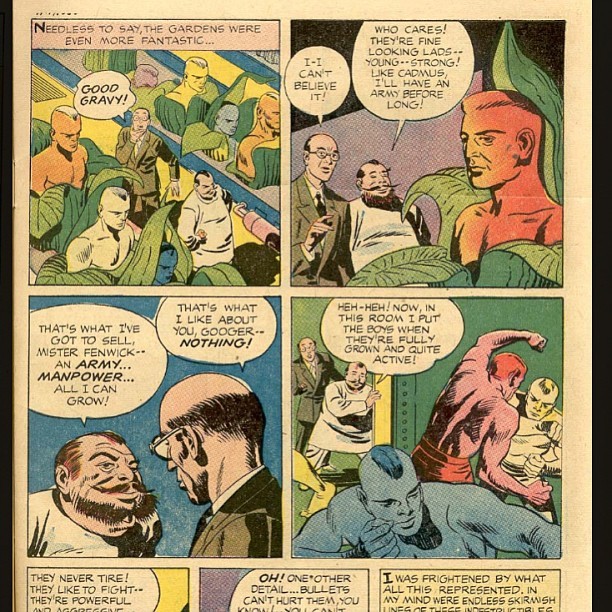
For example, in "Superman's Pal Jimmy Olsen" #133 Kirby introduced the Project, designed to create superhumans from clones for the benefit of mankind.  This was later called Project Cadmus.  In "Alarming Tales" there's a story called "The Cadmus Seed."
Superman explains The Project to his pal Jimmy Olsen
Professor Horace Googer grows humans from seeds in the project he calls "the Dragon Seeds of Cadmus."


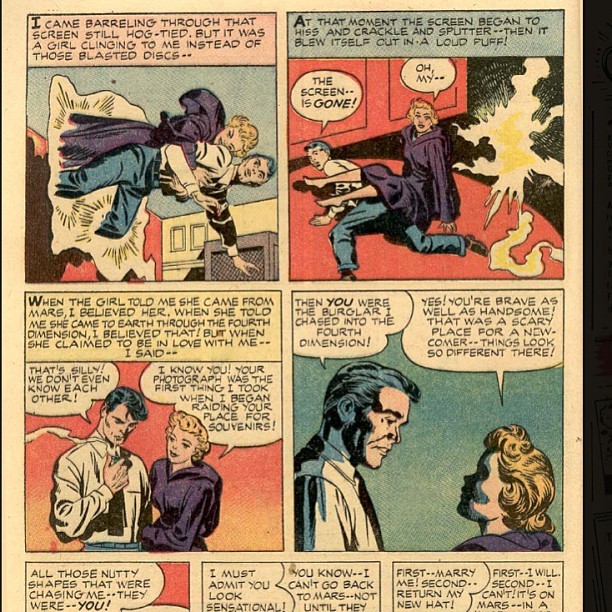
In another story called "The Fourth Dimension is a Many Splattered Thing!" a man tries to apprehend a mysterious thief by traveling to the fourth dimension through an early version of a Boom Tube.
Clark Kent returns home in Superman's Pal Jimmy Olsen via a Boom Tube

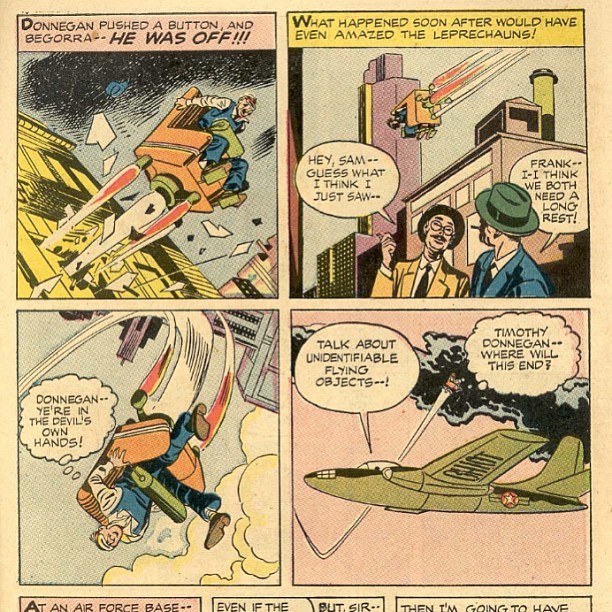
In a little bit more of a stretch, a janitor discovers a wacky version of Metron's chair in the story "Donnegan's Daffy Chair".

The New God Metron has a space-time chair

A janitor has an extra-terrestrial experience in "Donnegan's Daffy Chair"


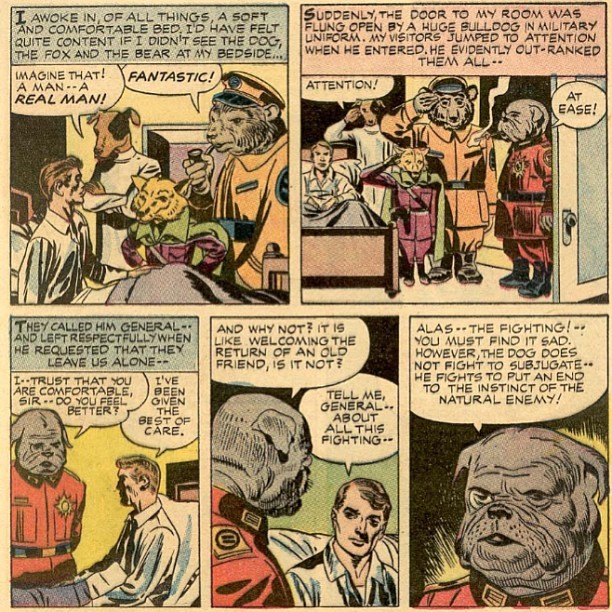
"The Last Enemy" is a short story of a time traveler from our present who finds the distant future populated by intelligent animals is the best example of Kirby reusing and reworking his ideas.
The dogs run Canada in Kamandi #28
"The Last Enemy" in Alarming Tales, 1957

Considering the impact and amount of creativity that Kirby gave to the DC universe, it's surprising to realize he only spent about five years at DC. Yet, the heroes and villains that he created continue to play major roles in the publisher's comics.  Darkseid, for example, played a pivotal role two of DC's recent comic events, Final Crisis and The New 52.

On the other hand, after DC Kirby would continue to re-work his earlier ideas, but with considerably less success. He seems to focus on gods and massive events, omitting the small human-scale stories that made his work from the 50's and 60's endearing (yes, even his monster stories were endearing).

In the end, it's interesting to see how an artist can take the germ of an idea and play with it, evolving the story. Which is perhaps what I like to see about many of the recreations of the golden age heroes from Marvel and DC that were reinvented in the 60's and 70's.  In some cases, such as with Captain America, the original artist (Kirby!) got the chance to evolve the hero in a second generation.  I'm just thankful to find a copy of Alarming Tales so I can see the originals.


Enhanced by Zemanta

4/17/13

Separated at Birth? #1

I was reading the Art Spiegelman chapter of Arie Kaplan's "Masters of the Comic Book Universe Revealed!" In it he mentioned Spiegelman's "Ace Hole Midget Detective."  Of course this reminded me of Hanna-Barbera's Saturday morning cartoon "Inch High Private Eye."  I wondered which came first?

Kaplan cites 1974 as the year Spiegelman published Ace Hole, while Inch High ran on NBC starting in September, 1973.  Pretty close. Maybe something was in the water.  Or, maybe this was a prior term. This site says that "One Inch High Private Eye" is slang for a "short person usually found in the work place who is enjoys snitching on fellow colleagues to the big boss."  Or, maybe the phrase is some derogatory slang for the male member?

Art Spiegelman's "Ace Hole Midget Detective"


Hanna-Barbera's "Inch High Private Eye"