10/16/11

Super Magician Comics Vol 4 No. 4 - August 1945

In May of 1941 a new comic book called "Super Magic" hit the news stands. It portrayed a fictional magician loosely based on the real Harry Blackstone, Sr. In the comic, Blackstone solved crimes and captured evildoers, often at the request of government agencies such as the FBI. After the first issue, publisher Street & Smith renamed the periodical Super Magician Comics, and it ran under that name until slightly after World War II, hanging up the magic in 1947.

There's an interesting convergence in Super-Magician comics. The publisher was Street & Smith Publications, who also put out The Shadow pulp magazine. Walter B. Gibson, the creator of The Shadow, knew the real Harry Blackstone, and according to this article on Wikipedia, he ghost-wrote most of the magician's books, and also wrote the scripts to the Blackstone comics and radio show. This sort of melding of reality and fiction predates the fuzzy edges of 21st century reality TV shows by at least 60 years.

The cumulative effect of these stories didn't fall into a vacuum. The exploits of The Shadow and Harry Blackstone, on the radio, in pulps, and comics, inspired the imaginations and careers of many who heard them. The Amazing Kreskin, for example, explains how they started him on his road to stardom:
Walter B. Gibson's The Shadow was another character that captured Kreskin's imagination as a youth. Today, many copies of the pulp serial from the '30s are in his collection. "Gibson was an authority on crime and magic, and he was a friend of Houdini's," Kreskin said. "Through the character Lamont Cranston (The Shadow), Gibson combined the criminal mind and the crime fighter mind."

The Shadow, of course, became one of the most popular radio programs of all time, but it isn't the only character for which Walter Gibson is known. He also authored the Super Magician comics of the 1940s, often under the pseudonym Maxwell Grant. The main character was based on the real-life magician Harry Blackstone. The premise was that he performed magic and fought crime.

"I have a copy of every Super Magician comic book ever produced (it ran about six years), encased and in mint condition," Kreskin said. "I can't imagine what they're worth, but you know what? I don't care. These books and other items are part of the embroidery that make up the fabric of who I am. They're not for sale, and I don't care to have them appraised. That's not the point."


This issue from 1947 is uncredited, so the writer could have been Walter Gibson, but I couldn't find any corroborating evidence in any book or on the Internet.

The plot for the 14 page Blackstone story "Blackstone Battles Doctor Zero" is relatively simple: The FBI enlists Blackstone and his assistant Rhoda to investigate a strange character whom people have been visiting just before they get kidnapped. As Blackstone puts it "people go to Zero's and are seen there -- then they are found somewhere else, which makes it very uncanny!" The art is competent, although a bit sketchy. I like the "Little Nemo"-esque feeling of the inflating card players.

After the lead is another Blackstone piece, a bit of magic instruction, in "Blackstone Shows Tom and Dick How To Do the Color Trick."

I'll post the other stories, an 8 page Red Dragon story "Spheres of Satan", an 8 page Lady In White story "The Shrinking Giant", and an 8 page Blackstone story "The Riddle of the Rajpoot Ruby", in subsequent blog entries.


8/23/11

The Cinematic Approach to Comics - A Thought Balloon Experiment

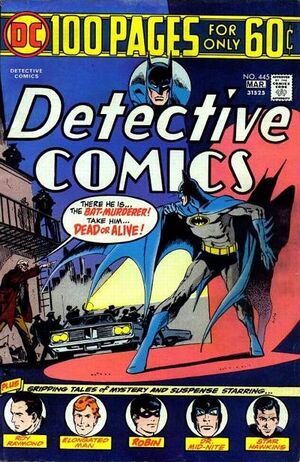
Take a look at the following pages from Detective #445 (March, 1974). They are from "Break-in At The Big House," the lead story in one of those DC 100 Pages issues (for only 60 cents -- oh, the '70s!). The story is part of a dramatic arc running across multiple DC Batman comics where Bats is wanted for murdering Ra's al Ghul's daughter Talia. Multiple witnesses and videotapes make it seem like Batman really did gun her down in cold blood, although we know he hates the very idea of guns.

The DC Wiki has a good synopsis of the story:
"Batman breaks into Gotham Prison to question Ra’s al Ghul about the killing of Talia. Ra’s admits that he is responsible for the incident, then turns a gun on himself, and throws the gun towards Batman before he falls. Guards assume Batman is responsible for another murder, and the Caped Crusader must fight his way out past guards and convicts."


Read 'em? Good. Now let me interrupt to skip ahead thirty years.

At the Stumptown 2011 panel on teaching comics Diana Schutz from Dark Horse, and Brian Michael Bendis discussed the way they teach comics literacy and creation, often comparing comics to movies. Bendis offered a number of books he uses as references when he's teaching, including Ivan Brunetti's "Cartooning: Practice and Philosophy," and surprisingly, David Mamet's "On Directing Film." Both the Brunetti and Mamet books stress visual thinking and letting the images tell the story, adding dialog only when it naturally evolves the storyline. This means omitting "maid and butler" dialog, which explains to the reader what is going on, as well as text that's redundant to the visual.

Interestingly enough, Bendis also mentioned that the editors at Marvel are tending toward dropping thought balloons. This would align with the suggestions from Brunetti and Mamet, but also seems to truncate a dimension that's fairly prevalent in comics, especially Marvel superhero comics: the internal narrative. Think of an early Spider-man fight that didn't include Peter's personal worries about Aunt May, money, and whether Mary Jane was interested in him or not.

So, as a personal experiment, I decided to doctor up a random couple of pages and compare whether it was "better" with, or without the external narrative and the internal thought balloons. The preceding pages are the result. Compare the altered pages with the originally published art as it appeared in Detective #445:


Now, before anyone complains, the goal here isn't to alter Jim Aparo's art or Len Wein's writing, or even to show off my amateur Photoshop skills, but to take a new look at a comic that wasn't drawn to today's expectations, and see whether it meets the cinematic ideals espoused by Bendis, Brunetti, and Mamet. I simply want to pose the question "How is the reading process different when the narrative and thought balloons are removed?"

First, let's look at the narrative. Most of the information is already captured in the images: we don't need to know that it took an instant to climb the wall, or that a spotlight narrowly misses exposing Batman's break-in. That's clearly shown in the images. The only part of the narrative which isn't completely shown in the images on the first page is that Batman is considered the "world's greatest escape-artist," which seems irrelevant and overblown compared to the subtle action on the page.

On the second page the narrative gives us two more bits of information: first, that it has taken the Batman a while to successfully penetrate to Ra's Al Ghul's cell, and second that it is Ra's in the cell. Again, I found these bits of information irrelevant to the story. From frame 3 to frame 5 I can see that Batman changed into a prison guard's uniform. That must've taken a bit of time, so why restate it in the narrative?

When I was a kid I regularly skipped the narrative boxes. In my mind they mostly served to obscure the artwork, only occasionally producing an interesting footnote or editor's note. This little experiment shows my inner child was right on the money for narrative in comics.

So, can the same be said for the thought balloons? Is Batman's internal dialogue also irrelevant?

In this sequence the Batman has only four explicit thoughts. Of the four, two are spent explaining action we can already see on the page: the searchlight sweeping toward him, and the guards' approach. Two others, however, provide some insight into Batman's character. First, that he was a consultant on the prison's design, and he's exploiting that information to break in. Second, even the Batman worries about his physical limitations. These internal thoughts expose the humanity behind the mask, and help the reader identify more closely with the man who's trying to clear his name in a frame-up for murder.

As this site mentions, "thought balloons have fallen out of fashion in recent years in preference for narrative captions." So, this is just moving the thoughts from the position within the image, to one that's aligned along the top or bottom of the image. Personally, I'd rather have relevant thoughts integrated into the image (as a thought balloon), rather than an internal dialogue that's distanced from the character, a la Prince Valiant for example.

Bottom line? It's likely that the average comic from the '70s, and maybe from any time period, will have redundant captions that echo the action in the image.  For the most part, it probably makes the comic stronger to eschew these narrative crutches, and to follow the ideals of Brunetti and Mamet.  On the other hand, I think that losing thought balloons, or relegating them to the edges of the frame in a narrative box, cuts off one of my favorite aspects of comics: the ability to show the internal dialogue of the character in an immediate way.


Incidentally, if you want to read the full arc of this Batman / R'as al Ghul story, the site Pulp & Dagger says it was collected in a 1981 digest called the "Best of DC digest #9."


Enhanced by Zemanta

7/19/11

"Smile" by Raina Telgemeier

At its heart, “Smile” is an autobiographical story of a girl who trips while leaving a Girl Scouts meeting, smashes her front teeth, and spends several years with dentists. But it's also a teen coming of age story, a documentary of the 1987 San Francisco earthquake, and a fun slice-of-life memoir. In documenting her “dental drama,” Raina Telgemeier has created a wonderful, painful portrait of life as it revolved around friends, school, video games and dental procedures that lasted from sixth grade until high school.

What I liked most about “Smile” is how honest it is, including details both good and painful. Even on the 10th reading, I cringe at the pages that show Raina tripping and smashing her teeth.  Likewise, when she’s betrayed in little ways by her friends, I feel the shame and hurt.  Also, although I wasn’t a teenage girl in 1987, I identify with the details: Mario on Nintendo, the DuckTales video game, the 1987 SF Earthquake, and the faux MS yearbook signatures on the end pages.  Even when young Raina and her friends see “The Little Mermaid” is its first release, we later see a figurine of Ariel on Raina’s desk when she’s in high school.  Heck, even the details of the dental procedures are accurately captured in jaw-dropping detail.

I also appreciated how Telgemeier expands her story into a coming of age story that any middle school student can relate to.  As Raina moves from 6th grade to high school, her dental problems follow her, but she also experiences day to day life: crushes on boys, getting pierced ears, girl friends who mature at different ages,  and playing spin the bottle at a party.  At one point Telgemeier is self-referential to her own memoir:
Mom: Lots of kids wear funny stuff to help fix their bodies…you probably just don’t realize it because no one talks about it.
Raina: Well, maybe someone should start talking about it!!
Raina (thinking): Maybe it would make us feel less like freaks.

The art is clean, and casually cartoony.  Bug eyes, comic-book icons such as light-bulb ideas, helpful arrows labeling items (“oatmeal”), and the occasion character floating in love add to the ambience rather than detract.  The backgrounds are almost architectural. I especially enjoyed the sense of timing, sometimes spending a full page to add emphasis to events.  One example of this is when Raina skips out on the Valentine’s dance without meeting her friend Sam.  Telgemeier has two 1/6-page frames with setting up Raina’s motivation outside the dance, two 1/3-page frames showing her indecision, and then a single page dedicated to Raina leaving alone while the “boomboom” of the music emanates from the gym.


I’d put Telgemeier in the same category as Judy Blume. While the audience for “Smile” is clearly younger teen girls, some middle-school boys will probably also enjoy it.  One difference between Blume's books and "Smile" is that the publisher, Scholastic, has made an effort to omit anything scandalous from “Smile.”  At Stumptown Comics Fest in 2010, Telgemeier mentioned there was a bit of censorship in the publishing process where Scholastic wanted a reference to "PMS" removed from the book, which she assented to.

One more comment: In addition to middle readers, every dentist should have a copy of "Smile" in the waiting room.  In comparison to Raina’s journey, a cleaning or a filling for most patients should be a piece of cake.

"Smile" was nominated "Best Publication for Teens" for the 2011 Eisner Awards. Raina Telgemeier's website is http://goraina.com. You can read the entire story of Smile online, although it's not in color.
Enhanced by Zemanta

7/18/11

"Return of the Dapper Men" by Jim McCann and Janet Lee

A fairy by John R Neill
When I was a kid reading L. Frank Baum’s "Wizard of Oz" books, I’d sometimes stop mid-story to look at John R Neill’s drawings of fairies, gnomes and other magical creatures of the land, and get so entranced I’d lose all track of the time. The elegant lines of the dresses of the beautiful fairies, the curlicues embossing the Cowardly Lion, the pretty and mischievous smile of Ozma, the girl ruler, were so expertly rendered I saw them on the page as if they really existed. This sense of wonder and whimsy in the illustrations so perfectly matches Baum’s stories that, even though other artists have had their turn illustrating the Oz stories, in my mind they are as intertwined as a climbing rose and trellis.


In "Return of the Dapper Men," written by Jim McCann and illustrated by Janet Lee, the artists have tried to create a similar work of whimsy, combining a fairy-tale story with lavish artwork, bringing to mind Baum & Neill, the Brothers Grimm, Little Nemo and maybe a touch of William Joyce. The result hovers somewhere between a graphic novel and an extended picture book.

In the land of Anorev, time has stopped. The robots live and work aboveground, while the children play in the dark caves underground. Only two beings can travel between the two realms: the boy Ayden and a robot girl named Zoe.  A robotic villain named Fabre tries to force Zoe to sprout wings and fly to the majestic broken angel that oversees the land on Anorev. Then, time starts again with the arrival of 314 dapper men, wearing bowlers and carrying umbrellas, flying into town.  With their advent, dapper man 41 stirs Ayden, Zoe, and the rest of the beings in Anorev into working toward their destiny.

Dapper Man 41 and Ayden
The artwork is definitely worthy of a modern classic fairy tale.  The characters sprawl over the page, with bits of detail filling the crannies.  The art continuously reminded me of a melding of Winsor McKay’s Little Nemo meets Johnny Gruelle meets William Joyce’s Robots, but was rendered with Lee’s own style, too.  A section at the end of the book explains Lee’s meticulous process in "The Making of a Dapper Page."  In this digital era, it’s amazing to see an artist who, after doing the layout and illustration, then physically cuts out the images to overlay them on abstract painted backgrounds.

Unfortunately, I wasn’t as absorbed by the story, which I found whimsical, without being enchanting.  I think the main issue with the story is reflected in the introduction by Tim Gunn that. He proclaims

"’Return of the Dapper Men’ is a transformational experience, a morality tale that is certain to become an instant contemporary classic. The narrative is instantly captivating and always multi-dimensional. The reader will find puzzles, riddles, and anagrams that serve as catalysts for further investigation and research. Be armed with Google and Merriam-Webster.com in order to enjoy the full-tilt experience of this wondrous read."

Frankly, the problem is that the story is both treated too preciously and not seriously enough.  McCann has allusions to September 11th, and to tragedies such as Romeo and Juliet and the drama of Tristan and Isolde, but the characters never seem engaged in the story. There are many wide-eyed proclamations, such as "The only boy to write. That’s why you are up here," and "There’s always time for lessons, especially when you have time."  Occasionally characters appear to talk to the "camera."  Some of the characters seem to be cast as antagonists, but the conflict is all spoken, and never acted on.  The only actual threat to all the characters is that time had stopped, and now it’s starting again, which, I guess, means change? In time of no time, the children and the robots had forgotten how to share work and play, and now they have to move forward.  Even in allegory, I didn’t find the story very compelling.

According to Wikipedia, when Baum was writing the Oz books, his "avowed intentions with the Oz books, and other fairy tales, was to tell such tales as the Brothers Grimm and Hans Christian Andersen told, bringing them up to date by making the characters not stereotypical dwarfs or genies, and by removing both the violence and the moral to which the violence was to point." Although his books were less gruesome than the Brothers Grimm, Baum failed to completely remove the violence.  Even in a land where no one dies, the threat of being cut into small pieces and left there for all eternity struck a chord in my imagination that stayed with me.  Also, the Wicked Witch, the Nome King, and the other antagonists showed enough malice to keep the plot exciting.  I can't same the same about "Dapper Men," which I found beautiful, but not compelling.

It appears that "Return of the Dapper Men" is a series, so perhaps this volume is only the prelude to a larger story.  Given time, we may find out why time stopped in Anorev, and who sent the Dapper Men, and whether Zoe will ever speak and the answer to many more questions. But, while this book has the artwork of a classic, the story was whimsical without wonder, and left me unfulfilled.  "Return of the Dapper Men" was nominated "Best Publication for Teens" for the 2011 Eisner Awards.
Enhanced by Zemanta

7/7/11

"I Thought You Would Be Funnier" by Shannon Wheeler

Weeks ago I bought Shannon Wheeler’s newest book "I Thought You Would Be Funnier," but I haven’t reviewed it yet for a simple reason: I’m biased. I think that practically everything he does is funny. By way of explanation, I started to list all the work by Wheeler which I've admired, but it started to turn into a comic-artist version of A Fan's Notes (except, I hope, less crazy).  Regardless, let's push on.

I started reading his Too Much Coffee Man strip years ago when it ran in the back of some local paper. TMCM was a new kind of superhero, similar to The Tick, except he didn't seem to have any powers other than a giant coffee cup attached to his head ( I know it's not part of the suit -- I've seen his skull!). The wry humor, interesting cast of recurring characters, and solid art grabbed and held my attention. TMCM had humor, insight, coffee and bathos. Well, I’m not sure if it had bathos, I’ve never understood bathos, but it had coffee. And Too Much Espresso Man.

Somewhere in the mid 90’s, Wheeler traveled all the way from Austin, Texas to a comic book show in Portland, Oregon where I met him in person and discovered that "Shannon" was a skinny guy with long curly hair. Up until then I’d thought he was a she. Not a big deal. It’s the body of work that’s important, not the person. I got over it, and so did my wife.  I even got him to sign a book.

I guess Wheeler liked his trip to Portland, since he moved to town, and I got more opportunities to buy the books and merchandise at local comic book shows, book signings, Wordstock, and eventually the Stumptown Comics Fest. The Too Much Coffee Man T-Shirts (I’m wearing the "pit of despair" shirt right now), the Too Much Coffee Man coffee cups, the Too Much Coffee Man cereal caddy. Ok, I’m joking about the cereal caddy. But I’ve got many of his books: Too Much Coffee Man’s Guide for the Perplexed, for example, and Too Much Coffee Man’s How to Be Happy.

Did I mention I wrote a TMCM screen saver? I know it was 1996, because Windows 95 had just come out, and it was late. I designed the program so you could configure the jitters, the anxiety, and how randomly TMCM would meander across the screen. I was so proud that I emailed a copy to Mr. Wheeler, who politely ignored the copyright infringement and wrote back that he owned a Mac, and wasn’t sure whether anyone would be interested in a TMCM screen saver.

So, how far can the TMCM thing go? Pretty far, apparently, but before I could tire of it, Wheeler moved in a new direction: the boxed set of "Postage Stamp Funnies." Designed to recall the look and feel of Maurice Sendak’s Nutshell Library, it's a collection of Wheeler’s weekly cartoons from The Onion. At the book signing at Oregon Historical Society, Wheeler told me that Dark Horse balked at the cost of binding and boxing the comics, but somehow he got the project completed. They’re soooo cute!

Turned out the box set was part of a one-two punch, with the production of Too Much Coffee Man: The Opera. Announced as "the first opera based on a comic book," I thought it was a great idea. I heard early versions of the songs at Wordstock, but unfortunately missed the full productions in Portland and Astoria. Something to look forward to, I guess.

Shannon Wheeler's First Published New Yorker Cartoon
By that time Facebook had come out, and I’d friended Wheeler, and played a number of games of Jumble or WordTwist (something like that) with him.  Like Homer Simpson to Mr. Burns, I don't think Wheeler remembered meeting me, but I was happy to see the occasional drawings he'd post on Facebook.  Surprisingly, he started posting rejections from the New Yorker, and finally in 2009 announced his first sale to that esteemed, inscrutable, comic magazine. Frankly, the acceptance policy for comics at the New Yorker is a bit hard to fathom, but maybe that’s the charm. There’s something for everyone, whether you understand it or not.


Wheeler started collecting the comics rejected from the New Yorker, and voila, the result is "I Thought You Would Be Funnier." It’s a quick read - about 100 comics, all of them funny, and showcasing Wheeler’s now-distinctive style. You won’t find any Too Much Coffee Man, but there are a few that echo Too Much Espresso Man. In one cartoon workers are picking beans, and one worker asks another "Tell me again the difference between a cappuccino and a latte." In another, a clown confesses to his doctor "It hurts when I laugh."

But, as the great Dr. Emilio Lizardo once said, "Laugh-a while you can, monkey boy." Wheeler’s upcoming project is not all humor and coffee. He’s working with Oregonian columnist Steve Duin on a book called "Oil and Water," a graphic novel based on the Gulf Coast catastrophe of the Deepwater Horizon oil spill.  Just like Wheeler's expansion from comics to opera, I look forward to this ambitious project mixing graphic novels with reporting.

In the meantime, "I Thought You Would Be Funnier" has two award nominations: in the running for the Eisner Best Humor Publication and the Harvey Special Award for Humor in Comics.  Does that sound funny to you?


Shannon Wheeler’s website is http://www.tmcm.com
Enhanced by Zemanta

7/4/11

"Ghostopolis" by Doug TenNapel

In “Ghostopolis” the relationship to the afterlife is slightly different than our own. Ghosts have a tendency to sneak back into the world of the living, and the living have the technology to visit the land of the dead. Agent Frank Gallows works for the Supernatural Immigration Task Force sending illegal ghosts back to the afterlife.  While working on a case of a skeletal stallion, he accidentally sends terminally ill teen Garth Hale to Ghostopolis, which his boss Lieutenant Brock deems “a real screwup.”  Fired from the force, Frank enlists the help of his ghostly ex-fiancée Claire Voyant and her barrier-breaking Plasmapod, a sort of hot-rod that can travel to the land of the dead, to find Garth and bring him back.  Meanwhile, Garth wanders the realm, encountering his grandfather, and learning about Joe, the mysterious Tuskegee Airman who created the world of Ghostopolis, and Vaugner, the Machiavellian ruler of the land.

The story has a lot of characterization, and the dialogue includes many kid-friendly jokes that are actually funny.  In one running joke, Benedict Arnold betrays himself as a traitor to both sides on multiple occasions. TenNapel shows his skill at comedic timing during the climactic fight scene when Vaugner asks “You know what I’ve got that you don’t?” In the next frame Garth replies “Diarrhea?”  The exchange is made even funnier because the two combatants are in the shape of giant battling buildings.

The book is about death, but death taken in a comforting way. Given that, I guess it’s no surprise that some Christian themes come through.  The airman Joe is a barely disguised version of God, and the crack into the next realm, beyond Ghostopolis could be seen as Heaven.  TenNapel has publicly written about using Christian themes in his works, and a story about the afterlife seems a pretty obvious place to discuss Christianity.  But for comparison, I found Ghostopolis less about Christianity than, for example, Aslan in the Narnia books by CS Lewis.  For the most part the points are integral to the story and don’t seem moralistic or preachy.

TenNapel seems to have had a lot of fun with the seven territories of the afterlife: the Specters, the Will-O’-The-Wisps, the Mummies, the Goblins, the Zombies, the Boogeymen, and especially the Bone Kingdom.  Dressed in Medieval armor garb, the Bone Kingdom reminded me of a perverse take on Prince Valiant.

The art is clean and comic, while moving toward realism when rendering the skeletons. I really enjoyed the scene where Garth and his nightmare are chased through the woods by the remains of velociraptors.  Some reviews I’ve read complained about the coloring, but the addition of color seems to bring out the drawings where black and white might have been overly dark.

A truly great story, however, must have a truly great antagonist. In Ghostopolis, Vaugner turns out to be a tragic figure, but only in the final act.  The extent of his powers, motivations and history is shrouded by the author until this time, and that weakens the character, leading to a slightly weaker story. In my opinion Vaugner would have been more tragic, more daunting if I’d known more about his motivation earlier. Also, his powers seem inconsistent: from atop his office building he’s able to detect and pinpoint Garth’s position in Ghostopolis. Later, however, he’s unable to find the boy in a slightly crowded street.  Also, his bug henchmen start out threatening, but end up comic.  Vaugner as a villain seems a bit arbitrary, weakening the story.

Bottom line, “Ghostopolis” is a fun read, with interesting characters, a rich landscape of the afterlife, and a satisfying conclusion. I’d recommend it to any student from 3rd to 8th grade – and adults will probably enjoy it too.  Ghostopolis was nominated "Best Publication for Teens" for the 2011 Eisner Awards.  Doug TenNapel's website is http://tennapel.com/comics.html. A movie version of Ghostopolis is listed on IMDB as “In development” for 2013.
Enhanced by Zemanta

6/11/11

"Hereville: How Mirka Got Her Sword" by Barry Deutsch

"Hereville: How Mirka Got Her Sword" by Barry Deutsch is the story of a young girl who's looking for adventure beyond the houses of Hereville. While her stepmother wants her to do the chores and learn to knit, Mirka looks for dragons and witches. Eventually she finds a talking pig, a witch, and a troll, and has to deal with them all, becoming, as the tagline states, "Yet Another Troll-Fighting 11-Year-Old Orthodox Jewish Girl."

The book is packed with details and characters.  Although we don't get to meet all eleven members of the Hirschberg family, Deutsch provides well-rounded versions of some of Mirka's siblings, her step-mother Fruma, and even the ghost of Mirka's mother.  He also intersperses the dialog with Yiddish words and sayings like "Dybbuk and "Drai mir nit kain kop!" (providing footnotes on the translation), giving us an insider view on the events in Mirka's life.

The Jewish culture is deeply woven into this story, but is never preachy or obstructive to the narrative.  
If anything it's an interesting alien world for most Americans, as well as opening a window into the lives of others. This article  from the "Jewish Daily Forward" says it best: "By normalizing the rhythm and values of Jewish life, rather than singling them out as a topic for discussion, he manages to make Mirka just another adventure seeking pre-teen who just so happens to be Jewish."

I emailed Deutsch with a couple questions about Hereville.

Comics Bin: These magical aspects of the story - the talking pig, the witch, the troll - are you working off Jewish cultural stories, or are they your own inventions?
Barry Deutsch: They're my own inventions. There are a lot of Jewish cultural ideas in Hereville, of course, but the magic isn't one of them.

CB: Why Hereville?
Deutsch: Although this never came up in the book, the town is actually named "Aherville." "Aher" is Yiddish for "here."

CB: Is Hereville in the past, present, where?
Deutsch: It's set in a small town in the present-day US (or the recent past).

CB: Do you know a girl like Mirka?
Deutsch: I don't know anyone quite like Mirka!

The way Deutsch has rendered Hereville it could be located in any slightly rural area, perhaps another country in the present-day, or outside of New York in the 1940s.  But the sepia coloration of the pages adds to the nostalgic, almost dreamlike qualities of the story. Deutsch never attempts to explain the pig, the witch or the troll, and although Mirka is surprised by them, she encounters them head-on, and thrives on the encounters. The ending is as satisfying as any tale from the Brothers Grimm or Aesop. I think that young and teen readers will enjoy the book through to the very end.

The art is clean, cartoonish, and consistent. Deutsch originally started drawing it as a webcomic for Girlamatic.com and then developed it into this book.  The 57-page webcomic is still available online.  The published book has been almost entirely redrawn and runs 139 pages.  You can see a 15-page preview here. He creates digitally, using a Cintiq tablet and Photoshop to draw and color the story.

In addition to his work on Hereville, Deutsch also drew one of the back-up pages in Brendan Douglas Jones's epic "Breakfast of the Gods" (the one about Super Sugar Crisp Bear).

Hereville was nominated "Best Publication for Teens" for the 2011 Eisner Awards.  The webpage is http://www.hereville.com/ and Deutsch's twitter handle is @barrydeutsch.


Enhanced by Zemanta

6/2/11

Wanted: Safe Bus Riders! - DC PSAs of the 50s and 60s

In DC comics from the 60's you'll see a number of public service announcements with titles such as "People Are People!" or "Let Science Serve You!".


Even when I was a kid these well-intentioned 1-page morality tales seemed hokey and outdated, in the same vein as a Dick and Jane or "Around the Corner" reader.


Let Science Serve You!

Now, however, I look at them as a time capsule, reflecting the morals and hopes of the Camelot administration.  They have the same wide-eyed optimism as the United Nations, or UNICEF, standing in stark contrast to the Tea Party and Neo-conservative zeitgeist of today.


Interestingly enough, most of the PSAs from DC were reportedly written by one man: Jack Schiff.  Schiff was an editor at DC during the Golden Age, and worked on on all the Batman Comics during the 40's & 50's.


I don't know when DC began to run the public service comics -- other publishers had PSAs as early as World War II.  For example, Bulletman’s appearance in "Paper Chase" in Master Comics no. 49 (Apr. 1944) promoted paper drives for the war.  DC’s 1-page service comics were sponsored by an NGO called the National Social Welfare Assembly, which later changed its name to the National Human Services Assembly.


This site has a history of the character Johnny Everyman, whose stories ran in World’s Finest and Comics Cavalcade in the late 40’s.
“The Johnny Everyman stories were essentially public service stories. Each Johnny Everyman tale preached liberal ideas, usually involving understanding and respect for other races and nationalities. They often gave a detailed look at the lives and problems of these groups, in an almost documentary like way. They embedded this mix of educational information and social commentary in what the writers hoped would be an exciting adventure framework.”
The Superman Home Page, in an article about DC artist "Win" Mortimer, explains the backstory to Schiff's PSA projects.
Jack Schiff's pet project was a series of one-page public service announcements that he hoped would be read by young comics readers and serve to give a wholesome message. Schiff worked with the National Social Welfare Assembly, a group of psychologists and educators from several organizations, including Nobel Prize winner Pearl Buck, to produce a page which appeared every month in over thirty magazines from 1949 into the 1960's. After delivering his assignment of Superman Daily strips to Schiff, Mortimer was often asked if he might be able to do a single page and produced a large body of work for this project featuring Superman, Superboy, Green Arrow, Tomahawk, and Batman to name just a few. The topics varied from racism, to doing chores around the house, traffic safety and study tips. The pages were requested by schools and civic organizations by the thousands and DC printed them and sent them out in a conscious effort to be a good citizen at a time when, as then-publisher Jack Liebowitz said, "a lot of people came into the [comics industry] who didn't have any standards at all."

Searching Michigan State's Special Collections index  I found a partial list of 75 of DC’s PSA comics.  From that list Jack Schiff wrote at least 23 of them, if not more.

In an odd contrast to the altruistic PSAs, this site claims that Shiff, often demanded under the table kick-backs from artists and writers of the period.  Hard to believe after reading all the good-natured stories from the man.

People Are People!
Here's an incomplete list of DC PSAs during the 1950s and 1960s:
  • "A Date with Effie" in Wonder Woman, no. 90 (May 1957)  - About Volunteering For Community Service.
  • "A Message from Otto the Robot!" / Jack Schiff, script; Bernard Baily, art. in My Greatest Adventure, no. 60 (Oct. 1961) 
  • "A Salute to Our American Indians!" in Superman's Girl Friend Lois Lane, no. 24 (Apr. 1961) 
  • "Are You a Litter-Bug?" / Henry Boltinoff. in Wonder Woman, no. 99 (July 1958) 
  • "Be a Good Citizen" (Superman) in Superman's Girl Friend Lois Lane, no. 34 (July 1962) 
  • "Be Sure of Your Facts!" (Buzzy) in Wonder Woman, no. 107 (July 1959)  -  About Not Jumping To Conclusions.
  • "Be Sure of Your Facts" (Buzzy) / Jack Schiff, script; Win Mortimer, art; Gaspar Saladino, letters. in Mystery in Space, no. 7 (Apr./May 1952); and in Wonder Woman, no. 107 (July 1959)  - In The Teen Humor Genre, About Not Jumping To Conclusions.
  • "Be Yourself, Your Best Self!" (Buzzy) / Jack Schiff, script; Win Mortimer, art. in Mystery in Space, no. 6 (Feb./Mar. 1952); and in Superboy, no. 18 (Feb./Mar. 1952)  -  In The Teen Humor Genre.
  • "Binky's Special Election Exhibit" (Binky) / Bob Oksner, art; Jack Schiff, script. in Wonder Woman, no. 86 (Nov. 1956)  -  About Voting
  • "Buzzy Learns About Careers in Nursing" (Buzzy) in Wonder Woman, no. 89 (Apr. 1957) 
  • "Buzzy Scores One for the Handicapped!" (Buzzy) in Superboy, no. 13 (Mar./Apr. 1951); and in Star Spangled Comics, no. 114 (Mar. 1951)  -  Portraying A Hearing-Impaired Teenager ("Deaf Guy") Who Can Play The Piano.
  • "Carelessness is No Joke!" (Peter Porkchops) in Mystery in Space, no. 14 (June/July 1953)  -
  • "Christmas in Many Lands" (Binky) in Wonder Woman, no. 72 (Feb. 1955)  -  In Quiz Format, About Christmas Customs In Norway, Mexico, Belgium, Yugoslavia, Chile And The U.S..
  • Nature's Bill of Rights
  • "Danger: Prejudice at Work" / Jack Schiff, script; Ruben Moreira, art; Ira Schnapp, letters. in Adventure Comics, no. 240 (Sept. 1957) 
  • "Do You Know How to be a Good Baby-Sitter?" (Buzzy) in Wonder Woman, no. 80 (Feb. 1956) 
  • "Do You Know Your Neighbors?" (Buzzy) in Wonder Woman, no. 78 (Nov. 1955); and in Superman's Girl Friend Lois Lane, no. 32 (Apr. 1962)  -  About Multiculturalism. Buzzy Visits Neighbors From Puerto Rico, Vermont, Japan, And Ireland.
  • "Do You Make Life Hard For Yourself?" in Wonder Woman, no. 106 (May. 1959)  -  Against Messy Bedrooms.
  • "Don't Give Fire a Place to Start!" (Superboy) in Wonder Woman, no. 67 (July 1954)
  • "Earn While You Learn!" / Ruben Moreira, art; Jack Schiff, script. in Wonder Woman, no. 92 (Aug. 1957)  -  On Summer Jobs.
  • "Formula for Success!" in Wonder Woman, no. 103 (Jan. 1959)  -  About Developing Talents Before Choosing A Vocation.
  • "Free Speech Free for All!" (Buzzy) in Wonder Woman, no. 115 (July 1960)  -   On Fairness In Political Campaigning.
  • "From Many Lands" in All American Men of War, no. 90 (Mar./Apr. 1962)  -  Page About International Commerce,  "
  • "Get a Grip on Your Gripes!" in Wonder Woman, no. 119 (Jan. 1961)  -  About Not Losing One's Temper.
  • "Get Hip to Old Folks" / Morris Waldinger, art; Jack Schiff, script. in Doom Patrol, no. 106 (Sept. 1966)
  • "Get Your Ticket to the Treasury of Books!" (Superman) in Wonder Woman, no. 82 (May 1956)  -  About Public Libraries.
  • Wanted: Safe Bus Riders!
  • "Give Your Pet All the Breaks" (Binky) in Mystery in Space, no. 16 (Oct./Nov. 1953) 
  • "Give Your Town a Present" (Superboy) / writer, Jack Schiff; artist, Win Mortimer; colorist, Bob Le Rose. p. 60 in The Greatest Golden Age Stories Ever Told (New York : DC Comics, 1990)  -  Originally Presented In 1949.
  • "Happy Hobby Time" (Superboy) in Sensation Comics, no. 109 (May/June 1952)  -  About Hobbies.
  • "Home Sweet Home" (Leave it to Binky) in Wonder Woman, no. 63 (Jan. 1954)  - About Domestic Arguments.
  • "Hop on the Welfare Wagon" (Superman) / Jack Schiff, script; Win Mortimer, art; Ira Schnapp, letters. in Mystery in Space, no. 8 (June/July 1952)  -  Superhero Genre.
  • "How Not to Enjoy a Vacation!" in Wonder Woman, no. 93 (Oct. 1957)  -  About Planning Ahead For Vacation Travel.
  • "How to Make New Friends" (Binky) in Wonder Woman, no. 91 (July 1957); in 80 Page Giant, no. 12 (July 1965); and in Superman's Girl Friend Lois Lane, no. 58 (July 1965)  
  • "How to Spend a Summer Week" (Binky) / Jack Schiff, script; Win Mortimer, art. in Mystery in Space, no. 15 (Aug./Sept. 1953); and in Wonder Woman, no. 85 (Oct. 1956)  -  On Finding Fun Things To Do In The Summer.
  • "It's Fun to Belong!" (Binky) in Wonder Woman, no. 81 (Apr. 1956)  -  About Joining Organized Activities.
  • "It's Fun to Help Others!" (Superboy) in Wonder Woman, no. 112 (Feb. 1960) and in Star Spangled War Stories, no. 89 (Feb./Mar. 1960) 
  • "It's Fun to Learn!" in Strange Adventures, no. 109 (Oct. 1959)  - Two Boys Clearing A Field For A Ball Field Learn About Levers And Fulcrums.
  • "It's Smart to Check and Double-Check" (Superman) / Jack Schiff, script; Win Mortimer, art. in Mystery in Space, no. 9 (Aug./Sept. 1952) 
  • "Job Counselor" (Superboy) in Strange Adventures, no. 1 (Aug./Sept. 1950) 
  • "Justice for All Includes Children (5)" in Kamandi, the Last Boy on Earth, no. 43 (July 1976)  -  Features Superman.
  • "Justice For All Includes Children (6)" / Continuity Associates, Inc. ;in Justice League of America, no. 134 (Sept. 1976); Claw the Unconquered, no. 9 (Sept./Oct. 1976); Tarzan, no. 253 (Sept. 1976) 
  • "Justice For All Includes Children (7)" in Justice League of America, no. 136 (Nov. 1976); The Unexpected, no. 176 (Nov./Dec. 1976); Blackhawk, no. 249 (Nov./Dec. 1976); Kamandi, no. 46 (Oct. 1976) 
  • "Keep Learning the Key to Success!" in Wonder Woman, no. 118 (Nov. 1960).    - On Staying In School.
  • "Know Your Community" (Binky) in Mystery in Space, no. 17 (Dec./Jan. 1953/1954) 
  • "Lend a Friendly Hand!" (Superman) in Wonder Woman, no. 116 (Aug. 1960)  -  On World Refugee Year.
  • "Look to the Stars!" in Wonder Woman, no. 102 (Nov. 1958)  -  About About The North Star.
  • "Lost, a Free Education" (Leave it to Binky) / Jack Schiff, script, Bob Oksner, pencils; Ira Schnapp, letters. in Mystery in Space, no. 4 (Oct./Nov. 1951); and in Wonder Woman, no. 101 (Oct. 1958)  -  In The Teen Humor Genre About Staying In School.
  • BEM Shows Up!
  • "Make Your Summer Count!" in Tomahawk, no. 111 (July/Aug. 1967)  -  About Cleaning Up A Vacant Lot, And Using The Broken Glass To Make A Mosaic Mural.
  • "New Stars for Old Glory" in Wonder Woman, no. 110 (Nov. 1959) and in Star Spangled War Stories, no. 87 (Nov. 1959)  -  Brief History Of The U.S. Flag, And The New States Alaska And Hawaii.
  • "Pennies for UNICEF!" (Superman) in The Flash, no. 133 (Dec. 1962)  
  • "People Are People" (Superman) in Mystery in Space, no. 13 (Apr./May 1953)  
  • "School Blues" (Buzzy) in Wonder Woman, no. 69 (Oct. 1954)  -  About Staying In School.
  • "Share Work with Others" (Superboy) in Sensation Comics, no. 107 (Jan./Feb. 1952)  -  About Sharing.
  • "Smoking is for Squares!" / Sheldon Moldoff, pencils; Jack Schiff, script. in Detective Comics, no. 332 (Oct. 1964); in Hawkman, no. 4 (Oct.-Nov. 1964); in Superboy, no. 116 (Oct. 1964); in Superman's Girl Friend, Lois Lane, no. 52 (Oct. 1964); in Superman's Pal, Jimmy Olsen, no. 80 (Oct. 1964)  - Bob Hope Appearance.
  • "Special Christmas Quiz" / Reuben Moreira, art; Jack Schiff, script. in Wonder Woman, no. 144 (Feb. 1964) 
  • "Superman" ;/ Al Plastino, Jack Schiff; in Action Comics, no. 143 (Apr. 1950) 
  • "Teddy Roosevelt, Guardian of Nature" / Ruben Moreira, art; Jack Schiff, script. in Wonder Woman, no. 94 (Nov. 1957)  -  About Conservation.
  • "That Deep, Dark Secret!" (Buzzy) in Wonder Woman, no. 54 (July/Aug. 1952)  -  Black And White Public Service Page, About Talking Openly About Mental Illness.
  • "The Atom, Servant of Man" / Jack Schiff. in Batman, no. 128 (Dec. 1959); and in Superboy, no. 77 (Dec. 1959)  -  Educational Page Celebrating The "Radio-Isotope," Created At Oak Ridge, Tennessee, And Used By Scientists In Germany, Japan, Brazil, Canada And Nigeria.
  • "The Best Present of All!" (Binky) in Wonder Woman, no. 79 (Jan. 1956); reprinted in Wonder Woman, no. 111 (Jan. 1960)  -  On Christmas Giving Without A Lot Of Money.
  • "The Case of the Careless Camper!" (Peter Porkchops) in The Dodo and the Frog, no. 89 (Aug./Sept. 1956)  -  About Forest Fire Prevention.
  • "The Flushing Remonstrance" in Wonder Woman, no. 96 (Feb. 1958); also appears in Mystery in Space, no. 42 (Feb./Mar. 1958)  -  About Quakers Standing Up For Their Right To Worship In 1656. Page Done .
  • Health Myths Debunked!
  • "The Invisible Handicap!" / Jack Schiff, script; Sheldon Moldoff, pencils. ;in Detective Comics, no. 348 (Feb. 1965)  -  The "Handicap" Is Brain Damage.
  • "The Key to Success" (Buzzy) in Wonder Woman, no. 70 (Nov. 1954)  -  On The Importance Of A Good Attitude At Work.
  • "The Magic Card!" in Wonder Woman, no. 104 (Feb. 1959)  -  On Using The Library.
  • "The Red Feather Kid" (The Green Arrow) / writer, Jack Schiff; artist, George Papp; colorist, Bob Le Rose. p. 150 in The Greatest Golden Age Stories Ever Told (New York : DC Comics, 1990)  -  From 1949.
  • "The Team's the Thing!" (Leave it to Binky) in Sensation Comics, no. 108 (Mar./Apr. 1952)  -  On Teamwork.
  • "Time Out For Talk" in Superman's Girl Friend Lois Lane, no. 33 (May 1962)  -  About Peacemaking.
  • "Tips on Camping" (Binky) in Wonder Woman, no. 74 (May 1955)  
  • "Tips on Summer Fun!" (Peter Porkchops) in Wonder Woman, no. 68 (Aug. 1954); reprinted in Wonder Woman, no. 108 (Aug. 1959)  -  About Manners And Fun.
  • "United Nations Day, October 24th" in Wonder Woman, no. 62 (Nov./Dec. 1953)  -  Black & White
  • "Wanted, A Teen-Age Code" in Wonder Woman, no. 95 (Jan. 1958)  -  About Party Crashing.
  • "Wanted: a Pal!" / Jack Schiff, script; Lou Cameron, art; Ira Schnapp, letters. in Adventure Comics, no. 251 (Aug. 1958); and in Wonder Woman, no. 100 (Aug. 1958)  -  About Close Friends.
  • "Wanted: Safe Bus Riders" / Bernard Baily, art; Jack Schiff, script. in Wonder Woman, no. 126 (Nov. 1961) 
  • "Welcome Amigo!" (Binky) in Wonder Woman, no. 66 (May 1954)  -  Black And White About Welcoming A New Friend From A Family Of Mexican Migrant Workers.
  • "What Are You Getting Out of School?" (Buzzy) / Win Mortimer, art; Jack Schiff, script. in Wonder Woman, no. 77 (Oct. 1955)  - Emphasizes The Social And Extracurricular Benefits Of Public Education.
  • "What's Your B.Q.?" in Wonder Woman, no. 105 (Apr. 1959)  - "B.Q." Stands For "Brotherhood Quotient."   Quiz-Format On Racial Equality And Equal Opportunity, In Cooperaton With The National Social Welfare Assembly.
Parents Have Rights, Too!
Smoking is for Squares!


Enhanced by Zemanta