2/24/12

OBA Graphic Literature Award

For the first time ever the Oregon Book Awards are including a category for comic books. Ok, so the actual category is "Graphic Literature" (neatly avoiding the overused term "graphic novel"), but in my mind they're comics.  But, as Doug Wolk successfully argues in "Reading Comics," they aren't just a genre, like superhero stories, but a medium, like film.  In any case, it seems that the literati of Oregon, which includes the illustrious Strunk & White society, feel that comics have arrived as a literary art.

So, which works are in the running for the 2012 award?

From this short list, I've only read "Stumptown" and "Ivy", and I think I'll have to re-read those.  The others look good, although "The Whale" is the biggest unknown to me.  So, I'm setting a goal to read all five books before the Oregon Book Awards ceremony on Monday, April 23rd.

Incidentally, there's a "Reader's Choice" award, so you can vote for you favorite book.  Cast your vote here before April 23rd.

Some other links of note: if you're already a fan of Greg Rucka's work, you can also become a fan on Facebook.  Oleksyk's Ivy is available online for free here.
Enhanced by Zemanta

2/15/12

Phantom Lady Gets Tough

The first time I learned about Phantom Lady was in the Justice League / Justice Society / Freedom Fighters crossover in Justice League of America #107, published in 1973.  She was similar to the Black Canary, and her only "power" was a black light projector used for blinding criminals. As a kid I thought that was a little weak, and the editors at DC must have thought so too, since in subsequent issues of The Freedom Fighters in the late 70's she gained the power to become immaterial - a true phantom.

In this story from Phantom Lady Comics #5, from 1955, however, our heroine gets a chance to show how tough she  really is. A thug snags her black light project, and she thinks she's sunk, until the pool balls give her an idea. Yowch!  The dialog oddly encapsulates some sort of proto-feminism. PL loses her weapon and her confidence, then falls back on self-reliance.
Thug: "No dame is going to scare me! Go back to your knitting, babe, before you get hurt!"
PL: "My black ray! I'm sunk without it! Should have been so confident in myself..."


Interestingly, the indicia lists this comic as "Phantom Lady Comics (formerly Linda)."  I wonder what happened to Linda?


Enhanced by Zemanta

"Reading Comics" by Douglas Wolk

"There’s a problem with the way a lot of people talk about comics: it’s very hard to talk about them as comics," explains Douglas Wolk, in his book "Reading Comics."  He continues: "as cartoonists and their longtime admirers are getting a little tired of explaining, comics are not a genre; they’re a medium."

With that sentence Wolk neatly presents the crisis and salvation that comics face today.  In the past thirty years comics have established a foothold in American culture as an acceptable serious medium, yet they’re still mostly thought of as fantasy-fulfilling superhero stories.  Instead we should open our eyes to see them as a vein of the media, like film, art, music or literature, while the stories themselves will fall into genres, superhero or otherwise.  He then takes this thesis and explains how comics are a unique art form.

"Reading Comics" is split into two sections, with the first third comprising an essay called "Theory and History" that covers the aspects that make comic books a unique medium, and the remainder a survey of comic examples that Wolk feels push the edges of the form.  During the essay he puts up a straw man discussion, probably well-tempered from various flame wars on the Internet, of his basic tenets of the comic book medium.  These include his definition of comics (which boils down to "don’t we already know what comics are?"), a brief struggle with the existence of superheroes ("not a week goes by that I don’t read, with pleasure, some glossy corporate superhero comics"), and the gist of his thesis, which is that comics can be read on multiple levels, and hey, some auteurs are putting together comics that need to be read on multiple levels.

Although Wolk tends toward a vocabulary that reminds me of an art history class I once had, he does it lightly enough that the pace moves along.  I also appreciated his burst of things that he loves about comics which he presented without much context. I have a shared experience in many items on his list.  Paul Gambi, the "crime tailor" who made costumes for some of the DC villains in the 60’s, for example. The ones I didn’t recognize were presented in a way that made me want to seek them out.

The latter half of the book, where he reviews a range of the most influential artists and works of the past forty years in comics, is more casual, but still just as insightful.  He bounces from Chester Brown to Steve Ditko to the Hernandez Brothers.  Of course he can’t ignore the 300 pound gorilla in the comics world, and so 30 pages are devoted to Alan Moore and the Watchmen series. Unlike Grant Morrison’s chapter in his book on comics history, which turned out to be an autobiography, Wolk presents an organized dissection of the ideas in the Watchmen.  For example, he pulls out the thread of the "The Black Freighter" in the graphic novel, and looks at it from all sides, including a slice of EC Comics history.
"Just as ‘Black Freighter’ is a metaphorical representation of the world of Watchmen, that world is a metaphorical representation of our own, a simplified and caricatured mirror image. Our New York is theirs, without the pretty plug-in electric cars; the American invasion of Afghanistan in 2001 chillingly recalled the one in Watchmen; most of all, the "destroy it to save it" calculus of Watchmen is the same one it readers face in the atomic era."
Wolk has a way of finding and clarifying the defining characteristic in a work.  His essay on Craig Thompson, for example, put into words the feelings I had after reading Thompson’s "Blankets."
"Where Raina is concerned, though, Blankets is almost as starry-eyed and self-important as Thompson apparently was at the time. He never gives her anything like interiority or suggests that she might have had any significance other than being a perfect, stainless Celia for his work…none of this is as irritating on a first reading as it becomes with later reflection, though, because Thompson is so gifted at sweeping the reader along with him. His drawing has an incredible sense of flow."
When I first saw "Reading Comics" on the shelf at the book store, I thought it was just an imitation of the work already covered in Scott McCloud’s work "Understanding Comics."  Luckily, I overcame that preconception and found instead an insightful book whose goal is to rearrange the way you read comics.  I’ll have to admit, even as a lifelong comic-book reader, this "Reading Comics" opened up my brain to some new ways of seeing, and some new avenues to explore.

Enhanced by Zemanta

2/7/12

The Boy Champions, and other Golden Age Gangs


I don’t know whether Jack Kirby got the idea for a comic book about a gang of kids in a tough neighborhood from The Bowery Boys, the Dead-End Kids, from Doc Savage’s team of experts, or even Our Gang, but it seems that there were plenty of examples of street gangs in popular culture when he created his sidekicks for the Guardian.  Nevertheless, Kirby seems to have taken this idea and run with it, spawning multiple examples in his comics: The Newsboy Legion appeared in Star-Spangled Comics, the Boy Commandos fought in the European theatre, later the unseen Yancy Street Gang bedeviled The Thing in the Fantastic Four comics, and even into the ‘70s a 1st Issue Special debuted the “Dingbats of Danger Street.” 


I was always interested in the kid gang stories, especially when they were set in distant or sci-fi locations, or when they were from the golden age comics, which had an otherworldliness about them.  The kid gangs seemed the next step in the evolution of the sidekick.  As mentioned in this Wikipedia entry, "kid gangs seemed to be the way to go. Teenage sidekicks (Batman's Robin, Captain America's Bucky, etc.) were fast becoming a comics staple, intended to provide young characters with whom the youthful readers could identify.” What’s more natural than to provide a whole entourage of characters as a foil to the hero?   


Kirby wasn’t the only one to create comic-book gangs.  The Golden Age Daredevil had his own following called The Little Wise Guys.  I also have a Thrilling Comic that showcases the Commando Cubs. Commando Cubs were originally group of American kids who were originally sent to England as part of a study of "the effects of the old-world culture on kids of different backgrounds." But when the World War II reached the shores of the British Isles, the kids found themselves stranded. This blog author has put together a nice survey of some of the other gangs, both from the Golden Age, and later years. 

And recently I was reading The Green Lama and found a gang previously undiscovered (by me).  The Boy Champions look a lot like an imitation of Kirby’s Newsboy Legion.  Tuffy is an amalgamation of Scrapper and Gabby, while Mickey could be Tommy without the leadership skills, and Wellington wears the glasses, standing in for Big Words. The time frame, from 1944 to 1946, corresponds closely with the output from Kirby.  The characters are so similar in style, I was curious whether the art was cribbed from Kirby. That is, until I noticed it was Jerry Robinson (best known as the creator of the Joker ) drawing the Boy Champions.  Side-by-side you can see that these aren’t the best examples of Kirby’s work, while the art from Robinson has been cleaned up so it’s almost cartoony.  Mort Meskin wrote the Boy Champions stories, and they appeared in all eight issues of The Green Lama when it was published by Spark Publications.

A typical story is where the Boy Champions are hired by a rich woman to take her spoiled brat of a son out with them and see to it that he engages in good, clean fun. They head for the circus, just in time to spot a robbery in progress.  In a different issue the boys, after being denied the chance to give blood because they are too young, decide to try and get a Red Cross nurse's fiancĂ© to donate himself.  Most of the stories involve being hired for a task, and then accidentally uncovering a robbery and solving it.
 

1/22/12

CBR's Top 100 Comics of 2011

Comic Book Resources has compiled their list of the "Top 100 Comics of 2011," which could double as my "to read" list.  So, as a reminder to myself, I'm reblogging the list here, with a couple of comments on what I've read, and what looks good.

100-76 on the list
I've read Jim Woodring's psychedelic "Congress of the Animals," a twisting wordless tale that's ultimately a love story.  I haven't yet read Chester Brown's "Paying For It," but it sounds intriguing -- or painful (it's hard to tell). Also tempting yet perhaps painful is Mark Waid's "Irredeemable." On the other hand, "Darkwing Duck" is just pure fun.


75-51
I've read the intro to "Archive Meets Kiss," but I'm not sure it's one of the best of 2011 -- I'll have to check it out.  It's interesting that OMAC comes in at #52 on the list -- coincidence? And finally, "A Tale of Sand" written by the late Jim Henson of Muppet fame looks interesting.

50-26
I gave my wife a copy of Sarah Oleksyk's book "Ivy," and I also read the online version. The art is so engaging, and the story equally endearing.  The other comic that I've read from this list is almost the complete opposite: "Chew."  As the blurb says, "Layman and Guillory's insane tale of a cop who can read the history of any food he eats" is a cool premise, skillfully done.

From this section two books that I particularly want to read are "Pepper Penwell & The Land Creature of Monster Lake" and Carla Speed McNeil's "Finder:Voice."  I saw McNeil at Portland's Stumptown Comics Fest, but I failed to get a copy of the Finder book at the time.

25-11
Unfortunately I haven't read any of the comics in this area.  Ray Fawkes' "One Soul" is sitting on top of my "to read" pile right now, so I'm looking forward to that. Also, I've been following Vera Brosgol on twitter, and I'm eager to read her work of a teenage girl who's picks up a friendly specter that slowly turns scary in "Anya's Ghost."

10-1
Out of the top 10, most of CBR's selections are superhero series.  There are three exceptions, all interesting.
I've read some of Kate Beaton's "Hark A Vagrant" online, and new stories of "Love & Rockets" is always a good thing, but Craig Thompson's "Habibi" is the oyster's pearl here.  It's a massive work, years in the making, and a turning point for Craig Thompson. I've read it twice, but I feel I need to read it again before making any further proclamations.

Looking over this list, I evidently need to read a lot more comics.

Enhanced by Zemanta

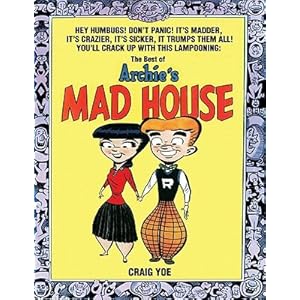
"The Best of Archie's MadHouse" by Craig Yoe

When I was a kid I read a comic-book story that completely baffled and amused me. Not a big deal, since I was often baffled & amused by comics, but this story has stuck with me. It's the story of Snowboy, by Dan Decarlo, originally printed in Archie's MadHouse Comics #22.

Snowboy's origin is a bit unclear, but his situation is he's a high-school student that's a bit different: he's a snow man. At first every one gives him the cold shoulder, but as he shows his sense of humor they start to warm to him. A pal sets him up with a blind date, a girl named Dagmar, and their relationship grows into true love. The more time Snowboy spends with Dagmar, the more his love grows, until finally "the warmth of Dagmar's love did something for Snowboy" -- it melted his snowy exterior revealing a normal teen-ager. Unfortunately, when he arrives at Dagmar's house she's become a snow girl.

This is a basic love story, and a teen coming-of-age story, wrapped within a science fictional setting, presented as an Archie comic. What's not to find amusing and baffling about that? It's an excellent example of the types of stories one would find in any issue of Archie's Mad House Comics. Now a set of these comics has been edited and reprinted by Craig Yoe, in a hardcover book called "The Best of Archie's MadHouse" published by IDW Books.

The volume is a hefty 200 pages, reprinting more than 60 gag pages and stories, and includes about a dozen Mad House covers, and some original art. If you're unfamiliar with MadHouse comics, they were from Archie, but separated in a distinct way. Archie Comics were interesting but predictable - mostly based around various love triangles with the characters of Archie, Betty, Veronica, Reggie, Jughead, Moose, Ethel, Midge, and Dilton. MadHouse comics were utterly unpredictable, starting with the Archie characters, adding spoofs from popular music, movies and TV, and letting the Archie artists run wild. Similar to Mad Magazine, but some might say even more unconventional.

Like a MadHouse comic book, "The Best of Archie's MadHouse" is split into sections.

The Teen Age Section reprints some of the earlier Archie-centered gags, as well as the other mid-60s jokes on pizza, rock'n'roll music and dating. Probably the highlights of this section are the stories with Lester Cool and Chester Square. I found it interesting that in these stories Lester Cool is the disrupter, and also usually the victor. Nowadays the stereotype is that the "nerdy" underdog Chester might be the hero of the story.

The Monster Section gives the artists a chance to spoof the horror movies of the day. "The Son of Dr. Jerkyll" is another Twilight Zone-ish story by Dan DeCarlo where the hero attempts to give himself the face of Elvis facsimile Melvin Prestone. That story impressed me enough years ago that it is as clear in my memory as it is when I re-read it in the collection. Other mad scientists appear in this section, such as Dr. Syklops, Boris Karlaff, and a hippie version of Frankenstein's monster, but the most memorable original character from this section is probably Sabrina, the Teen-age Witch.

Pep Comics #1 (January 1940), the first appear...
The "Way Out" section is a grab-bag of oddball stories of mermaids, cavemen and "The Discovery of Sleep." The best story from the "Outer Space" section is from my favorite Little Archie artist, Chic Stone. He takes a stock story of a Martian prince named Zyx on a reconnaissance mission to Earth before the invasion, and provides a wonderfully goofy and artistically rendered "Tale of Wail."

Archie comics originally started out as the MLG group, publishing superhero comics such as "The Shield" and "The Black Hood." "The Good Guy" section gives the Archie artists a chance to recall these heroes, and mix it up with a goofball hero (who nevertheless gets the job done) called Captain Sprocket. When I was a kid I loved these stories, although as an adult I find them less interesting than the other sections. They have a Shaggy Dog tale feeling to them, without any plot twists or character depth.

What I like about this book is that it gives people a chance to read the old MadHouse comics without breaking the bank.

Buying a set of MadHouse digest reprints off eBay would probably cost about $5-$10 per issue. "The Best of Archie's MadHouse" brings it all together for $34.99 (I found it for as little as $20 on Amazon.com). I also appreciated Yoe's introduction, although I felt it was a little light on meaty material. That's a complaint I've had about other Yoe projects, such as his book "The Bizarre Comics of Boody Rogers."

Another thing I learned is that Dan DeCarlo looks like his drawings, for example Snowboy. There's a photo of DeCarlo in the introduction, and you can see it in the chin, the hair, the smile.

I also liked that each excerpt showed which Madhouse issue it came from, as well as the artist and publication date. Some people, however, may find this information is printed too small.

There are a couple examples of original art in the book, but I would have liked to have seen more.

Yoe has his own quirks in designing books, and a couple of them show up here. All the page numbers are printed upside down, which may be a goof or a joke. Also, the cover has some faint comments embossed on it: "Don't read this" "Don't read this either." Yoe asks the readers if we would like to see more MadHouse, so it seems as if he's planning a series of reprints.

In all, "The Best of Archie's MadHouse" is a great introduction or reading copy for a collection of MadHouse stories. If you're looking for more depth into the background of the artists, the stories, or the Archie publishing group, you'll be disappointed. But, if you want an affordable way to see for yourself the madness that was MadHouse, buy this book. In this cold world of ours, the goofy love you find for MadHouse comics might melt your snowy exterior.
Enhanced by Zemanta

11/27/11

Crack Comics #44 - September 1946

In a time before it was ironic to have a magazine called "Crack Comics," Quality Comics published this book, and the similar "Smash Comics." While Smash Comics starred mainly a Spirit lookalike called Midnight, and an oversized robot called Bozo the Iron Man, the main draw for Crack Comics was Captain Triumph.

Captain Triumph was sort of a Golden Age precursor to DC's Firestorm in that Lance Gallant had a ghostly twin brother with whom he communicated. When Lance rubbed the strange birthmark on his wrist he merged with the spirit of his brother Michael to form Captain Triumph. Captain Triumph was super-strong, fairly invulnerable, and his only weakness seemed to be that Lance Gallant was

As the splash page proclaims: "Lance Gallant calls forth the spirit of his dead twin brother, Michael, to form the indomitable Captain Triumph."

In this story, Lance, along with his comrades Biff and Kim, encounter a con-man named Silvertip, who poses as a mystic in order to rob the rich. Once Captain Triumph appears the balance of power is strongly in his favor. At one point the desperate Silvertip threatens to commit suicide as his only option to escape Captain Triumph.


11/21/11

"Supergods" by Grant Morrison


Grant Morrison, one of the top writers for DC in the 21st Century, believes in Super Heroes, both real and imagined.  He explores the existence of these heroes  in his book "Supergods."  Subtitled "What masked vigilantes, miraculous mutants, and a sun god from Smallville can teach us about being human," the inside flap claims that "Morrison draws on art, science, mythology, and his own astonishing journeys through this shadow universe to provide the first true history of the superhero." As I read deeper into the book, I began to wonder if this statement had a dual meaning in Mr. Morrison’s mind.

The book begins innocently enough.  The first of four sections, "The Golden Age" roughly corresponds to the comic book industry’s acknowledged golden age from 1938 until the decline of superheroes in the early ‘50s, the publication of Frederck Wertham’s "Seduction of the Innocent," and the advent of the Comics Code.

The Silver Age section starts with an analysis of Mort Weisinger’s Superman stories from the late ‘50s and coasts into the early ‘70s with Jack Kirby’s creations of OMAC and the New Gods, and Marvel Comics’ Captain Marvel and other psychic/psychedelic comics.

The Dark Age starts in the early ‘70s, touching on the Green Lantern/Green Arrow team-up when it’s discovered that Speedy is a drug addict, and then caroming off Frank Miller’s "The Dark Knight Returns," Alan Moore’s "The Watchmen," and Morrison’s own "Zenith," until bouncing once or twice off Image and Vertigo imprints and dropping into the depths somewhere around the year 2000.

The fourth section, comprising over 150 pages -- over a third of the book -- concerns the time period from 2000 until the present, an era that Morrison considers The Renaissance.

"Supergods" is marketed as a history of comics, and an analysis of the heroes, but the book actually follows two threads. After the Golden Age, we find Morrison mapping his autobiography onto the history of comics, showing how the comics have influenced his life, and how he in turn has influenced comics.


The psychoanalyses of the characters in the Golden Age are interesting, but read a bit too quickly, as if Morrison is reciting what he’s learned without having lived it.  And it’s true. Born in the ‘60s, he may have read the Golden Age comics, but through a filter of a more modern time.  Evidently he feels the same way, since only about 50 pages are devoted toward establishing the tropes from the birth era of the superheroes. 

In the Silver Age, Morrison starts to weave his personal history into the comics, clearly expressing a preference for The Flash and DC’s "multiverse."  At this point we begin to see glimpses of Morrison’s obsession: "If Barry [Allen, the Flash] lived on a world where Jay [Garrick, The Flash of Earth-2] was fictional, did that mean we, as readers, were also part of Schwartz’s elegant multiversal architecture?"  For a full chapter he continues to explore how the existence of multiple universes has manifested itself to us, both in the comics and in the "real" world.  He cites "cosmologists" who say that the multiverse is real, and then a few paragraphs later talks about the emergence of continuity in comics "first recognized by Gardner Fox, Julius Schwartz, and Stan Lee as a kind of imaginative real estate that would turn mere comic books into chronicles of alternate histories. 

This chapter, "Infinite Earths," examines many of the key ideas that have captured Morrison’s attention, including the possibility of having real superheroes. "In so many ways, we’re already superhuman. Being extraordinary is so much a part of our heritage as human beings that we often overlook what we’ve done and how very unique it all is."  He also considers what other dimensions might exist. "Superhero science has taught me this: Entire universes fit comfortably inside our skulls. Not just one or two but endless universes can be packed into that dark, wet, and bony hollow without breaking it open from the inside…To find out what higher dimensions might look like, all we have to do is study the relationship between our 3-D world and the 2-D comics. A 4-D creature could look ‘down’ on us through our wall, or clothes, even our skeletons…perhaps even our thoughts."

And then Morrison takes the biggest leap. He describes how he asked an artist to create a comic-book avatar of himself so that he might don this "fiction suit" and enter the comic-book work.  At first I thought maybe this was some sort of mental writer’s exercise, but he describes being immersed so completely in the comic that it’s almost an altered state of consciousness. He describes how, while working on his comic "The Invisibles," he found characters actively resisting his will. "Perhaps, like a beehive or a sponge colony, I’d put enough information into my model world to trigger emergent complexity…I wondered if ficto-scientists of the future might finally locate this theoretical point where a story becomes sufficiently complex to being its own form of calculation and even become in some way self-aware…I imagined a sentient paper universe and decided I would try to contact it."


The Dark Age of superheroes concentrates mostly on "Batman: The Dark Knight Returns," and "Watchmen," which could be considered two of the most influential graphic novels of all time, but isn’t it perhaps irrelevant to mention such massive influences to the current generation?  Morrison doesn’t do much to put these in context, except to exclaim that they are the context.  Still, I appreciate his short survey of punk British comics that were also taking the stage, such as "Tank Girl" by Jamie Hewlett and Alan Martin, Pat Mills’ "Marshall Law," and "Enigma" by Peter Milligan and Duncan Fegredo.  The most interesting part of the Dark Age section is how it corresponds to Morrison’s own life. Up until his late 20’s he claims to have been straight-edged, but he suddenly starts exploring alcohol, mushrooms and other mind-altering drugs.  Flush with cash from his best-selling book "Arkham Asylum," and filling out his monthly income by writing a couple hundred pages a year, he begins to binge-travel and perform magical experiments. Reading about cross-dressing berdache shamans, he adopts a female alter-ego for some of the darker magical operations. At the end of the section Morrison describes a mystical experience which becomes a turning point in his life.


Curiously, the incident of Morrison’s mystical experience in Kathmandu ends the Dark Age, but also begins the Renaissance.  He explains that while partying in Nepal, he begins to lose contact with the physical reality of his hotel room. The walls dissolve into ancient streets and archaic half-remembered dreams of childhood. He feels "presences" emerging from the surroundings, described as blobs of pure holographic meta material, or chrome angels, he intuits they may have come from Alpha Centauri. They lead him to their galaxy, where he accidentally offends the locals and is then given "The secret of the universe." This secret is something about how to "plug into" the information lattices of reality.

After his otherworldly vision, however, Morrison goes into a decline, locking himself away in his house, and eventually being checked into the hospital.  What he describes as "boils, traditional sign of demon contact," the doctor cures with antibiotics.  Even now Morrison can’t reconcile his experience.  "What’s important about this experience is not whether there are ‘real’ aliens from a fifth-dimension heaven where everything is great and we’re all friends. There may well be, but I have no real proof."

I found that after this revelation the book began to meander as closed in on present day.  The details are clearer, but the stories have less passion. The survey of superhero movies is about as constructive as a couple hours spent browsing the internet -- search phrase: "comic book movies." Similarly, his props for writers and artists at DC and Marvel in the first decade of the 21st century are admirable, but lack the context they will be given by history.  The most interesting arc is his description of DC’s "Crisis" trilogy, which includes his own "Final Crisis."  It’s also interesting to see how he waves off the "event fatigue" in comics in the new century, while failing to mention that it is problem caused primarily by the publishers, who saw such success and excess in the 1990’s that they are continuing to create hype rather than craft stories.

As comic history book go, Supergods is far from ideal.  As mentioned, the Golden Age essays are only average.  The illustrations are all only from DC Comics, which is the publisher that Morrison currently works with. Also, Morrison plays with time, to such a degree that it’s disturbing to someone who might rely on this book as history.  For example, he juxtaposes the movie "The Dark Knight," which was released in 2008, with the events of September 11th, 2001, as if the movie somehow preceded the terrorist attacks.  There are multiple other examples where events that may have been years apart, Morrison brings together for dramatic effect.  And finally, if you’re looking for an objective account, look elsewhere.  Morrison’s ego is not small, and he’s constantly infiltrating himself into the scene, or comparing the work in question to his own work.  Moreover, he always seems to be pushing for the "next big thing," ignoring adequate comics which are interesting in their own time but don’t necessarily push the boundaries.

On the other hand, Grant Morrison is the most intriguing character in this book, and he stands up to his portrayal as a person who was influenced by comics, and has influenced comics.  His personal beliefs, in the comics universe, in higher universes, in magic, and the membranes between these worlds is also mesmerizing, although a bit more bizarre.  I don’t know if he’s being 100% truthful in these episodes, but they are definitely exceptional in the pantheon of comic creator stories. And the most interesting thing about Grant Morrison is his passion for superheroes, what they represent, and the possibility of fictional heroes creating the real world. It’s truly amazing, and shows in his works.

Summary: Supergods - adequate psychoanalysis of the superhero mythology, mesmerizing autobiography of Grant Morrison.
Enhanced by Zemanta