6/11/11

"Hereville: How Mirka Got Her Sword" by Barry Deutsch

"Hereville: How Mirka Got Her Sword" by Barry Deutsch is the story of a young girl who's looking for adventure beyond the houses of Hereville. While her stepmother wants her to do the chores and learn to knit, Mirka looks for dragons and witches. Eventually she finds a talking pig, a witch, and a troll, and has to deal with them all, becoming, as the tagline states, "Yet Another Troll-Fighting 11-Year-Old Orthodox Jewish Girl."

The book is packed with details and characters.  Although we don't get to meet all eleven members of the Hirschberg family, Deutsch provides well-rounded versions of some of Mirka's siblings, her step-mother Fruma, and even the ghost of Mirka's mother.  He also intersperses the dialog with Yiddish words and sayings like "Dybbuk and "Drai mir nit kain kop!" (providing footnotes on the translation), giving us an insider view on the events in Mirka's life.

The Jewish culture is deeply woven into this story, but is never preachy or obstructive to the narrative.  
If anything it's an interesting alien world for most Americans, as well as opening a window into the lives of others. This article  from the "Jewish Daily Forward" says it best: "By normalizing the rhythm and values of Jewish life, rather than singling them out as a topic for discussion, he manages to make Mirka just another adventure seeking pre-teen who just so happens to be Jewish."

I emailed Deutsch with a couple questions about Hereville.

Comics Bin: These magical aspects of the story - the talking pig, the witch, the troll - are you working off Jewish cultural stories, or are they your own inventions?
Barry Deutsch: They're my own inventions. There are a lot of Jewish cultural ideas in Hereville, of course, but the magic isn't one of them.

CB: Why Hereville?
Deutsch: Although this never came up in the book, the town is actually named "Aherville." "Aher" is Yiddish for "here."

CB: Is Hereville in the past, present, where?
Deutsch: It's set in a small town in the present-day US (or the recent past).

CB: Do you know a girl like Mirka?
Deutsch: I don't know anyone quite like Mirka!

The way Deutsch has rendered Hereville it could be located in any slightly rural area, perhaps another country in the present-day, or outside of New York in the 1940s.  But the sepia coloration of the pages adds to the nostalgic, almost dreamlike qualities of the story. Deutsch never attempts to explain the pig, the witch or the troll, and although Mirka is surprised by them, she encounters them head-on, and thrives on the encounters. The ending is as satisfying as any tale from the Brothers Grimm or Aesop. I think that young and teen readers will enjoy the book through to the very end.

The art is clean, cartoonish, and consistent. Deutsch originally started drawing it as a webcomic for Girlamatic.com and then developed it into this book.  The 57-page webcomic is still available online.  The published book has been almost entirely redrawn and runs 139 pages.  You can see a 15-page preview here. He creates digitally, using a Cintiq tablet and Photoshop to draw and color the story.

In addition to his work on Hereville, Deutsch also drew one of the back-up pages in Brendan Douglas Jones's epic "Breakfast of the Gods" (the one about Super Sugar Crisp Bear).

Hereville was nominated "Best Publication for Teens" for the 2011 Eisner Awards.  The webpage is http://www.hereville.com/ and Deutsch's twitter handle is @barrydeutsch.


Enhanced by Zemanta

6/2/11

Wanted: Safe Bus Riders! - DC PSAs of the 50s and 60s

In DC comics from the 60's you'll see a number of public service announcements with titles such as "People Are People!" or "Let Science Serve You!".


Even when I was a kid these well-intentioned 1-page morality tales seemed hokey and outdated, in the same vein as a Dick and Jane or "Around the Corner" reader.


Let Science Serve You!

Now, however, I look at them as a time capsule, reflecting the morals and hopes of the Camelot administration.  They have the same wide-eyed optimism as the United Nations, or UNICEF, standing in stark contrast to the Tea Party and Neo-conservative zeitgeist of today.


Interestingly enough, most of the PSAs from DC were reportedly written by one man: Jack Schiff.  Schiff was an editor at DC during the Golden Age, and worked on on all the Batman Comics during the 40's & 50's.


I don't know when DC began to run the public service comics -- other publishers had PSAs as early as World War II.  For example, Bulletman’s appearance in "Paper Chase" in Master Comics no. 49 (Apr. 1944) promoted paper drives for the war.  DC’s 1-page service comics were sponsored by an NGO called the National Social Welfare Assembly, which later changed its name to the National Human Services Assembly.


This site has a history of the character Johnny Everyman, whose stories ran in World’s Finest and Comics Cavalcade in the late 40’s.
“The Johnny Everyman stories were essentially public service stories. Each Johnny Everyman tale preached liberal ideas, usually involving understanding and respect for other races and nationalities. They often gave a detailed look at the lives and problems of these groups, in an almost documentary like way. They embedded this mix of educational information and social commentary in what the writers hoped would be an exciting adventure framework.”
The Superman Home Page, in an article about DC artist "Win" Mortimer, explains the backstory to Schiff's PSA projects.
Jack Schiff's pet project was a series of one-page public service announcements that he hoped would be read by young comics readers and serve to give a wholesome message. Schiff worked with the National Social Welfare Assembly, a group of psychologists and educators from several organizations, including Nobel Prize winner Pearl Buck, to produce a page which appeared every month in over thirty magazines from 1949 into the 1960's. After delivering his assignment of Superman Daily strips to Schiff, Mortimer was often asked if he might be able to do a single page and produced a large body of work for this project featuring Superman, Superboy, Green Arrow, Tomahawk, and Batman to name just a few. The topics varied from racism, to doing chores around the house, traffic safety and study tips. The pages were requested by schools and civic organizations by the thousands and DC printed them and sent them out in a conscious effort to be a good citizen at a time when, as then-publisher Jack Liebowitz said, "a lot of people came into the [comics industry] who didn't have any standards at all."

Searching Michigan State's Special Collections index  I found a partial list of 75 of DC’s PSA comics.  From that list Jack Schiff wrote at least 23 of them, if not more.

In an odd contrast to the altruistic PSAs, this site claims that Shiff, often demanded under the table kick-backs from artists and writers of the period.  Hard to believe after reading all the good-natured stories from the man.

People Are People!
Here's an incomplete list of DC PSAs during the 1950s and 1960s:
  • "A Date with Effie" in Wonder Woman, no. 90 (May 1957)  - About Volunteering For Community Service.
  • "A Message from Otto the Robot!" / Jack Schiff, script; Bernard Baily, art. in My Greatest Adventure, no. 60 (Oct. 1961) 
  • "A Salute to Our American Indians!" in Superman's Girl Friend Lois Lane, no. 24 (Apr. 1961) 
  • "Are You a Litter-Bug?" / Henry Boltinoff. in Wonder Woman, no. 99 (July 1958) 
  • "Be a Good Citizen" (Superman) in Superman's Girl Friend Lois Lane, no. 34 (July 1962) 
  • "Be Sure of Your Facts!" (Buzzy) in Wonder Woman, no. 107 (July 1959)  -  About Not Jumping To Conclusions.
  • "Be Sure of Your Facts" (Buzzy) / Jack Schiff, script; Win Mortimer, art; Gaspar Saladino, letters. in Mystery in Space, no. 7 (Apr./May 1952); and in Wonder Woman, no. 107 (July 1959)  - In The Teen Humor Genre, About Not Jumping To Conclusions.
  • "Be Yourself, Your Best Self!" (Buzzy) / Jack Schiff, script; Win Mortimer, art. in Mystery in Space, no. 6 (Feb./Mar. 1952); and in Superboy, no. 18 (Feb./Mar. 1952)  -  In The Teen Humor Genre.
  • "Binky's Special Election Exhibit" (Binky) / Bob Oksner, art; Jack Schiff, script. in Wonder Woman, no. 86 (Nov. 1956)  -  About Voting
  • "Buzzy Learns About Careers in Nursing" (Buzzy) in Wonder Woman, no. 89 (Apr. 1957) 
  • "Buzzy Scores One for the Handicapped!" (Buzzy) in Superboy, no. 13 (Mar./Apr. 1951); and in Star Spangled Comics, no. 114 (Mar. 1951)  -  Portraying A Hearing-Impaired Teenager ("Deaf Guy") Who Can Play The Piano.
  • "Carelessness is No Joke!" (Peter Porkchops) in Mystery in Space, no. 14 (June/July 1953)  -
  • "Christmas in Many Lands" (Binky) in Wonder Woman, no. 72 (Feb. 1955)  -  In Quiz Format, About Christmas Customs In Norway, Mexico, Belgium, Yugoslavia, Chile And The U.S..
  • Nature's Bill of Rights
  • "Danger: Prejudice at Work" / Jack Schiff, script; Ruben Moreira, art; Ira Schnapp, letters. in Adventure Comics, no. 240 (Sept. 1957) 
  • "Do You Know How to be a Good Baby-Sitter?" (Buzzy) in Wonder Woman, no. 80 (Feb. 1956) 
  • "Do You Know Your Neighbors?" (Buzzy) in Wonder Woman, no. 78 (Nov. 1955); and in Superman's Girl Friend Lois Lane, no. 32 (Apr. 1962)  -  About Multiculturalism. Buzzy Visits Neighbors From Puerto Rico, Vermont, Japan, And Ireland.
  • "Do You Make Life Hard For Yourself?" in Wonder Woman, no. 106 (May. 1959)  -  Against Messy Bedrooms.
  • "Don't Give Fire a Place to Start!" (Superboy) in Wonder Woman, no. 67 (July 1954)
  • "Earn While You Learn!" / Ruben Moreira, art; Jack Schiff, script. in Wonder Woman, no. 92 (Aug. 1957)  -  On Summer Jobs.
  • "Formula for Success!" in Wonder Woman, no. 103 (Jan. 1959)  -  About Developing Talents Before Choosing A Vocation.
  • "Free Speech Free for All!" (Buzzy) in Wonder Woman, no. 115 (July 1960)  -   On Fairness In Political Campaigning.
  • "From Many Lands" in All American Men of War, no. 90 (Mar./Apr. 1962)  -  Page About International Commerce,  "
  • "Get a Grip on Your Gripes!" in Wonder Woman, no. 119 (Jan. 1961)  -  About Not Losing One's Temper.
  • "Get Hip to Old Folks" / Morris Waldinger, art; Jack Schiff, script. in Doom Patrol, no. 106 (Sept. 1966)
  • "Get Your Ticket to the Treasury of Books!" (Superman) in Wonder Woman, no. 82 (May 1956)  -  About Public Libraries.
  • Wanted: Safe Bus Riders!
  • "Give Your Pet All the Breaks" (Binky) in Mystery in Space, no. 16 (Oct./Nov. 1953) 
  • "Give Your Town a Present" (Superboy) / writer, Jack Schiff; artist, Win Mortimer; colorist, Bob Le Rose. p. 60 in The Greatest Golden Age Stories Ever Told (New York : DC Comics, 1990)  -  Originally Presented In 1949.
  • "Happy Hobby Time" (Superboy) in Sensation Comics, no. 109 (May/June 1952)  -  About Hobbies.
  • "Home Sweet Home" (Leave it to Binky) in Wonder Woman, no. 63 (Jan. 1954)  - About Domestic Arguments.
  • "Hop on the Welfare Wagon" (Superman) / Jack Schiff, script; Win Mortimer, art; Ira Schnapp, letters. in Mystery in Space, no. 8 (June/July 1952)  -  Superhero Genre.
  • "How Not to Enjoy a Vacation!" in Wonder Woman, no. 93 (Oct. 1957)  -  About Planning Ahead For Vacation Travel.
  • "How to Make New Friends" (Binky) in Wonder Woman, no. 91 (July 1957); in 80 Page Giant, no. 12 (July 1965); and in Superman's Girl Friend Lois Lane, no. 58 (July 1965)  
  • "How to Spend a Summer Week" (Binky) / Jack Schiff, script; Win Mortimer, art. in Mystery in Space, no. 15 (Aug./Sept. 1953); and in Wonder Woman, no. 85 (Oct. 1956)  -  On Finding Fun Things To Do In The Summer.
  • "It's Fun to Belong!" (Binky) in Wonder Woman, no. 81 (Apr. 1956)  -  About Joining Organized Activities.
  • "It's Fun to Help Others!" (Superboy) in Wonder Woman, no. 112 (Feb. 1960) and in Star Spangled War Stories, no. 89 (Feb./Mar. 1960) 
  • "It's Fun to Learn!" in Strange Adventures, no. 109 (Oct. 1959)  - Two Boys Clearing A Field For A Ball Field Learn About Levers And Fulcrums.
  • "It's Smart to Check and Double-Check" (Superman) / Jack Schiff, script; Win Mortimer, art. in Mystery in Space, no. 9 (Aug./Sept. 1952) 
  • "Job Counselor" (Superboy) in Strange Adventures, no. 1 (Aug./Sept. 1950) 
  • "Justice for All Includes Children (5)" in Kamandi, the Last Boy on Earth, no. 43 (July 1976)  -  Features Superman.
  • "Justice For All Includes Children (6)" / Continuity Associates, Inc. ;in Justice League of America, no. 134 (Sept. 1976); Claw the Unconquered, no. 9 (Sept./Oct. 1976); Tarzan, no. 253 (Sept. 1976) 
  • "Justice For All Includes Children (7)" in Justice League of America, no. 136 (Nov. 1976); The Unexpected, no. 176 (Nov./Dec. 1976); Blackhawk, no. 249 (Nov./Dec. 1976); Kamandi, no. 46 (Oct. 1976) 
  • "Keep Learning the Key to Success!" in Wonder Woman, no. 118 (Nov. 1960).    - On Staying In School.
  • "Know Your Community" (Binky) in Mystery in Space, no. 17 (Dec./Jan. 1953/1954) 
  • "Lend a Friendly Hand!" (Superman) in Wonder Woman, no. 116 (Aug. 1960)  -  On World Refugee Year.
  • "Look to the Stars!" in Wonder Woman, no. 102 (Nov. 1958)  -  About About The North Star.
  • "Lost, a Free Education" (Leave it to Binky) / Jack Schiff, script, Bob Oksner, pencils; Ira Schnapp, letters. in Mystery in Space, no. 4 (Oct./Nov. 1951); and in Wonder Woman, no. 101 (Oct. 1958)  -  In The Teen Humor Genre About Staying In School.
  • BEM Shows Up!
  • "Make Your Summer Count!" in Tomahawk, no. 111 (July/Aug. 1967)  -  About Cleaning Up A Vacant Lot, And Using The Broken Glass To Make A Mosaic Mural.
  • "New Stars for Old Glory" in Wonder Woman, no. 110 (Nov. 1959) and in Star Spangled War Stories, no. 87 (Nov. 1959)  -  Brief History Of The U.S. Flag, And The New States Alaska And Hawaii.
  • "Pennies for UNICEF!" (Superman) in The Flash, no. 133 (Dec. 1962)  
  • "People Are People" (Superman) in Mystery in Space, no. 13 (Apr./May 1953)  
  • "School Blues" (Buzzy) in Wonder Woman, no. 69 (Oct. 1954)  -  About Staying In School.
  • "Share Work with Others" (Superboy) in Sensation Comics, no. 107 (Jan./Feb. 1952)  -  About Sharing.
  • "Smoking is for Squares!" / Sheldon Moldoff, pencils; Jack Schiff, script. in Detective Comics, no. 332 (Oct. 1964); in Hawkman, no. 4 (Oct.-Nov. 1964); in Superboy, no. 116 (Oct. 1964); in Superman's Girl Friend, Lois Lane, no. 52 (Oct. 1964); in Superman's Pal, Jimmy Olsen, no. 80 (Oct. 1964)  - Bob Hope Appearance.
  • "Special Christmas Quiz" / Reuben Moreira, art; Jack Schiff, script. in Wonder Woman, no. 144 (Feb. 1964) 
  • "Superman" ;/ Al Plastino, Jack Schiff; in Action Comics, no. 143 (Apr. 1950) 
  • "Teddy Roosevelt, Guardian of Nature" / Ruben Moreira, art; Jack Schiff, script. in Wonder Woman, no. 94 (Nov. 1957)  -  About Conservation.
  • "That Deep, Dark Secret!" (Buzzy) in Wonder Woman, no. 54 (July/Aug. 1952)  -  Black And White Public Service Page, About Talking Openly About Mental Illness.
  • "The Atom, Servant of Man" / Jack Schiff. in Batman, no. 128 (Dec. 1959); and in Superboy, no. 77 (Dec. 1959)  -  Educational Page Celebrating The "Radio-Isotope," Created At Oak Ridge, Tennessee, And Used By Scientists In Germany, Japan, Brazil, Canada And Nigeria.
  • "The Best Present of All!" (Binky) in Wonder Woman, no. 79 (Jan. 1956); reprinted in Wonder Woman, no. 111 (Jan. 1960)  -  On Christmas Giving Without A Lot Of Money.
  • "The Case of the Careless Camper!" (Peter Porkchops) in The Dodo and the Frog, no. 89 (Aug./Sept. 1956)  -  About Forest Fire Prevention.
  • "The Flushing Remonstrance" in Wonder Woman, no. 96 (Feb. 1958); also appears in Mystery in Space, no. 42 (Feb./Mar. 1958)  -  About Quakers Standing Up For Their Right To Worship In 1656. Page Done .
  • Health Myths Debunked!
  • "The Invisible Handicap!" / Jack Schiff, script; Sheldon Moldoff, pencils. ;in Detective Comics, no. 348 (Feb. 1965)  -  The "Handicap" Is Brain Damage.
  • "The Key to Success" (Buzzy) in Wonder Woman, no. 70 (Nov. 1954)  -  On The Importance Of A Good Attitude At Work.
  • "The Magic Card!" in Wonder Woman, no. 104 (Feb. 1959)  -  On Using The Library.
  • "The Red Feather Kid" (The Green Arrow) / writer, Jack Schiff; artist, George Papp; colorist, Bob Le Rose. p. 150 in The Greatest Golden Age Stories Ever Told (New York : DC Comics, 1990)  -  From 1949.
  • "The Team's the Thing!" (Leave it to Binky) in Sensation Comics, no. 108 (Mar./Apr. 1952)  -  On Teamwork.
  • "Time Out For Talk" in Superman's Girl Friend Lois Lane, no. 33 (May 1962)  -  About Peacemaking.
  • "Tips on Camping" (Binky) in Wonder Woman, no. 74 (May 1955)  
  • "Tips on Summer Fun!" (Peter Porkchops) in Wonder Woman, no. 68 (Aug. 1954); reprinted in Wonder Woman, no. 108 (Aug. 1959)  -  About Manners And Fun.
  • "United Nations Day, October 24th" in Wonder Woman, no. 62 (Nov./Dec. 1953)  -  Black & White
  • "Wanted, A Teen-Age Code" in Wonder Woman, no. 95 (Jan. 1958)  -  About Party Crashing.
  • "Wanted: a Pal!" / Jack Schiff, script; Lou Cameron, art; Ira Schnapp, letters. in Adventure Comics, no. 251 (Aug. 1958); and in Wonder Woman, no. 100 (Aug. 1958)  -  About Close Friends.
  • "Wanted: Safe Bus Riders" / Bernard Baily, art; Jack Schiff, script. in Wonder Woman, no. 126 (Nov. 1961) 
  • "Welcome Amigo!" (Binky) in Wonder Woman, no. 66 (May 1954)  -  Black And White About Welcoming A New Friend From A Family Of Mexican Migrant Workers.
  • "What Are You Getting Out of School?" (Buzzy) / Win Mortimer, art; Jack Schiff, script. in Wonder Woman, no. 77 (Oct. 1955)  - Emphasizes The Social And Extracurricular Benefits Of Public Education.
  • "What's Your B.Q.?" in Wonder Woman, no. 105 (Apr. 1959)  - "B.Q." Stands For "Brotherhood Quotient."   Quiz-Format On Racial Equality And Equal Opportunity, In Cooperaton With The National Social Welfare Assembly.
Parents Have Rights, Too!
Smoking is for Squares!


Enhanced by Zemanta

5/17/11

Art Spiegelman & Joe Sacco

Note: Spiegelman gave this talk prior to publication of MetaMaus.
I didn’t realize it until I'd heard him speak, but I grew up with Art Spiegelman.

The event at PNCA on 04/27/11 was titled “Tragedy, Comedy and Truth in Comics,” but interviewer Joe (“Palestine”) Sacco immediately jumped from that track, declaring instead that he wanted the conversation to circle around two themes: “the decisions that artists make (including the decision of how to make a living)” and “high and low.”  After that, Sacco did a great job of asking questions and then sitting back as Spiegelman verbally explored the nooks and crannies of his body of work. In a similar way, I’m going to attempt to cover the highlights of the evening without too much editorializing.

Spiegelman, the author of the only comic book ever to have won a Pulitzer Prize, looked younger in person than he has in his recent photos – perhaps because he was so enthusiastic about his past and future projects.  He started out with a bit of theory: "Putting words and pictures together may be what 'art' is now."  He also referred to the idea of an “unreliable alloy,” how mixing words and images may be regarded as an imperfect blend.  And of course that segued into Mad Magazine, and his early aspirations as an artist.

Art Spiegelman and Joe Sacco discuss Garbage Can-dy

Mad Magazine was 10 years old when it influenced 15-year-old Spiegelman to create his imitation, "Blasé Magazine,” sporting a caricature of Kennedy on a cover dated “Feb . 1963.”  It was a clever cover, and as Sacco pointed out "copying is a very good way of starting out."  Only a year later Spiegelman had thrust his cartoons onto the local paper, and was drawing caricatures for the articles and cartoons to fill in the margins.

Sacco wondered how did immigrant parents take this turn of career? “Dad wanted a doctor, or a dentist,” answered Spiegelman. “If you’re a dentist, at night you can draw your cartoons, but if you’re a cartoonist nobody comes to the dentist at night."  Luckily, the editor of the paper had faith in young Art, and helped him get an internship at Topps Bubble Gum Company, which led to a 40-year stint doing baseball cards, Garbage Candy, Wacky Packages, and a paid gig writing for his childhood inspiration, Mad Magazine. 

(I couldn’t believe it! Here was a comic artist whose work I had followed since the late 80s, suddenly revealed as the creator of icons of my youth.  I remember collecting cans and bottles to return to the 7-11 to buy Wacky Packages, which I plastered over my bedroom door.  I also ate the Garbage Candy, lived through Garbage Pail Kids, and voraciously read some of the Mad Magazine gags he’d worked on.)

Not to say that his day job led to fame, but it let him work with some friends and influential cartoonists such as Jay Lynch, and Woody Gelman, co-creator of Popsicle Pete  and of Bazooka Joe.  The gig for Topps lasted for 40 years until he left to work for the New Yorker.  At this point Spiegelman revealed the secret to cartoons in the New Yorker: “draw a cartoon you don't get.”  He also found himself somewhere in the middle of the hierarchy of cartooning: top was painter, then illustrator, comic strip artist, comic book artists, and at the bottom we find tattoo artists.

From this point he jumped into a survey of his personal artistic efforts. He recalled meeting Met Robert Crumb when they were both doing bubblegum cards, which was a big setback for Spiegelman.  “Crumb was so good.”  But Crumb’s work influenced Spiegelman to “get in touch with your inner psychopath,” so he came up with “The Viper. “I'm not proud of my Viper period," said Spiegelman, “It was a poor imitation of Eisner…it was a period I went thru..."  With patricide, incest, murder and sex The Viper left no taboo unbroken.  But perhaps “The Viper” was a way to get this phase out of his system, for in in a comic called "Funny Aminals" (1972) he found real horror in his life rather than trying to invent horror.  Based on his parents’ own experiences in the concentration camps, he created a 3-page version of Maus, with mice as the Jews, and cats as the Nazis.  In a bit of self-analysis he said that Maus was a delayed response to his mother’s suicide in 1968.

Next he showed a slide of a 1-page comic titled “Don’t get around much anymore,” which he considers his third greatest achievement.  One page took eight months to create, and when he was done he said “Cubism! I get it!”  Incidentally, Spiegelman mentioned that this comic was also influential to comic artists as diverse as Alan Moore and Chris Ware.  It was in the context of this page that Spiegelman gave his definition of a comic: “A narrative series of drawings made for publication.”

“So,” Sacco asked, “how did the Underground see your work at the time?”

“It was very Balkanized,” responded Spiegelman, “Only about eight people liked me.”  He mentioned Zippy the Pinhead’s creator Bill Griffith, as well as Kim Deitch working with him on a magazine called “Arcade.”  The he started working on “Breakdowns,” which ultimately led to Raw and Maus.

“Breakdowns” is an oversized hardcover comic book, and it feels like it’s “worth something.”  Spiegelman reminisced about his trip to France in 1977 and seeing the comics culture there.  He wanted to create a comic like that.  “Every great cartoonist reinvents what comics is”, so he gravitated toward this idea for the form of a comic.

Detail of stained glass window for Spiegelman's old school
At the same time as he was looking for a new comic form, he was searching for content.  “people want stories, so what story is worth doing?"  At this point he remembered the 3-page Maus, and began his epic work that was eventually Maus and Maus II.  During the talk he referred to some tricks he’d learned about linking word balloons and artwork to bring the eye into the correct narrative flow. He pointed out the layout of the page from Maus where the family hiding in the attic is betrayed by a Jew whom they’ve invited into their house.  Because of the layout, showing the cats in the living room below the mice in the attic, the narrative must at times move top to bottom rather than left to right.  Spiegelman pointed out how the word balloon overlapped the comic frames, moving the eye downward.

Jumping forward, Spiegelman announced he’s working on a book called “MetaMaus.”  MetaMaus, slated for release Fall of 2011, attempts to answer three questions about his work on Maus: “Why mice? Why comics? Why the Holocaust?”   He also showed a selection of his New Yorker covers, some unreleased (eg: Clinton getting a BJ in front of a firing squad).  He also mentioned some of his current projects: A stained glass window for his old school, essays in comic form (“not everything needs to be 300 pages”), and comics for kids such as “Jack in the Box” and others in the vein of his Little Lit series.

Eventually time ran out, although I could have listened to Spiegelman talk about his work for twice as long.  After the initial shock of learning that he’d created some of my childhood icons, I also enjoyed the resurgent memories of reading Maus for the first time, discovering each new issue of Raw, and reading the Little Lit stories with my kids.  I remember asking Spiegelman signing my copy of Maus at Powell's books in 1992. So, through the years, and through Art Spiegelman’s body of work, we have grown up together reading comics.
Enhanced by Zemanta

4/17/11

Re-reading Daniel Clowes

Last summer when Daniel Clowes was promoting the release of his book Wilson, I went to hear him talk at Powell's Books.  I was struck by his comment that he thought Wally Gropius was the best comic book of the year.  Later he stated on The Daily Beast that the book was "a brilliant, hilarious, deeply complex and wholly original work that rewards a fifteenth reading as much as a first."

Since then I've read Wally Gropius, and was enthralled by the art, but wondered at the story. It seems to be led by a waking dream, from one absurd episode to the next. I wondered what Clowes saw in the book on the fifteenth reading.  So, I promised myself I'd re-read Wally Gropius, but first I wanted to align my viewpoint with Daniel Clowes.  To do that, I figured I'd re-read all the Clowes books I could get my hands on.

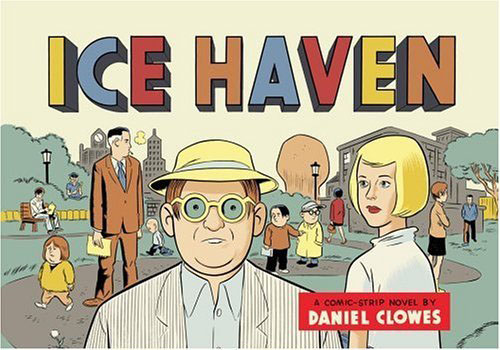
This weekend I spent a couple hours reading and re-reading "Ice haven" and "David Boring." The former is much more closely related in format to "Wilson," in that it's a  series of two-page stories focusing on a particular character from the town, with an artistic style particular to the character.  For example, Vida Van Der Platz is a teenager in the story, and her first appearance includes panels with love letters to her "Dear Penrod" and is titled "Seventeen."  A more baffling episode is the Blue Bunny sequence, evidently related to the thoughts of the toy blue rabbit owned by a child named George.


One thing that struck me after re-reading "Ice Haven" and "David Boring" in the same sitting was that the geologic formation in the center of the town of Ice Haven is the same shape as the hairdo of David Boring's ideal woman Wanda Kraml.  The rock appears throughout the book, including the cover, and this last page.


Compare it to this shot of Wanda's hair
 Is there something about this shape that Clowes has fixated on? Or, is it just too many re-readings on my part?  From what Clowes has said about Wally Gropius, and also from his "internal dialog" on comics via the character Harry Naybors, my guess is that it's not coincidence.

Even more curious is the fact that most of David Boring was drawn prior to 2000, and yet many of the girlfriends are perfect likenesses of Scarlett Johansson, but I'll leave that tangled thread until another time.


Enhanced by Zemanta

4/10/11

Tintin in Black and White - Part 2

 In an earlier post I mentioned that when Hergé published Tintin in color he revised his work, tweaking the pacing and creating more polished and skillfully told stories.  The example I gave was The Cigars of the Pharaoh, which was drawn from 1932 to 1934, and then redrawn in 1955 for color (the first English edition was 1971).  So, Hergé had over 20 years to consider this work and make a list of changes. But the first color editions made their way into publication during World War II, when Hergé was already well-known across France and beginning to enter the European market.  The earliest color editions were stories that had been printed in B&W only a couple years earlier.  This raises the question "What changes, if any, did he make on the war-era stories as they moved from B&W to color?"

The Crab with the Golden Claws was drawn (with several interruptions) during WWII, and was published in a black & white volume in 1941. With the color edition appearing in 1943, it was among the earliest of the editions to be reprinted.  It makes sense that this story would have fewer difference between the B&W and color editions, a comparison of the two shows some interesting differences.

It's tough to compare different editions, since it seems that tweaks are ongoing.  Other than the obvious change of translating the story from French into the local language (English, in my case), other changes that have been made are revised fonts, cropping of panels, and the addition of the hors-texte (full page wordless panels).  For this article I compared a reprint of the 1941 "Le Crabe Aux Pinces D'Or" with a mid-80's version of the color edition from Metheun / Magnet.

According to this article on Wikipedia, most of the changes made to the color edition were later, at the request of the American publisher:
"In the 1960s, the book was published in America with a number of changes. In the original, the sailor Tintin leaves bound and gagged in Captain Haddock's cabin, and the man who beats Haddock in the cellar, are black Africans. These were changed in the 1960s to a white sailor and an Arab due to objections by American publishers of having blacks and whites mixing together. [1] However, Haddock still refers to the man who beat him as a "Negro" in the English version. Also at the request of the Americans, scenes of Haddock drinking directly from the bottles of whisky on the lifeboat and the plane were taken out."In an interview, Hergé sarcastically stated that these moves were "justified" because "Everyone knows that Americans never drink whisky(!)" and "that there are no blacks in America(!)".

So, first let's look at the characters who are no longer black in the color editions.  When Capt. Haddock is captured by the smugglers he's tied up and beaten by one of the crew members.  Later the Captain escapes, and chases his tormentor down the street yelling "You have to arrest that Negro!"  In the color edition the man has been change to look more like a Spanish sailor, but the text still refers to him as a Negro.


Another character named Jumbo is also changed from black to pink.  The name "Jumbo" is a variation on a Swahili word that means "hello" or "chief." Also, the father from "Little Black Sambo" is named "Black Jumbo", so it seems that Herge meant for the character to be black.  The Tintinologist site has a color version of the black character from 1958, which reinforces the suggestion that the change was made for American markets.

A less striking change is that someone decided to remove the names of the cafes in the color editions.  Maybe this was just an overzealousness on the part of the translator.  But it seems to me that if your story is set in Paris and Morocco, both Francophone countries, it's acceptable for the cafes to have French names.

In the B&W edition, at the beginning of the book, when Tintin sees the Thom(p)sons on the street, it's at the "Cafe du Sport." Later, in Morocco, the Captain waits for Tintin at the "Cafe du Port."  In the color version both signs have been erased.  As a side note, I like the way the letters are shown backward, as if seen through the sign via the sun.


Another translation-related change is where "Au Secours" has been erased, but still shows over the window frame.


A more artistic revision is evident in the scene where Tintin and the Captain start out across the desert after their plane wreck.  In the original edition the handkerchiefs suddenly appear on the heads of Tintin and the Captain between the frames, as they also rapidly lose their coats.  The revised edition has them still in their coats, sans hats.  Then, the larger desert panel gives the space to suggest some time has passed, and shows them coat-less and wearing their handkerchiefs.


Another change requested by the American publisher is to omit panels where Captain Haddock has his lips to the whiskey bottle. The "Golden Claws" is the first time Tintin meets the Captain, and he's introduced as a drunken wretch whose alcoholic life has led to the point where he's working for smugglers.  So, it's especially odd to include all the other pages where the Captain is stumbling and rambling from intoxication, yet to decided to hide two simple panels of him actually drinking from a bottle.  Nevertheless, the change was made. In my opinion the edit neither helps nor hinders the story.


The final change is the one that has the most impact on the story: two sequences have been swapped for dramatic effect.  The B&W version starts with Tintin in disguise, on the trail of Mr. Allan, to see if he can find where the first mate is holding Captain Haddock.  Then, it has the humorous sequence where the Thom(p)sons accidentally stumble into a mosque.  In my opinion the color version works much better, showing the Thompson's antics for comedic effect, and then heightening the tension for the final acts of the story with a furtive chase through the alleys of the port city.


So, what does it all mean?

Well, for one thing it tells me that editors aren't omniscient.  It's significant that, while the American publishers were concerned about racial issues, they weren't concerned enough to pay attention to the character names, or how the characters are referred to in the story.  Also, if they meant to sanitize the story to avoid offending people with racial stereotypes, why weren't other questionable caricatures, such as the Japanese agent, and the Arab shopkeeper altered?


More significantly are the changes done, and not done to the plot.  The fact that most of the story and art is completely intact between the B&W edition and the color edition shows an artist at the height of his career, with the skill to render his imagination into a fully-realized world.  But the willingness to swap the sequences at the end of the story also indicates an artist who can recognize faults in his own work, and take steps to improve it.  The will to revise, coupled with the ability to render, is at heart the basis for most great artists.

I'd like to thank the Tintinologist.com site, who provided a great chart of the publication dates of the Tintin library.

Read Tintin in Black & White Part 1 - The Cigars of the Pharaoh. Also check out my review of Tintin in the Land of the Soviets.

3/18/11

Dear Comics Diary, 2010

Cover of "J. Edgar Hoover: A Graphic Biog...Cover of J. Edgar Hoover: A Graphic BiographyBetter late than never, here's my twitter diary of comics I read in 2010.
This list doesn't contain many of the single issue comics I read, just the compendiums and TPBs.

1/4/2010    Start the new year right with 'The Golden Age of DC Comics: 365 Days' by Les Daniels & Chip Kidd      
1/17/2010    "Reading ""Crisis on Infinite Earths"" compendium. ridiculously complete history of the creation"  
1/30/2010    "Iron Man vs Dr Doom... explosions, intrigue, Camelot and time travel. Should be great, but I'm just not that into it."       
1/30/2010    Read Hunter X Hunter #3 last night. Related to Battle Royale?
1/31/2010    Reading 2 vol. set of Humbug magazine. I <3 the annotations @ end. Exclnt companion to this. 2/4/2010    "Reading ""The Rough Guide to Graphic Novels"" Nice basic list of 60 graphic novels + discussion of  graphic novels
2/4/2010    "Read 'The Flash: Emergency Stop' last night. Fun story with ""The Suit."" Also the ""Speed Force"" uniform."
2/10/2010    "The ""Incal Noir"" by Moebius & Jodorowsky is one of the best sci-fi graphic novels IMHO"   
2/16/2010    "Reading 'Uncle Sam & the Freedom Fighters: Brave New World'. Good story, despite mutations. A luscious Phantom Woman."   
2/18/2010    "Just discovered Naoki Urasawa's ""20th Century Boys"" #manga series. I'm hooked"
2/18/2010    20th century boys...for some reason I want to relate this to Patrick McGoohan's The Prisoner. Why?      
2/18/2010    About to read Batman: R.I.P. by Grant Morrison       
2/18/2010    "I'm 1/2way thru ""Big Man Japan"". Mockumentary re: bygone days of monster fighters. sad,funny, odd #manga #japan"
2/20/2010    "The 2nd reading of Batman RIP makes more sense, but the story still has some odd gaps"   
2/20/2010    "You caught me looking at "The Devil's Panties Volume 2"    
2/20/2010    Kim Deitch is always a master. The art & story on 'Alias the Cat' enthrall me. Waldo is a devil!     
2/21/2010    "Finished "Big Man Japan" The ending confused the kids--they haven't seen enough old monster movies vis a vis Ultraman"   
2/24/2010    Nosing around TFAW in Milwaukie. Picked up the last copy they had of Stumptown #2. 2/25/2010    Reading comics w/the covers over my head: Countdown to Final Crisis. Mary Marvel just got powers back frm Black Adam      
3/5/2010    Blog post: Reviews of what I read in February
3/6/2010    "On Vol 4 of Naoki Urasawa's 20th Century Boys -- getting intense, building obstacles"
3/7/2010    Reading "J. Edgar Hoover: A Graphic Biography" by Rick Geary. 100 pg bio of the FBI "director for life."  
3/7/2010    Fact: In 1960 the FBI had only 5 black employees, all servants to the director.      
3/7/2010    Fact: in 1920 Hoover oversaw the detention of 6,328 immigrants as subversives. Only 1000 found ""guilty"" & none deported
3/7/2010    Geary's artwork on "Hoover" manages to be both utilitarian & occasionally impressionistic!    
3/7/2010    what would Kirk do? 'Goats The Corndog Imperative' by Jonathan Rosenberg   
3/11/2010    Reading "Diana prince:wonder woman" in Comics Journal #299."   
3/16/2010    picked up Green Lantern #47 at #eccc10. Convoluted story by John Broome, art by Gil Kane . Loved it.       
3/16/2010    I'd never read any of the "Pol Manning" GL stories
3/19/2010    BridgeCityComx Hey-o! Scott Pilgrim fans, listen up... the wait is over Vol. 6 is coming on July 20!
3/20/2010    Got this by Rucka & Lieber at #eccc10. Lieber said he was paid to stay away during film production
3/20/2010    Reading Stumptown #2 by Greg Rucka & Matt Southworth. Lots of #pdx scenery in the detective story       
3/20/2010    "Reading Siege #1. Allusions to Iraq intel, Oklahoma city bombing, religious right"       
3/20/2010    "Earlier I re-read Ellie Connelly ""preview"" --like a Victorian mystic tintin in america"    http://www.ellieconnelly.com
3/24/2010    Reading the "New Avengers, Vol. 1" by Brian Michael Bendis"
3/27/2010    Reading 'A Wrinkle in Time' to my 4th grader
3/27/2010    Finally reading 'The Bizarre Comics of Boody Rogers.' Seen 'em as a kid. Yes, they're still bizarre."
3/27/2010    Just read 'Avengers Disassembled.'
3/27/2010    Next up: 'Whiteout Vol. 1' by Rucka & Lieber. I just read why she killed her husband...sort of.
3/29/2010    The bizarre book of Boody Rogers   
3/31/2010    Still reading Naoki Urasawa's 20th Century Boys. Finished 5,6,7. Getting 8 & 9 next. How many volumes are there?"
3/31/2010    While I'm reading Naoki Urasawa's, I figured I'd also try his "Monster" Anyone hooked on that?"
4/1/2010    with Identity Crisis, Brad [Meltzer] was working out some serious personal issues heh."   
4/4/2010    Nice turn of the story by Gaiman on "Whatever Happened to the Caped Crusader?" Did not disappoint a tried & true fan
4/4/2010    Also liked addt'l material esp. "Pavane" & "Black & White World". All stories tended to be a bit talky."
4/12/2010    Avengers on the brain! "Secret Invasion" last night, Avengers, Vol. 2 tonight"
4/21/2010    Looking forward to the release of 'Wally Gropius' by Tim Hensley. Reminds me of European "BD"s like tintin"
4/23/2010    Get the 1st chapter of Sarah Oleksyk's story "Ivy" free. Sarah will be at stumptown comics fest #pdxcomics"  
5/18/2010    Read Yoshihiro Tatsumi's 'Black Blizzard'. Cinematic, I can see why he called it #gekiga, not #manga"
5/18/2010    Here's an excerpt from 'Black Blizzard'.
5/18/2010    gekiga -> manga is akin to Will Eisner calling his work 'graphic novels' as opposed to "comic books""    
5/20/2010    Surprised by "The Farewell Appearance of Daphne Dean in 'The Flash Archives Vol 4'. Thot I'd read all the early Flash"
5/2/2010    Reading Veitch's 'The Maximortal,' a twisted vision of a "real" superman incl. Einstein, Oppenheimer & a faux Disney
5/12/2010    Finished Deitch's 'Shadowland'. Holy crud! "DaVinci Code"? More like a "Dali Code"! Amazine story & art!
5/12/2010    Reading 'Shadowland'. One review on Amazon says "This is Deitch's DaVinci code.""   
5/14/2010    So, I started to read the #manga Old Boy. Vol 1 was intriguing. Maybe the female lead gets more believable    
5/23/2010    Reading Chris Ware's 'Jimmy Corrigan: The Smartest Kid on Earth'
6/1/2010    Looks good! RT: @comicinfo: As FEAR AGENT Ends, Writer Rick Remender Reveals Secrets"  
6/1/2010    Read 'Ghost World: Special Edition' last night. Good, but essentially GW + screenplay with some extras. 
6/1/2010    re-reading the comic makes me want to watch the movie again...'Ghost World'
6/1/2010    Also read 'Mercury' by Hope Larson. Good story. The art style grew on me as I read it.   
6/1/2010    Just read 'Brat Pack' by Rick Veitch --  definite talent for the gross & twisted. A mature tale of sidekicks gone bad
6/5/2010    Got 'Pluto: Urasawa x Tezuka' @ the library. Did not realize it was vol. 6. Great stuff    want to start from beginning
6/5/2010    I read 1/2 of 'Persepolis' today. Surprisingly full of insight & humor. The art is honest & clean
6/6/2010    Saw they've got "20th Century Boys" dvd out. I'll have to rent it at Movie Madness #manga
6/8/2010    Reading 'Tales of the Fear Agent'-- great! 2-4 page sci-fi/noir tales reminiscent of 50's EC comics, with a bite."
6/13/2010    Reading 'Nightwing & Flamebird Vol. 1' by Greg Rucka, looking forward to vol 2."    http://amzn.to/dy1WtJ 
6/16/2010    Cool! Another Portland comic. I've been reading Stumptown #pdxcomics
6/17/2010    Yes! reading 'Naoki Urasawa's 20th Century Boys, Vol. 8' tonight for bedtime."   
6/17/2010    Also, if I stay awake long enough: 'Pluto: Urasawa x Tezuka, Vol. 1'. Start from the beginning this time"
6/18/2010    'Carl Barks: Conversations' is a fun, occasionally repetitive set of interviews w/Barks. Great to hear his perspective" 
6/18/2010    'Carl Barks: Unmasking the Myth of Modernity' is a bit heavier, but still good bio. I preferred 'Conversations'
6/21/2010    Dan Clowes says 'Wally Gropius' is his "favorite book of the year by a wide margin..." I'm gonna buy it
6/21/2010    If you love Archie comics, prepare to be shocked by 'The Pin-Up Art of Dan DeCarlo'. Scandalous! (tee hee)
6/23/2010    on the nightstand: 'Hopeless Savages Volume 2' by @Hopelessjen and Bryan Lee O'Malley.   
6/25/2010    Read 'Pluto:Urasawa x Tezuka Vol 3'. 8 vol. series is a retelling of "Greatest Robot on Earth"   
6/25/2010    Interesting the way Urasawa re-imagines the story- art more "realistic" vs Tezuka's almost iconic style."  
6/27/2010    Reading 'Haunted' by Philippe Dupuy. compelling scribbles, dredging up funny, dreamlike stories. running themes
6/27/2010    Haunted's running = pun (ow!) recurring plot of running, & themes that reappear. pits, art, dogs, guts, gaps, & forest friends
6/30/2010    Started 'Invincible Iron Man Omnibus Vol. 1' by Matt Fraction last night. Good bio-terror/Iron man/Stane plot
7/7/2010    Boing boing mentioned 'Basil Wolverton's Culture Corner' today. Great stuff!
7/20/2010    'Werewolves of Montpellier' looks good. I'll have to check it out.
7/30/2010    Sir, I am a poet. (Drew Weing's "Set to Sea")"   
8/1/2010    Jean Craighead George = great kid eco-writer. 'Who Really Killed Cock Robin?' = one of my favorite 5th grade books
8/9/2010    Summer reading? Try 'Consider Phlebas' by Iain Banks. Episodic like Star Trek, yet 'way more graphic.
8/9/2010    'The Atrocity Archives' by Charles Stross is what happens when the "IT crowd" meets Cthulu.
8/9/2010    'The Jennifer Morgue' was more cohesive than "Atrocity Archives". If Ian Fleming played D&D..."
8/13/2010    Reading 'Naoki Urasawa's Monster #1'. Bit melodramatic, but not what I expected. Surgeon tracks a psycho killer
8/13/2010    'Temperance' sounds like a graphic novel spawn in the vein of philip dick.
8/14/2010    read 'Werewolves of Montpellier' last night. Clean art, laconic style, sparse dialog, nice story.
8/14/2010    1 reservation re:'Werewolves': the stylistic characters (crows, dogs, bunnies) all looked too similar
8/14/2010    Now I want to read more by Jason: 'I Killed Adolf Hitler': assassin goes back in time, Hitler steals time machine.
8/14/2010    More Jason 'The Left Bank Gang': Cartoonists Hemingway, Pound, Fitzgerald & Joyce struggle in Paris
8/25/2010    Everybody Is Stupid Except for Me. I still want this
8/26/2010    Read 'The Left Bank Gang' last night. Hemingway, Fitzgerald & Pound as starving cartoonists in 20's Paris, w/a twist
8/26/2010    Also started 'X-Men: Kitty Pryde and Wolverine'. Can't believe I've never read this story
9/2/2010    Note to self: Read 'The Best American Comics Criticism' 2010.
9/3/2010    Action is character. F Scott Fitz. shoulda been writing comics. An alternative: Jason's "Left Bank Gang"
9/8/2010    @GNReporter talks w/Cathy Malkasian re: Temperance. If you like allegory (eg Narnia Chronicles) you might like this 
9/9/2010    Reading 'Petey & Pussy'. Crazy foul-mouthed cat & dog w/bald men heads have adventures. Weird!
9/10/2010    I've been reading quite a bit of Jason lately. Would you say he's of the Franco-Belgian school? 
9/11/2010    My reviews of "I Killed Hitler", "Left Bank Gang" and "Werewolves of Montpellier".
9/13/2010    Peter Bagge's Everybody Is Stupid Except for Me = funny+thoughtful. I eschew Libertarian politics but he has some great points
9/25/2010    Amazon says 'X'ed Out' by Charles Burns will be out in October. Anyone read an early review copy? Looks good
9/26/2010    'The Last Musketeer' is a cartoon movie serial, mixing 3 musketeers, robots & alien invasions, yet still chivalrous
9/26/2010    I found 'You Can't Get There From Here' the least engaging. Frankenstein & monster have girl troubles.
9/26/2010    'Tell Me Something', similar to "Living & Dead", minus the zombies, plus thieves. Somehow more engaging."
9/26/2010    'Meow, Baby!' Jason strip & short gag stories w/mummies, skeletons, zombies & angels. In vein of laconic Gary Larson"
9/26/2010    'Almost Silent' by Jason collects "Meow, Baby" "Tell Me Something" "You Can't Get there..." & "The Living & The Dead"
9/26/2010    'Pocket Full of Rain' is Jason's "origin story." Collected from "Mjau Mjau" magazine, interesting in its unevenness."
9/26/2010    If you like silent films, romance flicks, or zombie movies, check out 'The Living and the Dead'. A sweet tale."    
9/26/2010    Bits of weekend were filled with Jason's blank-eyed dog/crow people. After 3 books (see link) wanted to fill the set...    
9/26/2010    'Hey, Wait...' is Jason's "A Separate Peace" carried through to the end.
10/1/2010    Been reading Rucka's 'Queen & Country Vol. 1'. Tight spy action in vein of Le Carre, but with strong female character. 
10/1/2010    Now 'Queen & Country Vol 2' I'm liking Carla Speed McNeil's rendition of characters. None of the art pulls any punches 
10/2/2010    Some comics I'm a total sucker for. eg: 'Tom Strong' is Doc Savage re-imagined w/a polyethnic/species cast  
10/2/2010    Also Peter Bagge's 'Apocalypse Nerd'. Gotta love it 'cause he takes pot-shots at everyone, an epic Hate-fest
10/8/2010    Underground, by Jeff Parker & Steve Lieber, mentioned on BoingBoing today    
10/13/2010    Anyone disillusioned w/voting this fall _must_ read 'Citizen Vince'. Gangsters v Pols in this Reagan era novel     
10/23/2010    Reading 'Ocean' by Warren Ellis. Cool hard-tech solar system space thriller.  
10/29/2010    Steve Lieber & Jeff Parker's "Underground" in glorious black & white."    
11/16/2010    Getting 'The Freak Brothers Omnibus' for my birthday. Of all the drug-culture #comix, these guys are the funniest   
11/16/2010    Also got 'Best American Comics Criticism'. Interesting love/HATE piece on Spider-man by Peter Bagge, & other essays
11/17/2010    The Freak Brothers showed up on my doorstep today    
11/25/2010    Lying in bed reading the 'The Freak Brothers Omnibus'   
12/4/2010    Reading Greg Rucka's "Queen & Country vol 3." Then going to get an x-mas tree  
12/4/2010    Later... I'll pick up Naoki Urasawa's "20th Century Boys, Vol. 11". The twists & turns of the story are compelling
12/14/2010    Reading '3 Story: The Secret History of the Giant Man.' a 3-sided tale of a poor giant hired by the CIA in the 60's.   
12/14/2010    Naoki Urasawa's '20th Century Boys' is still compelling @ vol 11. How many more? Some twists in this one!
12/15/2010    Some musings on "3 Story: The Secret History of the Giant Man" #graphicnovels #comics"    
12/20/2010    Reading 'CHEW Vol. 1.' Mix of humor, sci-fi, "men in black" & cannibalism (mostly humor). Hard for some to stomach?
12/20/2010    Also on my "to read" pile: Chester Brown's "Louis Riel: A Comic-Strip Biography" Looks great!"    
12/29/2010    Jason's "dead mickey"
Enhanced by Zemanta