9/13/09

"The Beats: A Graphic History" by Ed Piskor and Harvey Pekar


When I met William S Burroughs during a reading at Powell's books in Portland circa 1995 he was an old, hunched-over man, hardly distinctive except for the entourage and reverence that followed him. Reading "The Beats: A Graphic History" gives a completely different view of Burroughs. Harvey Pekar's script and Ed Piskor's clean black and white art distill the man's life into a series of marginal, crazy and often violent episodes, including a drunken "William Tell" stunt that ended with his wife's death and jail time for Burroughs. The sparse script hits all the key points that explain why Burroughs is now firmly ingrained in popular and literary culture.

"The Beats" is split into two sections. The first 100 pages focus on the trinity of Jack Kerouac, Allen Ginsberg and Burroughs and is cleanly written and drawn by Pekar and Piskor. Together the three segments on these three icons of the Beat writers cover the length and breadth, highs and lows of their lives with surprising clarity and brevity. Pekar lays out Kerouac's pinball lifestyle, Burroughs' self-destructive line-drive, and Ginsberg's ever-expanding drive for everyone to get along and love each other. The clean black and white drawings of Piskor remind me of a religious tract a la Chick publications or an anti-drug comic, warning you what will happen to your soul if you become a Beat poet.

The second part, called "The Beats: Perspectives" includes details on the San Francisco poetry renaissance, Lawrence Ferlenghetti, Gregory Corso, Gary Snyder, Ken Kesey, Beatnik Chicks, and other lesser known Beat figures such as Ken Rexroth. In the second section Pekar & Pisko still contribute quite a bit of work, but they also step aside for other writers and artists such as Nancy J. Peters, Trina Robbins, and others. I especially enjoyed the counter-point to the counter-culture in the essay "Beatnik Chicks" by Joyce Brabner and Summer McClinton. I was also captured by the Tuli Kupferberg segment drawn by Jeffrey Lewis in a Crumb-like style.

The essays also have the ability to condense and shift time in a way that makes it easier to gain perspective. I had never really thought of Kerouac as a product of WWII, but the concise biography helped. Another significant event was October 7, 1955 -- the "big bang" of Beatniks. Known as "The Six Gallery Reading," it brought together the East and West Coast factions of the Beat Generation and was also the first public reading of Ginberg's "Howl". All the essays in the book hover around this day in a Rashomon-like manner. And finally another important year mentioned in "The Beats" is 1961, the "upside down year." It's the same year when read upside down, but it's also the year teenagers began to have more influence than their parents. It's also the year that Beatniks invaded popular culture in the form of Maynard from "Dobie Gillis," or Buz from "Route 66".

In my opinion "The Beats" should be required reading for any high-school or college student who's been assigned to read the works of these authors. I've read "On The Road," "Junkie," and "Howl," along with other books from the canon ("Subterraneans", "Naked Lunch", the list goes on...) but as semi-autobiographical as their works may be, the lens is still screwed up by their own visions. It takes someone as cynical and bitter as Pekar to lay out the facts panel by panel, including Kerouac's middle-class aspirations to buy his mom a house and reject his radical younger days right next to a panel describing his gaining popularity. He also contrasts Ginsberg's failure to address violence at the Naropa school (co-founded by Ginsberg) with his ant-war protests. Never one to shy from being "drawn out" (pun intended) Pekar occasionally includes himself and his own comments in the narrative.

After I read "The Beats" I had a new inspiration to re-read "On The Road" and the other books and poems mentioned in the essays. It's an inspiring book -- give it a try!


Reblog this post [with Zemanta]

9/6/09

Life During Wartime: Comic Ads 1943

These two ads are the outside and inside covers to Captain Marvel Adventures #28 from 1943. Since they're from during WWII, it's not unusual they mention the war, but I was struck by the difference in attitudes & advertising regarding the war in the 40's and the current conflicts in Iraq and Afghanistan.

For example, the X-acto Knives proclaim: "Help Uncle Sam - Make official Plane Models". I have no idea how making plane models helped the US war effort, but they explain how you can use your X-acto Knives to start building for Uncle Sam right away. The cartoon shows one kid saying "I want to make Navy models too. I'll ask Dad for a set (of knives)." Dad, being patriotic completely agrees: "Sure, son, here's the money. You're serving Uncle Sam right now!" They also have an offer for a booklet: "How to Build Scale Models - Defense" which claims to be "profusely illustrated. Chuck full of information."

Try indoctrinating school-age kids into fighting the war nowadays and see how far that'll fly. "Hey, kids! Learn how to differentiate between Al Qaida and Al-Shabab" (Hmmm, I don't see it).


The war also invaded Christmas Card sales. This ad asks kids to sell cards and get "swell prizes." The set of toys you can get includes a U.S. Army outfit with "a snappy officer's belt and cap outfit with an automatic-type pistol". Also an "American Craft So. Cal Raider" machine gun that "...operates on a swivel or dismounted, like army guns." There's the "pre-flight training set - exactly like regular airplane cockpit...gunsight and cannon trigger too." Other prizes include War Games and an Army Suit alongside more traditional prizes such as the "Old Spice" Toilet Kit and a Gene Autry Guitar.


Reblog this post [with Zemanta]

Captain Marvel Adventures #28 (October 1943)

Excalibur Comics had a 1/2 price sale this weekend, and I picked up a ragged copy of Captain Marvel Adventures #28 from October, 1943 on the cheap. It's in poor condition, but readable and quite a bit of fun.

This issue is a time capsule in itself. It's hard to believe CMA was more popular than Superman, but even in 1943 they boast right on the front cover: "Largest Circulation of Any Comic Magazine." The war-time Capt. Marvel stories had a certain cachet to them: he fought against the Nazis, the stories often included actual locales and real public figures, and they still had a sense of humor to them. In this issue Hitler sends a cadre of Nazi agents to San Francisco where a mysterious character called the Fog Phantom helps them to take over the city and establish a base at Coit Tower.

The real people in the story include mayor Joseph Rossi, KPO radio announcer Archie Presby, and columnist Prescott Sullivan from the SF Examiner.

Also, the locations include Alcatraz Prison, Coit Tower, Chinatown, even the Smith Wholesale office, who apparently distributed Fawcett comics in SF in the 40's. Note the Capt. Marvel posters in the background of the distribution office.

Since the comic came out smack in the midst of WWII, it's hard not to notice that everything in this issue shows the mentality of the times. Hitler appears in two of the stories. Also the masthead shows that Eleanor B. Roosevelt (past president of the Girl Scouts council for New York) and Rear Admiral Richard E Byrd are on the Editorial Advisory Board. Of course C.C. Beck is the "Chief Artist," but it doesn't say who wrote the stories. They contain so much open propaganda I wonder if the writer was in earnest, or was the patriotic content dictated by a higher authority? Anyone know?

Even the inside front cover advertises a book "Fun for Boys" which includes topics such as Spotting Planes to recognize enemy vs friendly planes and how to protecting yourself with Jiu Jitsu, just like the Marines, Soldiers and G-Men do!

This issue also includes Chapter VII of the serial popularly called "The Monster Society of Evil." In this chapter, "The Lost Sunrise," Mr. Mind wants to stop the Earth's revolution, giving Nazi Germany eternal sunlight while leaving America in the dark. Mr. Mind first meets the Nazis as he falls into a shipment of black market meat while escaping from the Big Red Cheese. The meat is shipped to Herman Goering, who brings the worm to Hitler, and together the three evil-doers plot to destroy America. Capt. Marvel foils the plot but in the process has to let Mr. Mind and Hitler escape.


Reblog this post [with Zemanta]

9/5/09

"Asterios Polyp" by David Mazzuchelli

What three things would you grab if your house were burning and you had to leave immediately? That's the question posed, both real and theoretically, to Asterios Polyp, the title character of David Mazzuchelli's new graphic novel. This question poses more of a problem for Asterios than for most people because he prefers to use dichotomy to structure his life, dividing everything cleanly into two opposing pieces. He proceeds to chop his world into pieces until he meets a woman named Hana, who is more comfortable with uncertainty and shades of gray. She's the one that asks him the question hypothetically, and it's clearly in his head at the beginning of the book as we watch lightning strike and burn down his New York apartment. But even Occam's razor can't explain why he eventually gives away the three items he's rescued from the burning building. For that answer you have to read the book.

The book is narrated by Asterios' twin Ignatz, who died in childbirth. He tells the story of Asterios, an over-educated architect who has never designed anything actually built, and who teaches college and moves through life with a purpose, but without direction. He constructs rules for dealing with life and quotes them to his students as if they were the bible. As his star is rising he meets a sculptor and artist named Hana, who appreciates and loves his world, but also brings fuzziness to his life, complicating things.

For some reason as I read the story the word 'erudite' kept popping into my head ("characterized by learning"). Asterios is someone who's interesting to be with because he makes you feel smart. At least until he uses his analytical mind on you, at which point the dissection can become uncomfortable, but makes for compelling reading. Mazzuchelli isn't afraid to take side trips while telling the story, and I appreciated that. It reinforces theme: here's an intelligent guy, but he still has a lot to learn. This is reflected in a scene with one character who pontificates that after the 60's the goverment realized that an educated people were too hard to govern, so that why they've cut school funding for the past 30 years. There are also numerous allusions to the question of God vs gods vs free will; what makes a relationship work (the answer is shown with 3 beer coasters); and even a retelling of the Orpheus legend.

To enrich his storytelling efforts Mazzuchelli throws in tons of literal and graphical puns. The character's name, for example: Asterios, meaning a star, perhaps the star of the book and his life. But then adds 'polyp' to the name: an abnormal growth of tissue projecting from a mucous membrane, reflecting Asterios' feelings that he should have died instead of Ignatz.

Another example is that the story is illustrated in monochrome shades of primary colors. The flashbacks are blue when it's Asterios alone, and red when they include Hana, while the present-day story is told in shades of yellow. As the story concludes, and moves into the immediate present it suddenly combines the three colors, bringing both the narrative and the color scheme into harmony. Similarly he draws Asterios with strong, bold outlines, often including his ghostly brother as a dotted line, while Hana and her life is sketched in uncertainty. I especially liked the mysterious spotlight that comes and goes out of frame in synch with Hana's self-esteem.

If I had one complaint about the story, it's that the resolution felt hurried, and the final pages throw in a curveball that feels like a beanball. I would have preferred an ending that stretched out the resolution by another 20 or 30 pages, maybe adding some internal hurdles for Asterios to leap. And while the final page isn't completely out of the blue, it was too contrived for me. Just let me say that they lived happily ever after.

My 12 year-old son read the book as well, and his comment was: "Ok, a bit heavy on the philosophizin' and art theory." I'd put the book down as a PG-13 rating. The graphics and story are great, as well as the printing. This book has been on everyone's top 10 list for 2009 graphic novels, and I'd say it's a good bet it will stay there. Mazzuchelli's previous work City of Glass (with writer Paul Karasik) was chosen as the quintessential New York graphic novel. You can buy this book online at Amazon through the links below, or at Powell's Books.


Reblog this post [with Zemanta]

9/2/09

Astro Boy Movie trailer now online


The trailer for the new Astro Boy movie is online. It looks a lot better than the disappointing four-issue movie prequel from IDW Publishing. The animation is in the same vein as Jimmy Neutron, although it looks less annoying, more aesthetically pleasing. The movie comes out 10/23/09.

From the trailer it looks like they tried to continue with the themes Osamu Tezuka's often addressed in the original Astro Boy manga, questions such as: "What makes us human?", "Where is the soul?" and whether the human race can reconcile differences and live in harmony rather than continually fight for power and control over others?
When I was a kid I only got a small glimpse into the Astro Boy world because most of the stories had never been translated, but thanks to Dark Horse Comics you can now get the full suite of Tezuka's books in English.
Purchase them online at Amazon.com, or Powell's books.


Reblog this post [with Zemanta]

8/20/09

"A History of Violence" by John Wagner and Vince Locke


I just read "A History Of Violence". Cripes it's gripping! I'd seen ads for the movie with Viggo Mortensen, but wasn't that intrigued. Then I saw the book at the local library and consumed it standing up in less than an hour. I was shaky with adrenaline by the last page.

The art is sketchy, and sometimes some of the characters look the same, but the writing and dialog is distinctive, and the subject matter gripping. A man who's escaped his past of organized crime stops a robbery at work. His heroic actions attract the mob's attentions, and he and his family are threatened.

The last time I felt this was about a story was when I sat in the first row at "Goodfellas," and drank a 32oz Coke on an empty stomach. Read the graphic novel and get jazzed! (Buy it online at Powell's books.)


Reblog this post [with Zemanta]

7/9/09

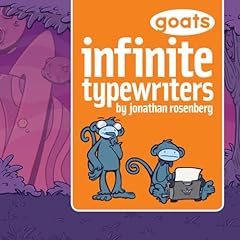
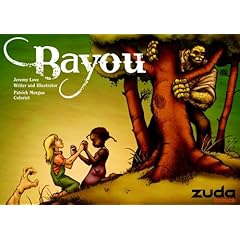
"Infinite Typewriters" by Jonathan Rosenberg, "Bayou" by Jeremy Love

Last spring at Stumptown Comics Fest Jeff Parker of Marvel Comics wondered whether weekly print comics would continue in the future. He theorized that monthlies will eventually be entirely online, and the only tangible printings will be TPBs or anthologies. While I haven't seen mainstream comics changing to weekly web versions, I notice that two of the notable Graphic Novels from 2009 are exactly this: web comics compiled and printed by larger publishers.


Goats: Infinite Typewriters by Jonathan Rosenberg is a nicely bound paperback printing of a couple hundred of the webcomics. It's the first in a trilogy, followed by The Corndog Imperative and The Showcase Showdown. While it's a collection of strips, they fit nicely together to tell ongoing stories of the origin of Diablo the Satanic chicken, his Machiavellian offspring Oliver, and other various humans, aliens and semi-intelligent animals. The plots usually involve God, Satan, Robert Goulet and some (cartoon) violence and (real) swearing. I'd have to say there was a laugh in every comic, which is a lot better record than anything printed in the newspapers today. My 12-year-old son, however, told me that Goats is not appropriate for younger kids, and while he meant his younger brother, I'd say that any adult should read it before giving Goats to a kid younger than 17.


Bayou , on the other hand, is a book that Tweens should read. As Publisher's Weekly sums up:
Bayou follows a young African-American girl in 1930’s segregated Mississippi, who sets off on an adventure in a fantastical South to save her father, who is wrongly accused of a crime.

The crime is suspected kidnapping of Lee's young white friend Lily, and we see from Lee's point of view that the girl was eaten by a fantastical monster called Cotton-eye Joe.

Bayou has many great qualities. First, there's the art, which translates well to both the web and the page. The drawing are simple, without being cartoony -- unless it's called for by the story. The colors are well used to support the characters emotions and settings.

Then, there's the story itself. Love deals with the events frankly, whether it's looking for a dead boy in the swamp, killing a chicken for dinner, or two friends enjoying time together in a field. He weaves in the issues of racism and poverty without being preachy. The characters feel authentic.

And finally, the best part of Bayou is seeing the story from Lee's point of view. We don't know for sure whether the monsters of Bayou and Cotton-eye Joe are real or not, but they're real to her. When she sees sprites under the swampwater she can't believe her eyes, but because it's coming from this young girl it helps us believe them all the more.

Bayou is the first Zuda webcomic to make it to print and DC plans to release more print versions of original Zuda webcomics later this year.

You can read the webcomic here, or buy the Bayou paperback from Amazon.


Reblog this post [with Zemanta]

6/10/09

"Moomin Book One: The Complete Tove Jansson" by Tove Jansson

In fifth grade I discovered the Finn Family Moomintroll books. By Finnish author Tove Jansson, these books tell odd stories about human-sized hippo-like characters who experience magic and nature in a world slightly like ours. Or, maybe more like Finland of the 30s and 40s. From the happy-go-lucky episodes of the "Finn Family Moomintroll," to the alluring private adventures Moomin experiences in the "Moominland Midwinter," to the surreal and almost frightening epic of the "Comet in Moominland," I was enraptured by the stories. I must have re-read each book at least three times, spending hours one summer in the hammock, while immersed in the frigid tale of the squirrel with the bushy tale who froze to death (or not!?). I couldn't get enough of the characters, and I was amazed both by how many people I met had never heard of the Moomintrolls, and also whenever I found an artifact from the world of Tove Jansson.

So, imagine my surprise when I was at Powell's books a couple years ago and saw "Moomin Book One: The Complete Tove Jansson Comic Strip." I bought it for my kids (yeah, sure) but read it myself. How could these comics have never crossed my path until published by Drawn & Quarterly Press in 2006? According two the description on Powell's website:
"Tove Jansson is revered around the world as one of the foremost children's authors of the twentieth century for her illustrated chapter books regarding the magical worlds of her creation, the Moomins. The Moomins saw life in many forms but debuted to its biggest audience ever on the pages of the world's largest newspaper, the London Evening News, in 1954. The strip was syndicated in newspapers around the world with millions of readers in forty countries. Moomin Book One is the first volume of Drawn & Quarterly's publishing plan to reprint the entire strip drawn by Jansson before she handed over the reins to her brother Lars in 1960. This is the first time the strip will be published in any form in North America and will deservedly place Jansson among the international cartooning greats of the last century."
The strips have a funny revisionist quality, sort of like the Superman stories in the Sunday comics in the 40's. The characters and the drawings are the same, but the situations are different from the "real world," and the strips don't attempt to achieve a storyline like the novels. Instead they follow the antics of the Moomins as they deal with situations like a new maid, or how they react to living in a hotel on the Riviera (apparently the Moomins have been doing all right for themselves!). But, both people who are well-versed with the Finn Family Moomintrolls, and new readers will like the stories, although the comics are really only a gateway to the best stuff: the books.

When I bought the book I only saw "The Complete Tove Jansson Comic Strip." When I finished reading the strips I closed the book and gazed at the cover for a moment before I realized it also said: "Book One." How many more strips are there? Well, the people at Drawn & Quarterly are releasing "Book Four" in June 2009, and I hope there are many more. Click here to see a preview of "The Complete Tove Jansson Comic Strip Book Four." (Oh, and click here for a preview of another Tove Jansson book, "The Book About Moomin, Mymble and Little My.")


Reblog this post [with Zemanta]