3/9/11

Black Terror in Exciting Comics #61

In 1948 superheroes were losing their popularity, and comic fans were shifting their interests toward gangsters, teen and romance stories, and Westerns.  Exciting Comics #61 from May, 1948 is a microcosm of that sentiment.  Previously the Black Terror dominated the cover of this series, but in 1948 the covers feature mostly Judy of the Jungle. A few issues later, with Exciting Comics #67, the format drops superheroes entirely and changes to a Western comic, then ends its run.

The contents of comic reflect the publisher's confusion. Inside is an 8-page Judy of the Jungle story "The Deadly Triangle" by Ralph Mayo, this 10-page Black Terr story "The Deadly Choice" with art by Mort Lawrence, a three-page text story called "King of the Chimpanzees" by Charles S Strong and masthead art by Ralph Mayo, a one-pager gag called Zippy by Al Hartley, an eight-page Roger Dodger story by Art Gates,  a story with Rick Howard, the Mystery Rider by a mystery artist, a 2-page "how-to" called Junior Judo, subtitled "Another Real Lesson in Judo" by and the last story is the last appearance ever of Strut Simmons in a 7-page story by Ed Good.


A side note about Mort Lawrence, who probably drew this Black Terror story. He is best known for his work on Atlas Comics' Young Men series (1953–1954) which reintroduced Captain America and Bucky as communist hunting super-heroes.  He does a respectable job on this story, and I especially like the final two panels.  You can see more of Lawrence's work here.


Here's the summary of "The Deadly Choice":  A crime boss named Torch is released after five years of jail time and, despite the pleas from his girlfriend Candy, is determined to get his revenge on the D.A. who put him away.  He hears the D.A.'s little girl has a rare disease called Cardocomitis, and plans to steal the girl's medicine. Fortunately for the D.A. and his daughter, pharmacist Bob Benton (aka The Black Terror), and his assistant Tim (aka Tim), are delivering the Cardocin medicine.

The thugs break in and grab the medicine. To avoid further danger to the DA and his daughter Bob and Tim let the thieves go, but as soon as they're clear the Terror Twins burst into action. I love the panel where they're crashing through the D.A.'s front door. This is the panel that shows of their powers the most, unfortunately they aren't in costume.

The thugs get away, and Bob decides to run an ad in the paper offering $10,000 to anyone who can provide some Cardomicin serum. Time is short, the girl can't last more than 3 days without her medicine, but luckily Torch answers the ad. For the meeting with the crime boss, Bob and Tim pose as an aging industrialist and his wife and pay a visit to the gangsters.

A fight ensues (still not in costume) and in the confusion Candy grabs the medicine in an effort to take it to the D.A.'s daughter.  The chase ends up at the railroad yards where Torch tries to shoot his girlfriend. Candy pulls her own gun. "Don't make me do it, Torch," she says. "Ugh! I didn't thing you'd..." he replies.

The final two panels are my favorite in the story: "It'll be hard for a while, Candy-- but you'll forget." Says the Black Terror to Candy."Some day you'll be able to live the kind of life you really want."
"And you saved a kid's life..." adds Tim.

Reflecting the movement away from superheroes, this story is also a microcosm of the passage from superheroes in the 40's to the gangster comics in the 50's.The Terror Twins are hardly ever in costume, and show almost none of their powers. Except for the pharmacist angle, this story could have had Mickey Spillane characters rather than superheroes.

There's an emphasis on gangster dialogue, so much that it's almost annoying.  Note the 6th panel of the 2nd page where the thug says "r-e-e-t" or during the fight scene on page 6 "pardon my boardin' house reach, toots!"

Unlike the earlier Black Terror stories, Jean is nowhere to be found. The leading lady is clearly Candy. She's drawn as if draped over the page, sultry, bad, yet trying so hard to be good.

I thought the caricatures were much more pronounced in these stories, almost in the style of Will Eisner or Jack Cole.  Take, for example, The Torch's right-hand man Snake.  Also, the artist took seemed to have a lot of fun drawing Candy throughout the story, and also the scenes when Bob and Tim are posing as the industrialist and his wife.  Note, too, the curve of the car as it moves across the traintracks in the 3rd to last page.


Atmostpheric - Amazing Fantasy #15 sells for $1.1 million

ComicConnect.com sold a copy of the first appearance of Spider-Man, Amazing Fantasy #15, for $1.1 million.  According to Time Magazine that beats an auction of "Detective Comics #27, Batman's first appearance from 1939, to become the second most expensive comic ever sold (Suitably, Superman's first appearance in 1938's Action Comics #1 remains in first place; a copy sold last year for $1.5 million)."

Comics A.M. quotes the CEO of ComicConnect.com on the sale. “The fact that a 1962 comic has sold for $1.1 million is a bit of a record-shattering event," says Stephen Fishler, "That something that recent can sell for that much and be that valuable is awe-inspiring.”

Last weekend at the Emerald City Comic-Con in Seattle a vendor had 5 of these in sealed CGC protectors. I was drooling over them, but didn't bother to ask the price.  My son, however, was more interested in the Scott Pilgrim T-shirt he'd just bought.  I can't help but wonder where to draw the line between fine art, nostalgia, madness and imagination.  In this case are we seeing people who grew up with Spider-Man amassing enough money to purchase back their childhood?  
 
I'm reminded of one time I was at my local comic book store Excalibur Comics in Portland. They had a copy of Amazing Fantasy for sale in the neighborhood of $500. A patron, who was a mechanic for the import garage from down the street, was calculating how many cars he'd have to fix to cover the cost of the comic (answer: 3).

Condition is everything when it comes to these types of prices, and it comes down to an ephemerality which borders on something closer to religious faith, or homeopathy.  In contrast to the $1.1 million version of the comic, you can buy a Very Fine copy of Amazing Fantasy today from the same place that had the auction for only $160,000.  These buyers, however, are pushing into the Wall Street investment area. Personally, I prefer to read my comics.

Incidentally, the one in the picture from the Time Magazine article (which I've shown above) is probably not the one that sold for $1.1 million. There's too much "Marvel chipping" on the picture.
Enhanced by Zemanta

2/23/11

Black Terror #11 - Part 2 "The Discovery"

Although it doesn't have an obvious title, I've seen this story called "The Discovery".

This, and the 1-page text story "Peruvian Boy" by William B McClellan comic reflect FDR's "Good Neighbor Policy" and the US's focus on South America during WWII. In a way the clinical description of the geography of Chile has the feel of Disney's animated movies of the time, "Saludos Amigos" (1942) and "The Three Caballeros" (1944). Either that, or Nedor publications was just trying to ride on the coat-tails of an exotic location that had worked its way into popular culture.
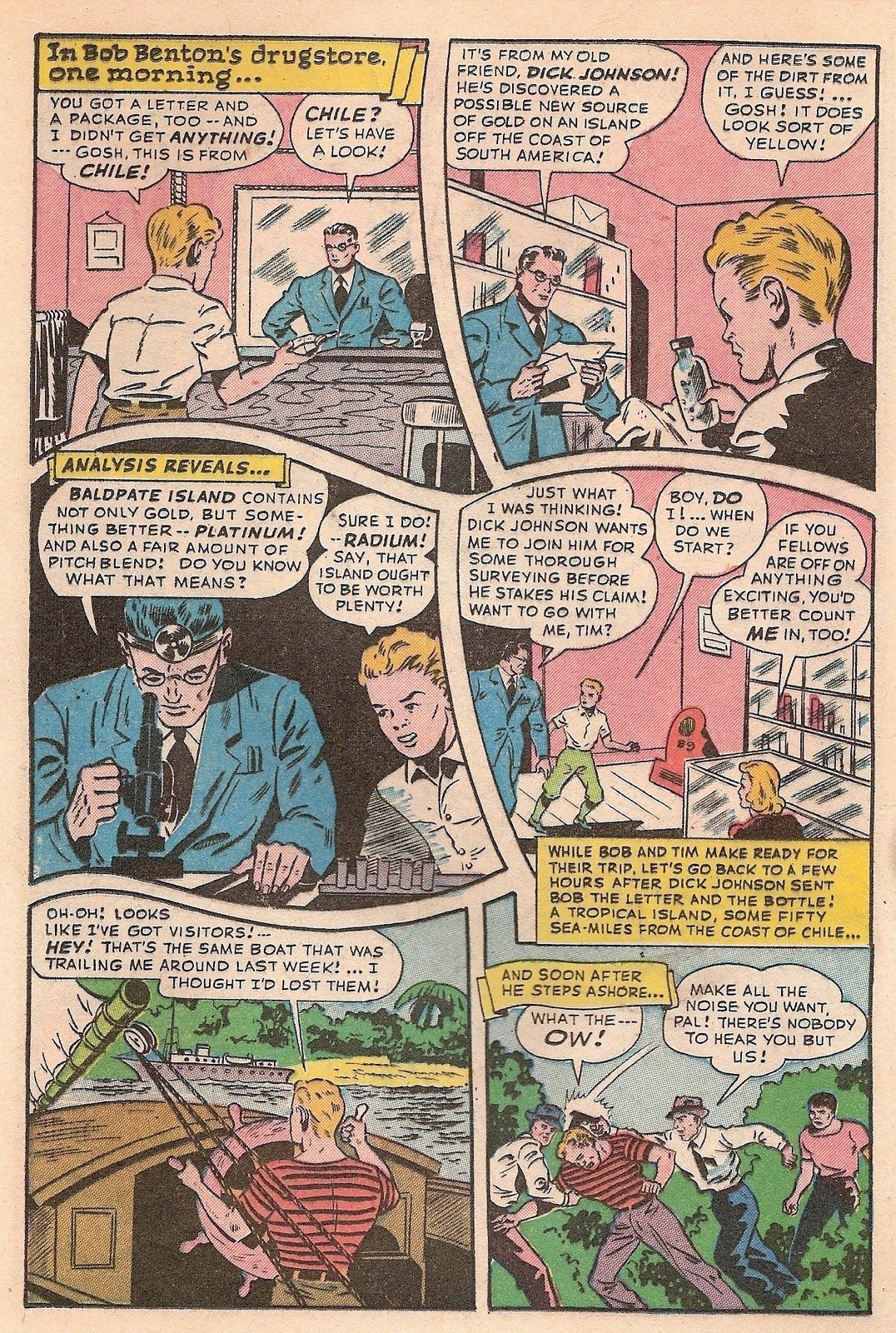
The plot of this Black Terror story nearly parallels "Black Terror vs the Voice." Bob Benton gets a letter from an old friend, Dick Johnson, who has discovered a new source of gold on an island off the coast of South America. An analysis of the sample included with the letter shows it's not only rich in gold, but also platinum, and pitchblend which indicates the presence of radium.  Bob decides to visit his friend, and just as he's inviting Tim along, Jean shows up and horns her way into the adventure.

Meanwhile Roger Chilling, the man who killed Dick's father, has his gang attack Dick, drive off his dog Thor, and bury the miner in the ground up to his neck.

Another "...meanwhile" and we discover the plane carrying Bob, Tim and Jean over the equator is being hijacked. The air pirates bring the plane down on an uncharted island, ruin the engine and leave in their own floatplane, stranding our heroes along with the rest of the air passengers. Luckily Tim and Bob jump into a nearby thicket and become the Terror Twins. They use their superhuman strength to create a rope bridge to the mainland, saving all the plane's passengers.

On the mainland they discover it's still a three-day trip by boat to Salvator Chile, so they commandeer a dugout and take Jean on the canoe ride of her life. From Salvator they're given a plane to fly to Baldpate Island.

Hearing the plane, Roger Chilling and his thugs run for their hideout. Luckily for Dick, Thor leads the Terror Twins straight to his master. The Black Terror and Tim are about to overwhelm the thugs when, somehow, they are overcome and knocked out.

The criminals toss the Terror Twins, and Dick into an underground river, then take Jean as hostage while they finish gathering soil samples to stake their claim. They're about to leave in the plan when Dick's dog stops them, only to be shot by one of the gangsters.

Through sheer will, and a little strength, the Terror Twins escape from the underground river and save Dick. They find Dick's dog, who turned out to be only wounded, and his scuttled boat, and they sail it full speed for the Chilean mainland. Once in Salvator they alert the authorities, who give the Terror Twins a fighter plane and also scramble the Chilean and Bolivian air forces to stop the thugs. In a two-panel finale, the Black Terror leaps from his plan to the fugitives' plane and arrests them.

Some questions the story raises:
  • Why did Roger Chilling kill Dick's father five years ago, and why doesn't he shoot Dick, rather than bury him up to his neck?
  • Why was the plane hijacked? Did the air pirates know Bob Benton / The Black Terror was on the plane? It's a complete hole in the story.
  • Once more Bob and Tim find themselves in a completely isolated setting, and Jean appears not to connect the dots between the pharmacist and the Black Terror... or does she? When she sees him coming out of the bushes she says "The Black Terror! I knew you'd turn up, somehow!" Is that a hint of sarcasm in her speech balloon?
  • What are the Terror Twins' powers? Strength, mostly, but their heads are apparently not invulnerable. Both Tim and The Black Terror are knocked unconcious on pages seven and eight by the butt of a gun. That leads me to ask again: why didn't the criminals just shoot them?
  • Why do the criminals have to file the claim in the US? Is Baldpate Island a US territory? (Or, perhaps a TERRORtory?) If it's off the coast of Chile it seems like they'd have to visit the Chilean authorities.
I love the care the artist put into making Dick's dog Thor a Bull Terrier. It really makes the dog sympathetic... a lot more than Dick, actually. I also like the script lettering in the captions, as well as the organic panels. It doesn't really add much to the layout, but I feel like the artist really cared about the captions.


Enhanced by Zemanta

2/11/11

Black Terror #11 - Part One "The Voice"

As opposed to America's Best Comics, which had an anthology of heroes, Black Terror comics focused mainly on the eponymous hero, with a couple of text stories and gag strips thrown in on the side. The Black Terror #11 from August 1945 has two Black Terror stories, a 1-page text story called "Luzon Luck" by Charles S. Strong, a 1-page text story by Tex Mumford called "The Bank Bandits", a Mortimer Magic story by the cartoonist known as VEP (Victor E. PazmiƱo), a 1-page text story "Peruvian Boy" by William B McClellan, and a 1-page cartoon called Adam the Chimp.

The lead-in for "The Voice" captures you with a cool image: "A gigantic skull and crossbones in the sky herald a mysterious death to the chosen victims of 'The Voice'! Guided by the whispered clues of dying men, Bob Benton, alias the Black Terror, and his fighting partner, Tim, go west for another spine-tingling, victorious adventure!"

In this story Bob and Tim travel west to Nevada to see an old classmate of Bob's named Fred Swanson. Fred's neighbors have been mysteriously killed after seeing a flying skull and crossbones. Bob, Tim and their friend Jean fly to Fred's property in Nevada to investigate.  That night, after arriving at Fred's shack, the mysterious skull and crossbones appear in the sky as a harbinger of death. It turns out the gruesome sight is just painted on the underside of a weird helicopter. The Black Terror leaps to catch hold of the helicopter as it swings low only to be thrown to the ground. The eerie chopper emits some poisonous gas and then escapes without a sound. "Probably some special engine designed to let the plane sneak up on its enemies. No wonder the murdered men thought they'd been attacked by a ghost!"

Running as super-speed they somehow manage to find the helicopter's secret hangar where they're captured by The Voice. The Voice is sinister-looking character in a purple hood and robe with a skull and crossbones instead of his face. He decides to test his "hemoline gas" on the Terror Twins. Meanwhile, Jean and Fred have been captured and are also brought to the secret base.

As The Voice is locking them in the gas chamber he describes his nefarious plot. "I am an expert on gases--I made it my hobby because I suffered severely from gas in the last war!" He continues "at dawn I will wipe out the entire city of Elkwater...then I'll be in control of one hundred square miles from which to launch me attacks against all America. Mines, factories, human beings...all will work at my command."

As the gas chamber with the Terror Twins begins to fill with hemoline gas, The Voice leaves to commence his plot. Luckily the Black Terror recognizes that the hemoline gas is heavier than air -- if the can only let the gas attack their shackles first they will then be able to break the chains and escape. Fortunately, it works out and they free Jean and Fred.

In the final page our heroes steal one of The Voice's helicopters, leap from plane to plane, kill the henchmen with one of the villain's own hemoline gas bombs, and capture the ringleader. In the last panel Fred congratulates the Black Terror. "You've done a wonderful service to the people of Nevada and all of America, Terror! But I wonder if you can find my friend Bob Benton for me?"

Things to note: Although Tim offered to ask Jean to come along in America's Best Comics #15, he's downright disappointed to find her waiting for them at the airport. Fred Swanson is also put out by Jean's presence when the arrive in Nevada. "I'm glad you could make it so soon, but I didn't know you'd bring a lady along." You'd almost think that Bob was more popular with the guys than the gals.

Again, Bob disappears just as the Black Terror shows up, which might be explained away. But in this case they're in the middle of the friggin' Nevada desert. Wouldn't Jean wonder why the Black Terror was out West? But, even at the last panel neither Fred nor Jean wonder where the Black Terror came from, or why Bob is missing.

Why did the villain name himself The Voice? Given his mastery of gases, and his pirate insignia on his hood, why didn't he call himself The Gas Pirate, or something more obvious. And shouldn't his silent airship have been a dirigible rather than a helicopter? The gas theme was sort of scattershot. I mean, why would someone who's been scarred by mustard gas in WWI take up a hobby of poisonous gases?  In any case, the design of the costume for The Voice is pretty cool.

Interestingly enough, since a gas gave the Black Terror his powers, one would think that Bob Benton could use his ingenuity to combat the voice, but he doesn't. I found a slightly different version of BT's origin on this website:
Pharmacist Bob Benton was being harassed for protection money. After he convinced the goons to give him one more day, they stormed out - knocking down teenager Tim Roland on the way. Feeling bad for Tim, Benton hired him as his assistant.

That evening, Benton and Tim were working on Bob's secret project - trying to develop a formula to help "run down people," as Bob puts it. Tim accidentally adds formic acid, which comes from red ants. The resulting "formic ethers" gave Benton super strength and invulnerability. He decided to use these powers to fight crime, starting with the goons who were hounding him. He sent Tim to a costume shop and then became the Black Terror.

After putting an end to their racket, Tim learned of a plot to crash a subway train. The Black Terror went to prevent the crash. Tim, thinking the Terror may need help, reproduced the experiment and developed the same powers as Bob. Tim showed up in the nick of time and the crash was prevented.

The powers of the Terror Twins seem especially inconsistent in this story. The Black Terror can leap from the ground to the helicopter, punch through a porthole, and hold his breath through poison gas, yet a single punch on the chin knocks him free of the plan. Both Tim and the Black Terror can run for miles very quickly, tear down 10-inch roof beams and bend steel bars, but they're both felled when hit by stout pieces of wood.

This story, however, gives the Terror Twins more opportunities to show off their fighting styles. I like the sequence where Bob leaps up, grabs the propeller, then Tim tries to do the same but is thrown off. The action, like the panel frames, feels very organic.

And the Schomburg cover, as always, is great. I like how the robbers look like humanized versions of the Beagle Boys. The frightened tellers also have some great expressions.


Enhanced by Zemanta

2/8/11

Black Terror in America's Best Comics #15

Given the white skull on the black costume, one might wonder whether the Black Terror is related to The Punisher.  In fact, he's more of a father figure, acting as a WWII-era punisher in the war effort.

According to Don Markstein's Toonopedia:
"The Black Terror was pharmacist Bob Benton, who got his super powers the same way Hourman, Asterix, Atomic Mouse and many other old-time superheroes did — by ingesting a substance which we would nowadays call a drug. In his case, it was "formic ethers", which he'd been experimenting with in his spare time. Breathing them gave him super strength, and toughened his skin to the point where bullets would bounce off harmlessly. His main motivation for putting on a costume to fight Japs, Nazis and criminals seems to have been the fact that practically everybody with super powers was doing it those days. "

In the stories the Black Terror's powers are slightly amorphous. Sometimes he's super-strong, sometimes he's almost invulnerable, and sometimes he can run four or five times faster than a normal human.

This story from America's Best Comics #15 from October, 1945 is written by Edmond Hamilton and drawn by Edvard Moritz, while the cover is done by the prolific and amazing Alex Schomburg.  I like how the black marketeers have put up a sign "Black Market Headquarters" so that the Black Terror, Doc Strange and The Fighting Yank know they're breaking up the right place!

The first-page caption of "One Corpse Too Many!" explains the whole plot:
"There's mystery a-plenty when young druggist Bob Benton arrives for a secret chemical job and finds his client, Brett Wilkins, strangely vanished! The body of a stranger turns up to confuse the picture until Bob and his friend Tim switch to combat garb as the might Terror Twins and break through the dam of hidden evidence to solve the riddle of 'One Corpse Too Many!'"

This summary reads more like an outline for the writer than something to be shown on the first page of the story. They even mention the conclusion in this brief text box.

A couple story points jump out at me. I love the premise that Bob, as a druggist, is hired to create explosive powder to help the war effort. Speaking of "explosive powder", could they actually mean gunpowder? What scientist could possibly create an anti-aircraft gun, but fail so completely with the gunpowder that he has to travel to another city to hire a druggist to make this explosive powder?

It's also very odd how Bob and Tim decide to travel to Chicago on the train while in costume. Bob says "meet me at the station in uniform, Tim! I think this job is going to start popping from the start!" But, ever more pathetic is Jean's confusion at having the Black Terror travel with her to Chicago instead of Bob Benton. It would be as if Lois Lane was disappointed that she had to share a taxi with Superman rather than Clark Kent. And I love how the Black Terror explains his presence instead of Bob: "he got a more important job and simply turned this over to me!"

The strangest event in the story is where the Terror Twins smash through the dam. You'd think breaching a dam of that size would cause considerable flooding, but the heroes shrug it as easily as they can lift Jean off her feet.

Overall, the story doesn't make a lot of sense. I'm not sure why Dexter wanted his uncle dead, something about an estate but the motivation is weak. I'm also unsure why he thought he needed to create another corpse to prove his uncle's death. The Black Terror and his sidekick Tim spend most of the time in costume, but perform few heroics until the last page, where they nearly flood the town.  But, ya gotta love the cover!


Enhanced by Zemanta