2/2/11

Tintin in Black and White - Part 1

Many people may not know that Hergé got a do-over when drawing most of the Tintin stories. His initial versions ran in black and white in the French magazine Le Petit Vingtieme. After Tintin found greater success, he got a chance to tweak his work when the books were re-published in color. I was reminded of this by a posting on the Tintin Facebook site:
"In 1942, Hergé's publisher decided to re-publish all the Tintin books in a new 62-page colour format. Why? Ever since 1930 (the date of the first appearance of the book of Tintin in the Land of the Soviets), all Tintin's adventures were published in black and white and stretched to around 124 pages long. ...He started in 1937 by inserting color plates in the books (hors-texte). The move to a 62-page format was partly a response to these paper shortages. Hergé was keen on adopting the colour. The conditions of publication changed too and Hergé looked at the American comics and wanted to take advantage of the quadrichromy. The deal was concluded in 1942. While The Shooting Star became Tintin's first adventure published in color, Hergé tackled the hard work of reformatting, re-adapting and colouring the albums of pre-war period with the help of the team of the Hergé Studios."
I have reprints of the black and white (B&W) editions, and decided to compare a couple pages from the Cigars of the Pharaoh, which was first printed in B&W in 1934, and then recreated in color in 1955.


The color edition takes 8 panels to introduce the scientist. I found it interesting that Hergé changed Tintin's trip from a circumnavigation of the world to a cruise around the Mediterranean. I can only speculate why the itinerary was changed, perhaps because the middle east areas Tintin planned to visit were too dangerous for a casual cruise, but since the boy reporter never gets beyond Cairo, the destinations mentioned are mostly spice for the opening conversation. Instead, Hergé adds spice by showing a dhow next to the cruise ship in the opening shot of the color edition.

The black and white edition takes only seven panels to get to the excitement, but lacks a certain tension. It's more casual with a long shot of the boat in the sea, then a friendly chat between Tintin and Snowy. Notice how in the conversation it's as if Tintin can hear Snowy. It's obvious throughout the books that Snowy can understand Tintin. But in the second panel when Snowy asks if the cruise will end in Port Said, Tintin answers directly back to the dog. I wonder if Hergé played with making their communication less uni-directional?

Also notice that Hergé signed the bottom of the second page. In the B&W editions every other page is signed because in Le Petit Vingtieme they appeared as two-page runs. This also directs the action: Hergé wants to create a bit of a cliff-hanger at the end of every second page so readers will come back for the next installment.


The color edition uses 12 panels for the incident where the scientist's papyrus blows overboard, while the B&W edition uses only 11. Notice that the crewman in the B&W edition ends up with a black eye, ostensibly because Tintin socked him off-camera. This might have been in character for the 1930's Tintin, but the more mature boy reporter 1955 merely gives the poor sailor a stern scolding.

The last panel in the B&&W edition, where Tintin is talking with the captain, seems to be taking place half an hour or more after the incident, while in the color edition Tintin discovers the scientist minutes later. I'm not sure which method I prefer: the B&W pause has a bit more comedic timing and fits with the 2-page print run, while the color edition keeps the story flowing more quickly.

It just goes to show, even if you're the great Hergé, the urge to revise is a good thing, and usually makes the work stronger.

The site "A Brief History of Tintin Books" has much more information on the time line of the different editions, and is worth a read.  The Wikipedia entry for Cigars of the Pharaoh has a section comparing more differences between the B&W and color editions.

Read  Tintin in Black and White - Part 2


Here's my translation of the French text of the B&W edition:
Pages 1 & 2:
Tintin: Tomorrow, my dear Snowy, we'll disembark at Port Said.
Snow: Port Said? And then our trip will be done?

Tintin: Done? After there's still the trip along the Suez Canal and then get off at Aden
Snowy: What?

Tintin: And then land again at Bombay, then Colombo, in the island of Ceylon
Snowy: More!

Tintin: And there's still Singapore... Hong Kong, and finally Shanghai.
Snowy: But...but that will take months! Months aboard this boat that moves like a turtle and in this stifling heat. Ah! The trip is boringly monotonous

Scientist: Stop it! Stop it!

Pages 3 & 4:
Scientist: Stop it! Stop it!

Tintin: Stop what? Stop what?

Scientist: There!...There!... that flying piece of paper!!

Tintin: Wait! I'll get it for you
Scientist: Stop it! Stop it!
Snowy: This is good! Let's go!

Scientist: Stop it! Stop it!
Tintin: ...And there it is!
Sailor: Halt! my friend, you won't escape that way!

Sailor: Got you!

Scientist: Lost! Lost! My papyrus! My beautiful papyrus!
Tintin: Calm yourself, sir!

Tintin: See what you've done with your stupid ideas! The gentleman was desperate...

Tintin: Hold on! Where's the scientist?
Snowy: He was here just a moment ago.

Tintin: ...After that, I didn't see him any more. I knocked on his door and have searched everywhere! He can't be found. I fear he's had an accident.
Captain: Provided he hasn't already jumped into the water to retrieve his precious papyrus. These scientists are so absent-minded.
Snowy: He's certainly a mysterious scientist

1/23/11

"Breaking Free" by J. Daniels - Contraband Tintin

This year Steven Spielberg is producing a studio version of Tintin that will be released the world over and will finally bring to the silver screen the story of the boy reporter from Belgium who has had so many exciting adventures.  But, what if Tintin hadn't been born in Belgium, and had lived in a slightly different time, would his life have followed the same path?  What if Tintin came of age in England during the Thatcher era of the 1980's when unemployment reached as high as 12%.  That's not exactly the premise for "The Adventures of Tintin: Breaking Free," but that's the setting for this unauthorized version of a Tintin story.

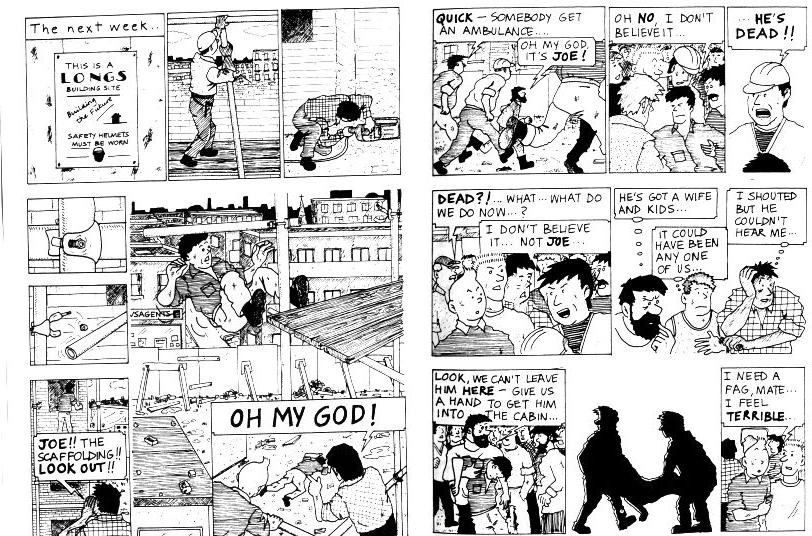
In "Breaking Free" Tintin lives in London with his uncle Captain Haddock, and spends his time either on the dole, or slaving away at menial construction jobs.  In the same environment that gave birth to the nihilist punk movement and the Sex Pistols singing about "no future," Tintin and his mates drink at the pub, go to football games, and generally complain about their economic plight.  Tintin's sort of a lout, but maybe that's understandable given the environment. The rambling plot has time to touch on the rise of Neo-Nazis in England, emerging gay rights issues, and concerns about gentrification before it focuses on how workers can make their grievances heard in the workplace by banding together and striking.
From there, the summary of the plot as Wikipedia puts it:


The workers become increasingly militant, turning to violent tactics and eventually firebombing the original building site. The strike begins to spread to other areas of the country without any official union involvement. Panicked, the UK government deals with strikers with increasing violence and repression, demonstrations turn into riots, and the Captain is arrested on false charges of conspiracy. As the story closes, there is a demonstration of half a million people in the town in which the events of the book unfold, several people have brought rifles and references are made to "strike committees" taking power in other areas of the country, the army being sent into Liverpool to "restore order," and similar unrest taking place around the world. The last page features the Captain, Tintin and the Captain's Wife Mary in silhouette. Tintin holds an assault rifle above his head, while the others raise their fists. Below is written: "This Is Not The End / Only the beginning…"
Obviously, this isn't the sort of story Hergé would have written, let alone agreed to associate with Tintin.  Much of the art looks like it's made by tracing actual Tintin characters into the story.  The first page is pretty shaky, and the drawing doesn't improve over the next 170 pages, but it's a dedicated effort.  In true anarchist/collective mentality no single artist gets credit for the work, mentioning only that the book is done by "Attack! International."  Contrasting this book with the Hergé Tintin stories where one or two characters save the day, the point of this story is that only through the solidarity of the workers can change be effected.


When I first found this comic in 1989 or 1990 I read it in one standing in the aisle at Powell's bookstore. Although it reads quickly, at 170 pages I must have stood there for about an hour.  I'm always interested to see comic icons re-purposed and reinvented, and this was only a couple years after Frank Miller had invigorated Batman with his miniseries "The Dark Knight Returns", so the idea of putting existing characters into new and unusual situations was very novel to me.  Using the Tintin cast in this political tract allows readers to identify with known characters, and brings them into the story very quickly, even if it's a different environment. This would be especially true for Europeans who had grown up with Tintin comics.  But it also sheds a pale light of reality, making the normally optimistic and industrious boy reporter into an everyday sullen teen, who doesn't want to work, but that's the only way to make money.

The copy I have is from 1989 and cost 2 UK pounds.  Since then it seems that there's been a reissue with a new cover.  You can also read the entire book (minus the cover) online.  One thing's for sure, Spielberg isn't going to turn this Tintin story into a movie.

Enhanced by Zemanta

1/1/11

Some 2010 Comic Event Highlights

Happy New Year. Here are some photos and notes from some of the comic-book events I attended in 2010.

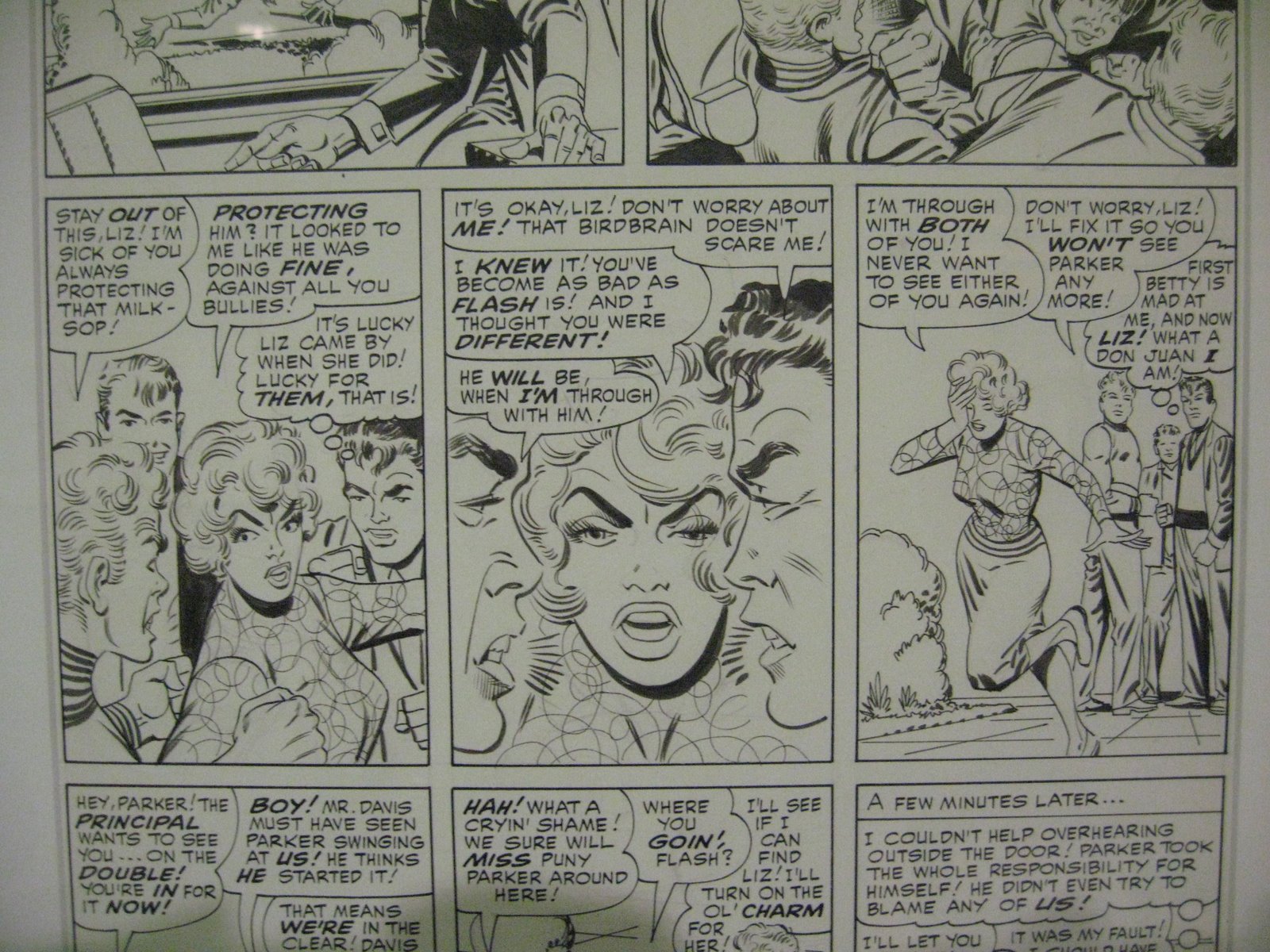
In January  I managed to catch the last day of the show "Faster Than a Speeding Bullet: The Art of the Superhero" at the Jordan Schnitzer Museum in Eugene.  This amazing show featured original comic artwork from the 40's to the present day.   Seeing original art gives you the chance to appreciate how comics are put together and revised during the creation process, as well as an opportunity to admire the artistry of the creators in a context-free setting. Also, I especially liked being able to read an entire issue of Spider-Man as rendered by Steve Ditko.


In March I geeked out at the Emerald City Comic Con. Caught talks by legends such as Leonard Nimoy and Stan Lee, and chatted with Brian Michael Bendis and Aaron Douglas.  Meeting Hal Sutherland, who helped start Filmation and create Star Trek: The Animated Series was especially meaningful to me, since I'd watched the show as a kid.


April brought rain, and also the Stumptown Comics Fest, where I got to see Mr. Bendis again on a panel about teaching comics. I also listened enthralled to Paul Pope on his treatise on re-branding Batman, heard from Craig Thompson about his work in progress "Habibi," and browsed the lush ecosystem of independent comics.


In May the Pearl Room was packed at Powell's as Daniel Clowes introduced his new book "Wilson" to the Portland audience. "Wilson" is a darkly humorous graphic novel told in seventy five six-panel strips.  Clowes was generous enough to talk with each person who stood in line, and also hailed his favorite book of the year "Wally Gropius" by Tim Hensley.


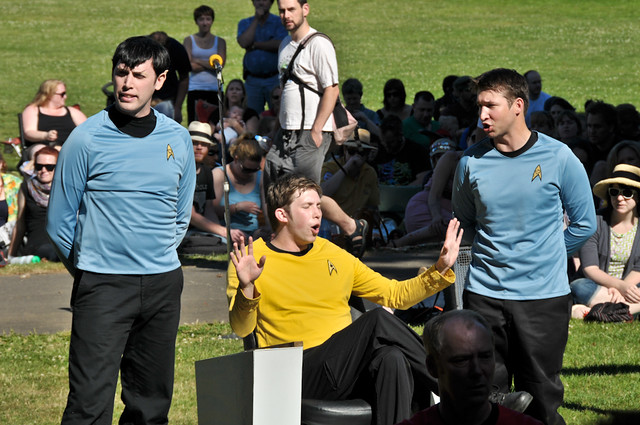
You had to get there early in July when Atomic Arts present "The Space Seed" episode of their series Trek in the Park.  It's not every day you get to sweat through a live fight sequence of Captain Kirk in hand-to-hand combat with the superman Khan.  Next summer they plan to stage "Mirror, Mirror."


True to form, I waited until September and the the last day of R. Crumb's Genesis show at the Portland Art Museum to see it. Although I've seen the book and read excerpts, it was stunning to see the original work laid end-to-end through the halls of the museum.  It gives a new meaning to a work of biblical proportion.


Speaking of inspiring works, in October I was fortunate enough to hear Lynda Barry on her tour promoting her book "Picture This: The Nearsighted Monkey Book."  During her talk she not only gave a spiel that encompassed her philosophy of "image" and how drawing or expressing your image is a therapeutic biological change that occurs in your body and makes you say "ah!", but she also started the evening by singing a song, and finished with a dirty joke she heard from her 70-year-old neighbor.  In the course of the talk she admitted her admiration for Bil Keane (she broke out weeping when meeting him in person for the first time), and during the signing generously made enough time to talk with each and every person who attended the talk.

Enhanced by Zemanta

Influence of Harold Gray on Chester Brown's "Louis Riel"

I recently read Chester Brown's amazing graphic novel "Louis Riel," about the man who fought for the rights of the Metis people during the Western expansion of Canada in the nineteenth century. The story is epic, and the clean artwork gives you a feeling of watching a historical movie.

In the foreward Brown mentions
"several people have asked me if Hergé influenced the artwork in Louis Riel. I love Hergé -- his Tintin books have probably affected my drawing-style to some degree -- but my main visual inspiration here was Harold Gray's work on Little Orphan Annie. I hesitate to acknowledge this because I'm well aware that my scratchings fall far short of the beauty of Gray's imagery."

I have to say that while I was reading the book I found many visual echoes of Gray's style, but rather than being distracting it enhanced the work. Like "Louis Riel", the Annie story lines focus on personal responsibility, pitching in with help when it's needed, and fighting for the underdog. The Tintin stories have some of these aspects, but he isn't usually the underdog in a fight.

Curiously, my son thought Louis Riel looked a lot like the Tintin artwork. I figured this was because he hadn't read "Little Orphan Annie," especially the earlier stories. So, here's a comparison of some panels from Chester Brown's work "Louis Riel," and some 1941 Sunday panels from Harold Gray's "Little Orphan Annie." (One more unintended similarity: their names are both colors.)

Both Gray and Brown use a lot of Chiaroscuro and cross-hatching to emphasize the characters. In the Sunday comics "Annie" was in color, while it ran in black and white in the dailies. Nevertheless, in the panel below you can see in this excerpt that the color is almost monotone with an emphasis on dark and light. Also, compare the way both artists use the dark and light. In Brown's case Riel is literally in the dark, wondering whether the Canadian government will provide amnesty for the Metis freedom fighters, while the priest is enlightened. In Annie's case, she stays in the dark as an observer while the war profiteer gets a poke in the nose from a father whose one son was killed at Pearl Harbor, and the other is fighting with the Rangers. Gray shines the light on justice served -- the war shouldn't be about making money. Contrast this with Tintin, which rarely uses crosshatching.


In a number of places Brown uses a solid black background both to imply space, but also to give a feeling of solitude or isolation. Riel's trial, for example, takes up most of the fourth act of the book and is entirely set in a solid black background. Brown mentions this in his notes: "The black backgrounds that I've used here might give the impression of a spacious room. The court-room was actually very tiny and very crowded." But, the way it's framed gives a feeling of Riel standing alone against the law process of the Canadian government.


Gray uses the black background in a similar way. The doctor has done all he can for Annie and even his medicine is no longer working for her. He's cut off from helping her through her pneumonia, and it's up to Annie now to survive on her own.

Hergé, by contrast, only occasionally uses a black background, and that is usually in the context of a night sky, or if the lights are out.

All three artists have a similar style in drawing their characters. Gray's empty eyeballs are slightly larger than those of Brown or Hergé. I'd have to say Brown's noses are drawn more like the characters in "Little Orphan Annie" than Tintin. Hergé usually keeps his people anatomically proportional, barely stretching the natural shapes of the human body. Both Gray and Brown, however, distort their characters, giving them massive girths, stretched faces, and imposing hands.


And finally, the most compelling comparison between the two artists is their consistent use of two-point perspective. The camera angle, raised to a slightly aerial position and to the left, not only gives a documentary feel to the art, but also seems to suggest a higher moral view. Hergé often used the two-point perspective, but his camera is usually level with the characters, bringing the reader into the story as if it were a newsreel. When Brown raises the camera to this aerial view it somehow manages to be both omniscient, and to say to the reader: "look, this is what's happening. Can you believe it?" It's as if he's removing us from the action to give us a chance to judge the characters.


Enhanced by Zemanta

12/26/10

Ziggy Loses It for Christmas

Both Ziggy and Family Circus have their critics, but yesterday's examples were the epitomes. Family Circus focuses too much cute kids, to the exclusion of being funny. The Christmas edition for 2010 has no punch line, but I suppose it's an acceptable version of the "Merry Christmas" strip.

Ziggy, on the other hand, long-criticized as irrelevant, hammers that point home with an inscrutable Batman / Spongebob movie mashup. Wha?

Is the "joke" that Ziggy is such a loser he's going to see a movie on Christmas? Or, maybe it's that he's going to see a really old movie, since there hasn't been a SpongeBob movie in the theater since 2004. I think the real joke is that my local paper continues to pay to run Ziggy on the comic page while laying off local writers, except I don't see any humor in it.

12/14/10

"3 Story" by Matt Kindt

2,752 people died in the attacks on the World Trade Center.

As of May 28th, 2010, US armed forces have suffered 4,404 deaths and 31,827 soldiers were wounded in action. The Associate Press estimates there have been 110,600 violent Iraqi deaths due to the conflict. All these numbers are staggering, but hard to fathom until you successfully place a story next to any one of the deaths.

A similar sentiment is uttered by one of the characters in "3 Story: The Secret History of the Giant Man." "When they put a number on it...it just made it real. But cold, like a business transaction."

In this case, the speaker is talking about his son, who was evidently killed in an accident involving Craig Pressgang, the Giant Man of the title.  Craig has a brain tumor which stimulates his pituitary gland, causing him to grow unnaturally large.  As a result he's six feet tall by age nine, more than ten feet tall while in college, and continues to grow to more and more mammoth until his death.

The book is told from three viewpoints.  The first story is Craig's mother's point of view. She mourns her husband's death in battle during World War II, and dotes on her son as a replacement for her lost "Butchy."  Craig's sudden growth ends that hope, and she treats his growth problem more as an act of rebellion than a physiological aberration.  When Craig starts having friends and dating girls his mother feels like "the hat-check girl they walk by on the way to the rest of their lives."  When Craig leaves home for college it's difficult to tell if he's leaving her, or she's closing the door on him.

The second story is told by Jo, Craig's girlfriend/wife. She meets "3 Story" at a protest rally, and there's a cute story detailing how they start dating.  She's an artist who sees Craig both as an architectural marvel and a human being.  The fall in love and decide to get married. Meanwhile, he's contacted by the CIA and given a secret job as a courier.  During their honeymoon Jo becomes pregnant, and Craig continues to grow.

The larger he grows the longer the nerve impulses take to reach his extremities, which is both a metaphor and a reality for someone who is soon approaching 20 feet tall. As a celebrity, Craig participates in the New York Thanksgiving Parade, walking between Snoopy and Underdog.  When he suffers a fit and topples into a building the image evokes the attacks of September 11th, 2001.  Kindt uses a full page to render the image of the Giant Man toppled into a skyscraper under the headline of "Disaster!"

Mirroring the first story, as Craig grows upward his wife becomes more distant, and she literally blocks him out of her life, building a smaller house inside their large house.  Eventually they can't even talk with each other, his voice is too booming loud, while hers is but a whisper in her ears. They communicate via rough messages on a chalkboard.  Since he's been let go by the CIA, and fearing he'll harm his wife or their young daughter, Craig leaves to wander the world in a massive walkabout.

The third and final story comes from the Craig's daughter as she searches for the ultimate resting place of her father.  She's received an advance from her publisher, which she's using to literally follow in her father's footsteps.  She learns the secrets of how the CIA manipulated Craig Pressgang, but she also has new questions as she follows the map.

The way Kindt relates the book of "3 Story" is interesting. Each story is from the first-person point of view, so we never know the internal thoughts of Craig Pressgang.  The only way to know Craig is through the stories told of him by the various characters, or by the images shown on the page. I suggest this is a metaphor for the larger problems in life, like wars, or 9/11, or even economic crises. Problems like these are too large for anyone to fully know unless we can relate to an individual's story.

"Three Story: The Secret History of the Giant Man" is drawn in a thoughtful way. The art has a sketchy, functional look about it, reminiscent of courtroom watercolors, which works well for the documentary aspect of the story. The story can be read in many ways. For example, Craig's abnormal growth could represent the expansion of the US economy and military after WWII.  Or, Craig's distance from his mother could be a metaphor for the growth of the teenager in the 50's.  The wonder of Kindt's work is that it suggests these thoughts without explicitly talking about them.

This book, however, isn't a feel-good, good overcomes evil sort of story.  Craig dies in the end, as do we all.  Yet, Kindt leaves us with a feeling of hope that some of our actions will be understood by allowing Craig to find a resting place near his loved ones. It's as if he's trying to find meaning to all the deaths in wars and tragedies through history.  Additionally, one of Craig Pressgang's most important actions is staring us right in the face. "The closer I looked at everything, the less I seemed to under stand," she says. "I guess ultimately the only clue to his identity was what he left behind."

Here's a link to Kindt's website, and  here's an 8-page new story about the Giant Man.
Enhanced by Zemanta

12/7/10

Christmas 1969

Sometimes all you want for Christmas is to be 6 again.
Here's a bit of Major Matt Mason nostaglia from the Sears Christmas Book 1969 catalog.


11/24/10

The Science of... Flash #121

In 1961 the world was bubbling with technological advancements.

The spring of that year President John F. Kennedy gave the country the goal of sending an American to the Moon before the end of the decade. Project Mercury was already underway, halfway to its mission of putting a human in orbit around the Earth by February, 1962. Only a few years earlier the Laser had been invented, and by the end of 1962 light emitting diodes would be developed at GE. In addition to the new frontier of space, visionaries such as Jacques Cousteau were working on permanent undersea living facilities. Science and technology were omnipresent and unavoidable.

Evidently DC editor Julius Schwartz and Flash writer John Broome figured that science also sold comics, shown by the "Flash Facts" pages, and the integration of basic scientific facts throughout the stories of the early 60's. A couple years later I'd pore over that information as if it contained the secret footnotes to Einstein's theory of relativity. Re-reading them as an adult, however, some of those facts break down, but they're still interesting.

The first half of Flash #121 is the story "The Trickster Strikes Back!"
 

Centrifugal Force - On one page The Flash performs several acts of super-speed. In the first frame the editor's note says "Flash's astounding speed enables him at times to defy gravity itself!"

Ok, so the Flash can run up walls? I've seen Jackie Chan run up a wall in movies, and I've also seen pretty cool parkour stunts, but how would it be possible for the Flash to run up the side of a skyscraper? Whenever Jackie does it he's using his forward momentum to hold him to the wall long enough to push off with his feet. Unless he's bouncing between two wall, the forward momentum can only last a fraction of a second.

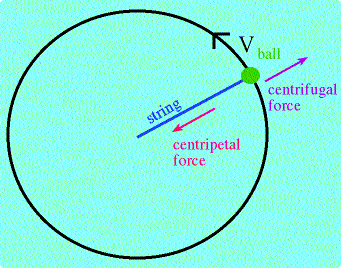
My first thought was "centrifugal force," which would have been wrong. Wikipedia tells me centrifugal force is a fictitious force, created by a centripetal force combined with Newton's First Law: a body in motion tends to stay in motion. When the two forces act on the body it causes it to move in a curve, such as a ball on the end of string going in a circle. When the centripetal force is removed by releasing the string, the ball travels in a straight line.

So, for the Flash to move up a skyscraper he would have to either have had a massive centripetal force applied to him at the base of the skyscraper, or he would have a continuous centripetal force applied to him perpendicular to the building. For the sake of the story I'm imagining he grabbed a horizontal bar at the bottom of the building and swung around that. His speed was great enough to provide the force to fling the scarlet speedster along the path of the building in such a way that he appeared to run up the side.

Gyroscopic Forces & Electrical Circuits - In the third panel of the same page Flash performs a literal high-wire act. "By moving fast I can keep my balance! And the voltage in these power lines won't affect me as long as no part of my body is in contact with the ground."

The second half of the statement is easier to corroborate. In an electrical circuit a ground is used for a return path for the electric current. Since the wires may not be insulated, and also since electricity follows the path of least resistance, if Barry Allen touched both the electrical wires and the ground he would become a literal flash.

It's the first portion about "moving fast" to keep his balance that I question. No matter how quickly the Flash is moving, his inertia (see Newton's First Law above) will make him tend to move in the same direction. If he stumbles he'll stumble quickly and lose his balance. The Flash might want to take a page from the tech of one of the Rogues, the Top. If the Flash was spinning he could use gyroscopic force to maintain his balance.

Aerodynamics - In the final panel the Flash avoids ending up as a street pancake with one of his favorite tricks: "By thrashing my legs at super-speed...I build up enough air pressure under me to ease my descent...and hit the ground slow enough to avoid these wires."

Potentially this could work, like a bumblebee in flight, as long as the Flash had airfoils on his feet. If he had some curved surface or articulated plane that could catch the air and produce an aerodynamic force then it just might work. Unfortunately, despite the little wings on his boots, I have never seen anyone mention that the scarlet speedster's costume is aerodynamic. It's more likely he'd beat the air and suffer some shattered tibia before the stunt was over.
http://en.wikipedia.org/wiki/Bumblebee#Flight


In Flash #109 the writer explains how the Flash can penetrate walls "just as a tornado-driven straw can penetrate several feet of solid oak." Evidently that was regretted because they have a new surprise for us: The Flash evades an explosion by vibrating through a wall, perhaps the first time he uses this soon-to-be-common technique. "By vibrating his body at hyper-speed the amazing Flash can penetrate a solid wall because the molecules of his body in super-vibration slide past the molecules of the wall!"

Ok, believe it or not, we already have an example of molecules moving through walls: it's called osmosis. In osmosis water and other liquids move through a semipermeable cell wall without disrupting the membrane. Since humans are mostly water, it's just a short logical step from osmosis to the Flash vibrating through a wall, right?

Luckily, the Flash is able to overcome all these scientific hardships and put the Trickster behind bars once again.

In the second story, "Secret of the Stolen Blueprint!" Barry Allen attends his 10-year college reunion and meets up with a classmate who's working on a new hydrogen power generator. Spies steal the device and the classmate, who knows Barry's a friend of the Flash, asks for the superhero's help.

Persistence of Vision - In order to make it appear that Barry Allen and the Flash are two separate people, the Flash performs a stunt moving at great speed so it seems that both Barry and the Flash are in the room together. As the editor notes, "scientifically this effect is the same as that seen on a motion picture screen where the frames succeed each other so swiftly that they give the appearance of continuous action! By super-speed, Flash is enabled to appear in place as Barry or himself a sufficient number of times per second to fool the eye into thinking he is there all the time!!"

What the writer fails to mention is that in a motion picture camera there is a shutter that interrupts the image between frames, causing us to see a series of individual frames rather than a blur. Using persistence of vision, our brains merge the stream of individual frames into moving images. If it weren't for the shutter movies would be a muddled affair.


In the Flash's case, he would have to have some way of darkening the entire room in the transition times between Barry Allen and the Flash. Otherwise, his college chum will see a red blur passing between the images of the two men.

Turbulence - The Flash tracks the hydrogen power plant thieves to a submarine, and dives into the ocean. The editor makes two comments on this page. "At super-speed, the World's Fastest Human can swim for miles under the surface without rising at all!" and "Just as a powerful ship in passing can pull unwary swimmers into its propeller wake, so Flash can create the same effect!"

 
Assuming the Flash does not have hydrofoils on his feet, yes, it's likely that kicking at super-speed can create a turbulence that will pull in the spies. Wikipedia defines turbulences as "fluid regime characterized by chaotic, stochastic property changes. This includes low momentum diffusion, high momentum convection, and rapid variation of pressure and velocity in space and time." Exactly what the Flash is doing with his feet at super-speed.

As far as being able to swim for miles... the average person can hold his breath about two minutes. In various issues of the comic the Flash has run around the world in less than a few seconds. We know from the Flash #108 he can surpass the speed of light. In that case it should be easy to swim for miles in less than two minutes, but the big question is how the Flash can expend so much energy using only the Oxygen available to his limited capacity lungs?

Thanks to the DC Comics Database for a memory refresher on the plots of Flash #121.
Enhanced by Zemanta